
The shooting
On the night of 28 February 1986, Olof Palme and his wife Lisbeth walked home from a cinema in central Stockholm. He was the prime minister of Sweden and he had no bodyguards with him, which was not unusual for him and not then thought remarkable in Sweden.
At 23:21, on Sveavägen, a man shot him once. He died. Lisbeth Palme was wounded. The gunman walked away up a flight of steps and was gone.
Forty years later nobody has been convicted of it, and the Swedish state's position on who did it has been issued, retracted, and left withdrawn.
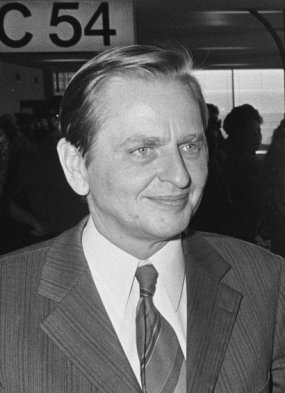
Wikimedia Commons — Bert Verhoeff for Anefo, CC BY-SA 3.0 nl
.jpg)
What was never recovered
The physical case has always been thin in a way that is worth stating plainly, because it determines everything that follows.
The murder weapon has never been definitively identified. Police test-fired something in the order of five hundred Magnum revolvers looking for a match. A revolver stolen in 1977 — the “Sucksdorff revolver” — attracted long attention and was never located. Another, the “Mockfjärd gun”, was pulled out of a lake in 2006 and was too corroded for conclusive forensic analysis. A further revolver turned up in a Stockholm river in 2021.
With no weapon, the case rested on witnesses, and more than twenty-five of them came forward with accounts that did not reconcile.
The conviction that did not hold
In December 1988, nearly three years after the murder, police arrested Christer Pettersson, a man with a criminal record and problems with alcohol. Lisbeth Palme identified him at a line-up and he was convicted.
The Svea Court of Appeal overturned it. The reasons given are the reasons this case has never recovered: there was no murder weapon, there was no clear motive, and the identification could not be relied on. The line-up had been conducted badly enough for the appeal court to use strong language about it — Lisbeth Palme had been told beforehand that the suspect was an alcoholic, which in a line-up where one man visibly fitted that description is not a neutral piece of information.
Pettersson died in 2004, legally innocent of the assassination.
There is a point of confusion here that trips up a great deal of writing on this case, and it is worth flagging because the two names are nearly identical. Christer Pettersson was the suspect convicted and acquitted in the 1980s. Krister Petersson was the chief prosecutor, three decades later, who closed the investigation. They are different men and the resemblance is a coincidence.
The 2020 announcement
On 10 June 2020, Krister Petersson held a press conference and named Stig Engström as the most likely perpetrator.
Engström was a graphic designer who had been working late at the Skandia insurance offices nearby, and who had given statements as a witness — which is how he acquired the nickname the Skandia Man. He had died in 2000, which meant no charge could be brought and no court would examine the case against him. The investigation was closed on the strength of it.
The evidence described was circumstantial throughout. The prosecutor pointed to Engström's familiarity with firearms, his associations in circles hostile to Palme, and clothing resembling what some witnesses had described. No direct evidence was produced. Other witnesses had said he was not at the scene at all.
The reaction in Sweden was not acceptance. Lawyers, serving and former police officers and journalists criticised the conclusion as resting on nothing a court would have accepted, and the obvious objection was pressed hard: the one man named was the one man who could not answer.
The 2025 retraction
In December 2025 the Swedish prosecution service withdrew it.
Director of Prosecution Lennart Gune stated that Engström was no longer considered a suspect, and went further — that he should never have been identified as one, the evidence being insufficient to support naming him as the perpetrator.
The investigation was not reopened.
That combination is the thing to sit with. A state named a private citizen, five years dead, as the murderer of its prime minister; closed the case on that basis; and five years later said the naming had been wrong all along, without resuming the search. The reputational consequence fell entirely on a man and a family with no mechanism for contesting it, and the case is now formally closed around a hole.
What this entry is actually about
Palme's death has attracted an enormous volume of theory — South African involvement, Kurdish separatists, the arms trade, intelligence services, the Swedish police themselves. Some of those lines were investigated and some were not pursued to any conclusion. This archive is not in a position to adjudicate between them and neither, after forty years, is anyone else.
What the record supports is narrower and more instructive. The physical evidence was lost or never found. One identification was obtained through a procedure the appeal court would not stand behind, and it destroyed a man's life before it collapsed. A second identification was announced thirty-two years later against someone who could not reply, and was abandoned five years after that.
The simplest explanation of why this case is unsolved does not require anyone to have covered it up. It requires only an investigation that mishandled its evidence early, and then kept producing answers under the pressure of a public that needed one. The conspiracy theories grew in the space that left, and the space is real.