
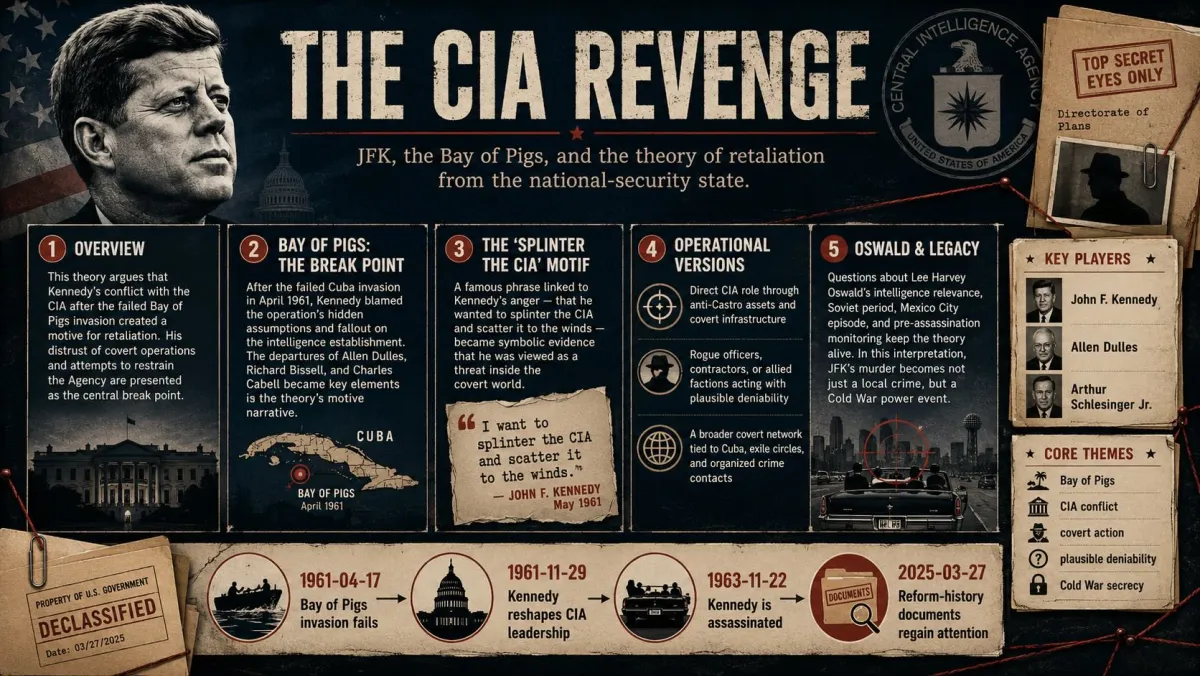
Overview
The CIA Revenge theory places the assassination of John F. Kennedy within the conflict between the president and the national-security state after the failed Bay of Pigs invasion. According to this theory, Kennedy’s distrust of covert operations, his removal of key CIA leaders, and his desire to restrain or restructure the Agency created a motive for retaliation.
Bay of Pigs as the Break Point
The failed invasion of Cuba in April 1961 is treated as the decisive rupture. Kennedy believed he had been maneuvered into supporting an operation whose assumptions were flawed and whose escalation pressures were hidden from him. The aftermath led to deep anger, high-level blame, and the departure of CIA Director Allen Dulles, Richard Bissell, and Charles Cabell. In the theory, this was not a normal policy dispute but a humiliation the covert bureaucracy did not forgive.
“Splinter the CIA” Motif
The most famous phrase in the theory is Kennedy’s reported desire to splinter the CIA and scatter it to the winds. Whether treated as literal policy or as private rage, the statement became symbolic evidence that Kennedy had crossed from president to threat in the eyes of a covert establishment. Later document releases and scholarship about Arthur Schlesinger Jr. and internal intelligence reform discussions gave this element lasting force.
Operational Versions
In some versions, the CIA directly ran the assassination through anti-Castro assets, deniable cutouts, and a prebuilt covert infrastructure already active around Cuba, exile networks, and organized crime contacts. In others, the Agency did not plan the killing institutionally but certain officers, contractors, or allied factions did so under the cover of plausible deniability. This distinction allows the theory to vary without abandoning its core claim.
Oswald and Intelligence Suspicion
The theory is strengthened in the public imagination by long-running questions about Oswald’s intelligence relevance, his time in the Soviet Union, his Mexico City episode, and the CIA’s pre-assassination knowledge of his movements. These questions do not provide a single documented chain of command, but they keep the theory anchored in the file record rather than in rumor alone.
Legacy
The CIA Revenge theory remains central because it joins motive, infrastructure, secrecy, and later document releases into one coherent frame. It transforms the assassination from a local crime into a Cold War regime event: the removal of a president by the very covert machinery he had tried to discipline.