
The claim
The ordinary question about Sarajevo is who killed Franz Ferdinand. This theory asks a different one: whether he arranged it himself.
In its strongest form it holds that the archduke either wanted a war badly enough to court his own death, or accepted assassination as a useful trigger — believing Austria-Hungary would come out of a short victorious conflict stronger than it went in. He becomes not the victim of the July Crisis but its author.
No document supports this. No letter, diary, order or testimony has been produced in which Franz Ferdinand contemplates his own killing as policy, and the theory has no archival foundation at all. What it has instead is a morning that went wrong in ways that are genuinely difficult to believe.
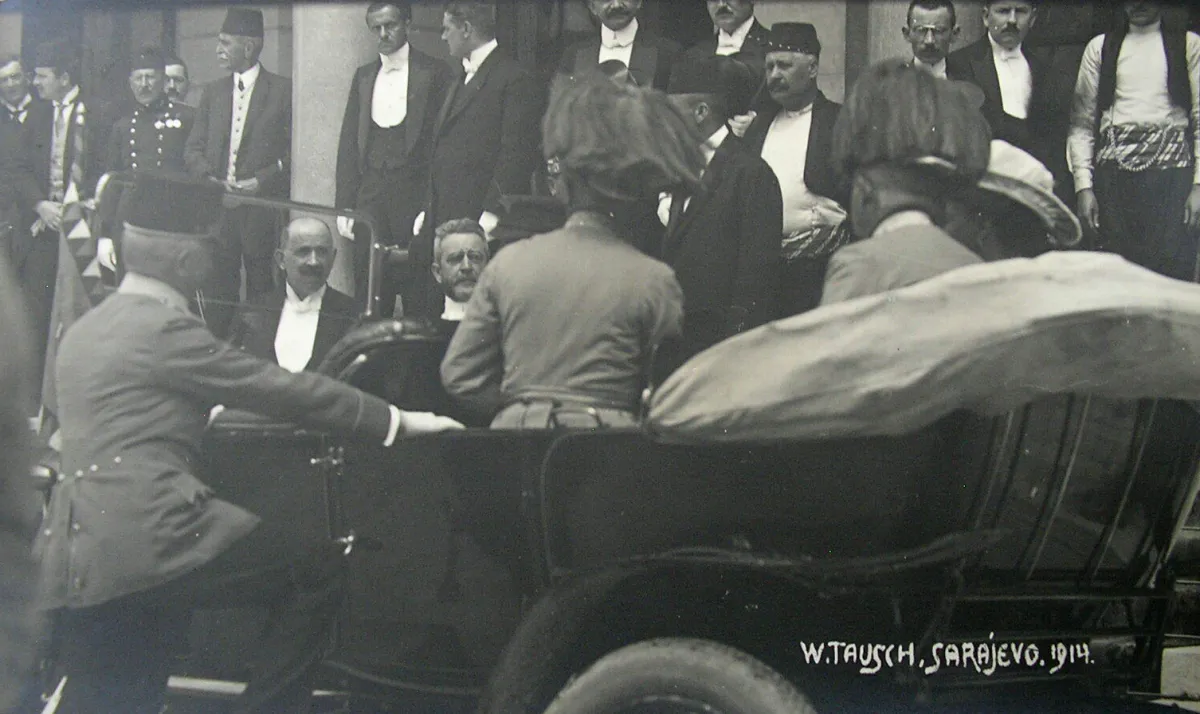
The archduke’s car at the city hall, between the bomb and the shooting. The photograph is marked W. Tausch, Sarajevo, 1914. Wikimedia Commons — Walter Tausch (1914), Public domain

What actually happened, in order
The detail matters here more than usual, because the theory lives entirely in the gaps.
On the morning of 28 June 1914 the archduke and his wife Sophie rode through Sarajevo in an open-topped car. The route ran along the Appel Quay, the wide avenue following the north bank of the Miljacka, and it had been published in advance. Six members of Young Bosnia were positioned along it.
At about a quarter past ten Nedeljko Čabrinović threw a bomb at the car. It bounced away and detonated under the vehicle behind, wounding several people including Potiorek's adjutant. The archduke was unhurt. The motorcade drove on to the City Hall, where he sat through a reception speech having just been bombed in the street.
Afterwards he asked to visit the wounded in hospital. A member of his staff suggested this was dangerous. Oskar Potiorek, the governor of Bosnia, answered: do you think Sarajevo is full of assassins? — and said he would take responsibility.
Potiorek did change the route. He decided the car should avoid the city centre and go along the Quay. He did not tell the driver.
The turn
This is the part the theory is built on, and it is also the part with the most ordinary explanation.
The officials in the car discussed the change in German. The drivers were Czech and did not speak it. Leopold Lojka, at the wheel of the archduke's car, followed the car ahead and turned right into Franz Joseph Street — the original route, the one that had been published, the one everybody had agreed to abandon.
Potiorek shouted that it was the wrong way and told him to stop and reverse. Lojka put the car into reverse. It stalled, and stood still.
It had stopped directly in front of Moritz Schiller's delicatessen, where Gavrilo Princip was standing. He fired twice at close range. Both the archduke and Sophie were dead within the hour.
Why anyone reaches for design
Set out like that, the sequence is almost intolerable. A published route. An open car. A bomb at ten fifteen that changes nothing about the day's plans. A governor who says Sarajevo is not full of assassins, hours after one has thrown a bomb at his guest. A route change nobody tells the driver. A wrong turn into the one street that still had an armed conspirator in it. A stall.
Any one of those is bad luck. Together they look like arrangement, and that is the entire engine of the theory. It is not built on evidence about Franz Ferdinand; it is built on the feeling that this much failure cannot be accidental.
But the chain has a documented mechanism at its weakest link, and the mechanism is banal. The route change was spoken in a language the driver did not have. An empire that ran on German gave an instruction to a Czech driver and did not translate it. That is not a conspiracy; it is the Habsburg nationality problem operating on the smallest possible scale, on the day it killed the heir.
What the theory has to assume
Two things, and neither survives contact with what Franz Ferdinand is known to have wanted.
First, that he could predict the political consequences of his own death with enough confidence to spend his life on it. In the summer of 1914 nobody predicted those consequences. The expectation on all sides was a short local war.
Second, that he wanted that war. The documentary record runs hard the other way. Franz Ferdinand was among the most consistent voices in Vienna against attacking Serbia, and he said why: harsh treatment of Serbia, he warned, would bring Austria-Hungary into open conflict with Russia, to the ruin of both empires. He argued the point repeatedly against Conrad von Hötzendorf, the chief of staff and the loudest advocate of a preventive war, and in a letter to Foreign Minister Berchtold in February 1913 he put the alternative plainly — that irredentism would cease if the empire's Slavs were given a comfortable, fair and good life.
The theory therefore requires the most prominent brake on the war party to have killed himself in order to start the war, having first predicted the Russian intervention that would make it catastrophic.
It also requires him to have brought Sophie. Their marriage was morganatic: she did not share his rank, title or precedence, and she was not normally permitted to appear in public beside him, ride in the royal carriage, or sit in the royal box. At court she stood far down the line. A provincial tour was one of the few settings where she could ride at his side, which is why she was in the car. She was shot in it.
A smaller false detail, worth noting
One of the most repeated facts about this assassination is that Princip had just bought a sandwich at Schiller's, stepped outside, and found the archduke's car in front of him.
It is not true. There is no contemporaneous source for the sandwich, and it appears to have entered circulation through much later retellings. Princip was outside Schiller's because the first attempt had failed and the conspirators had scattered along the route.
It is worth flagging in an article about this theory because the two things are the same mechanism at different scales. The sandwich makes the morning feel even more absurdly accidental; the suicide plot makes it feel designed. Both are additions to a record that is strange enough without them, and both travel because the documented version is harder to hold in the head than either.
Where it stands
The historiography of Sarajevo is genuinely unsettled, and this entry should not be read as saying otherwise. How much the Serbian government knew, what Apis and the Black Hand actually directed, and where responsibility sits between Belgrade, the conspirators and Vienna's response are all still argued in the scholarly literature.
None of those arguments concerns the victim's intentions. The open question at Sarajevo is who stood behind the men who fired. No evidence has been produced that one of them was the man they shot.