
Overview
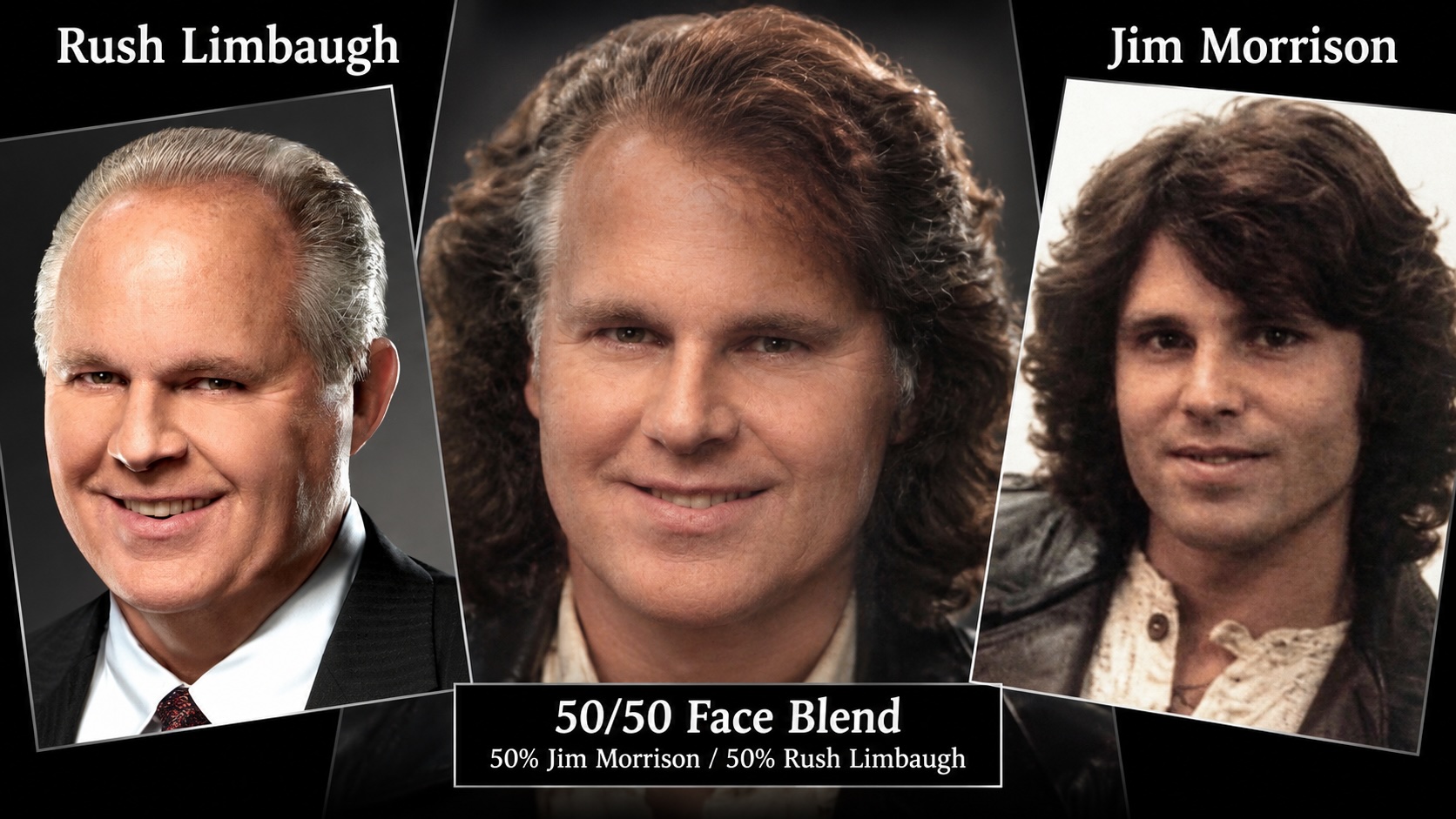
"Rush Limbaugh is Jim Morrison" is one of the strangest modern celebrity-identity conspiracy theories to emerge from internet culture. The theory claims that Jim Morrison, lead singer of The Doors and one of the most mythologized figures in rock history, did not actually die in Paris in 1971. Instead, believers say he faked his death, disappeared from public view, reinvented himself physically and ideologically, and later emerged as conservative talk-radio giant Rush Limbaugh.
At first glance, the theory appears absurd even by conspiracy standards. Morrison was a countercultural icon associated with psychedelia, rebellion, sensuality, poetry, and self-destruction. Limbaugh became one of the best-known voices of mainstream American conservatism, associated with political commentary, radio dominance, and culture-war messaging. Yet to believers, that very contradiction is what makes the theory so compelling. The story is framed not as a simple case of a celebrity surviving in secret, but as a symbolic reversal: the Lizard King becoming the voice of the establishment.
Because of that inversion, this theory has persisted as more than a joke. It operates as a strange hybrid of satire, pattern-seeking, celebrity death mythology, and deeper suspicion that public identities are staged performances rather than authentic selves.
Core Claim
The core claim is straightforward:
- Jim Morrison did not die in Paris in 1971.
- His reported death was staged or covered up.
- He adopted a new identity in the years that followed.
- That identity eventually became Rush Limbaugh.
- The dramatic shift in appearance, politics, and public role was intentional camouflage.
Believers sometimes treat this as a literal identity theory, and sometimes as a more symbolic revelation about transformation, media control, or the death of the 1960s counterculture itself.
What the record shows
The theory depends on Morrison's death being vague. It is better documented than that, and the actual gap in it is narrower, and more interesting, than the haze the theory assumes.
Morrison was found dead on 3 July 1971, in the bathtub of the Paris apartment he shared with Pamela Courson. He was twenty-seven. The cause entered on the paperwork was heart failure, and no autopsy was performed: no evidence of foul play was found at the scene, and Courson told French authorities he had not been using drugs. That is the whole of the gap — not a contested finding, but an examination that never took place. Biographers have since argued for an accidental heroin overdose, drawing on Courson's later account that he had in fact been using that night. Either way the absence is real, and it is the space every Morrison survival story is built in.
What this particular theory then has to do is put him inside somebody else's life. That life is documented too, and it begins well before the point the theory needs it to.
Rush Limbaugh was born on 12 January 1951 in Cape Girardeau, Missouri. He was working in radio while Morrison was still alive and recording — a disc jockey on KGMO in Cape Girardeau while he was still in high school, on air under the name Rusty Sharpe.
So the two lives do not run one after the other. They run alongside each other. In 1967 Limbaugh was sixteen and on the air in southeast Missouri; that September Morrison was in a television studio in New York. The Doors played The Ed Sullivan Show on 17 September 1967, performing "People Are Strange" and then "Light My Fire", and were told afterwards they would never be booked again, because Morrison had sung the line he had been asked to change. Two men, publicly active in the same season, in different states, with separate records kept by different institutions.
That overlap is the part the theory has no account of. It asks for a man to have been replaced by someone who already existed, in public, with a job.
Why the Theory Exists
This theory only makes sense within a broader cluster of celebrity-survival and replacement conspiracies. Jim Morrison has long attracted rumors that he faked his death because his passing already contains elements that conspiracy culture finds irresistible:
- He died young.
- He died abroad.
- The circumstances were hazy and have long been debated in popular culture.
- There was no large public funeral spectacle in the United States.
- His image remains frozen in youth and myth.
This creates fertile ground for survival narratives. Once a culture has accepted that Morrison's death contains mystery, it becomes easier for fringe theorists to ask not only whether he survived, but what he became.
Rush Limbaugh enters the picture because conspiracy culture often looks for ironic or poetically extreme transformations. The idea that the libertine rock poet of the 1960s could later become the booming voice of American conservatism is so culturally charged that it becomes memorable even when implausible.
Physical Resemblance Claims
The most common evidence presented by believers is visual comparison. They point to:
- facial structure,
- the shape of the nose,
- eye placement,
- mole patterns,
- expressions,
- and the way an older, heavier face might evolve from a younger one.
In internet versions of the theory, side-by-side image comparisons are treated as the central proof. Believers argue that if one compares later images of Rush Limbaugh with late-period Jim Morrison — especially when Morrison had gained weight and no longer looked like his youthful 1967 image — the resemblance becomes "obvious."
This approach is common in celebrity-identity conspiracies. It relies not on documentation, but on visual intuition, aging speculation, and the seductive force of pattern recognition. Once viewers think they see the resemblance, the rest of the theory becomes emotionally easier to entertain.
Timing and Reinvention
Another part of the theory focuses on chronology. Morrison's official death came in 1971, and Rush Limbaugh's eventual rise to national recognition came later. Believers treat that gap as enough time for:
- withdrawal from public life,
- physical change,
- identity construction,
- voice development,
- and ideological reinvention.
This "hidden transition period" is crucial to the theory because it allows believers to explain why the two public personas seem so different. Morrison did not supposedly become Limbaugh overnight. He disappeared, transformed, and re-entered the world under a totally new script.
In this view, the years between Morrison's death and Limbaugh's major public ascent become a kind of dark cocoon period in which a cultural icon shed one identity and assumed another.
The Ideological Reversal
The most psychologically powerful element of the theory is the ideological reversal. Jim Morrison is remembered as a symbol of:
- youth rebellion,
- anti-establishment energy,
- sexual liberation,
- poetic chaos,
- and the psychedelic edge of the 1960s.
Rush Limbaugh, by contrast, came to represent:
- conservative populism,
- anti-countercultural rhetoric,
- institutional media power,
- and the voice of traditionalist backlash.
For believers, this reversal is interpreted in several different ways.
1. The Ultimate Cover Identity
The total ideological shift would make Morrison harder to detect. No one would suspect that the embodiment of sixties excess had become a conservative media figure. The extremity of the change becomes the disguise.
2. The Death of the Counterculture
Some see the theory as an allegory disguised as conspiracy: the counterculture did not disappear, it sold out, aged, cut its hair, and became the thing it once opposed. In this reading, "Jim Morrison became Rush Limbaugh" functions almost as political myth.
3. Controlled Opposition
A darker version of the theory suggests Morrison may have been an intelligence-linked cultural asset all along, and that the later Limbaugh identity revealed his true operational role as a manipulator of public consciousness.
This third version merges the theory with broader claims that many major cultural and political figures are staged identities serving deeper power structures.
Jim Morrison's Death as the Weak Point
Like many celebrity survival theories, this one depends on uncertainty around the original death — and here there is a real one, set out above: no autopsy was carried out, so the recorded cause rests on what was observed at the scene and on what Courson told the authorities at the time.
Believers treat that absence, along with the conflicting accounts that followed and the lack of a public American funeral, as signs that something was concealed rather than simply unexamined.
In conspiracy logic, ambiguity is rarely neutral. It is often treated as evidence of design. The less clear a death appears in public memory, the more available it becomes for reinterpretation.
Rush Limbaugh as an Adopted Persona
Believers often emphasize not only appearance but performance. They argue that Rush Limbaugh felt like a constructed media entity:
- larger than life,
- highly theatrical,
- voice-driven,
- provocative,
- polarizing,
- and unusually skilled at commanding attention.
From that angle, Limbaugh is interpreted not simply as a broadcaster but as a role. If Morrison had survived, conspiracy believers say, he already possessed many of the necessary tools:
- charisma,
- stage presence,
- vocal command,
- narcissistic force,
- audience manipulation,
- and a taste for persona-making.
This line of argument treats the transition not as impossible, but as oddly fitting. Morrison the frontman becomes Limbaugh the broadcaster; the medium changes, but the performer remains.
Substance Abuse and Self-Destruction Themes
Another recurring theme in the theory is that both Morrison and Limbaugh were associated, in very different ways, with excess and controversy. Believers sometimes read this as continuity rather than coincidence. The argument is not that both men behaved identically, but that each embodied a high-consumption, boundary-pushing public masculinity that could be read as one life in two stages.
This is weak evidence in historical terms, but it matters psychologically within the myth. Conspiracy theories often rely on personality echoes rather than hard proof. They create continuity through vibe, style, contradiction, and symbolic resonance.
Why the Theory Spread Online
The theory spread because it is:
- visually memorable,
- politically absurd in an entertaining way,
- connected to an already mythic dead celebrity,
- flexible enough to be half-joke and half-belief,
- and perfect for image boards, conspiracy forums, podcasts, and short-form internet debate.
Its persistence shows how conspiracy culture often operates. A theory does not need institutional support or credible records if it offers:
- a shocking transformation,
- a recognizable face,
- a hidden identity,
- and an emotionally satisfying twist.
This theory offers all four.
Deeper Interpretations
1. Literal Survival Theory
Jim Morrison faked his death and literally became Rush Limbaugh.
2. Intelligence Identity Theory
Morrison was always a managed cultural asset, and the Limbaugh persona represented a later phase of the same deeper operation.
3. Symbolic America Theory
The theory encodes the broader cultural collapse of the sixties into the conservative media age. Morrison becoming Limbaugh symbolizes rebellion mutating into reaction.
4. Meme-Conspiracy Hybrid
The theory survives because it sits between satire and belief. It is ridiculous enough to spread as a joke, but suggestive enough for some people to half-believe.
This last interpretation may actually explain its longevity best. The theory thrives in ambiguity. It does not need everyone to believe it literally. It only needs people to keep repeating it.
Why It Resonates
The theory resonates because it compresses several American obsessions into one story:
- celebrity death mystery,
- cultural betrayal,
- identity reinvention,
- media manipulation,
- generational collapse,
- and the idea that public life is theater.
Jim Morrison and Rush Limbaugh stand at opposite symbolic poles of modern American culture. Bringing them together in one body creates an almost mythic shock. It feels impossible, which is exactly why it stays memorable.
Skeptical Interpretation
Skeptics treat the theory as internet folklore built from image comparison, celebrity-death mythmaking, and ironic cultural commentary. There is no credible documentary record that Jim Morrison survived his 1971 death, nor any serious evidence that Rush Limbaugh was a fabricated identity for Morrison.
Conspiracy Interpretation
Believers argue that the absence of proof is exactly what one would expect if the reinvention were successful. To them, the visual similarities, the murkiness of Morrison's death, and the bizarre elegance of the transformation are enough to keep the theory alive.
Conclusion
"Rush Limbaugh is Jim Morrison" is one of the most surreal celebrity-identity conspiracies in modern lore because it does more than claim a famous man survived. It claims he crossed the cultural universe and came back as his own opposite.
Whether read as literal hidden identity, symbolic political myth, or meme-born conspiracy folklore, the theory endures because it captures a disturbing possibility at the heart of modern media culture: that the people who shape public consciousness may be roles, masks, and reinventions all the way down.