
What was found
On 23 August 2010, Gareth Williams was found dead in the bath of his flat in Pimlico, central London. He was 31, a junior analyst at GCHQ on secondment to the Secret Intelligence Service.
He was naked, and he was inside a red sports bag. The bag had been zipped shut and secured with a padlock on the outside.
A key to that padlock was inside the bag, underneath his body.
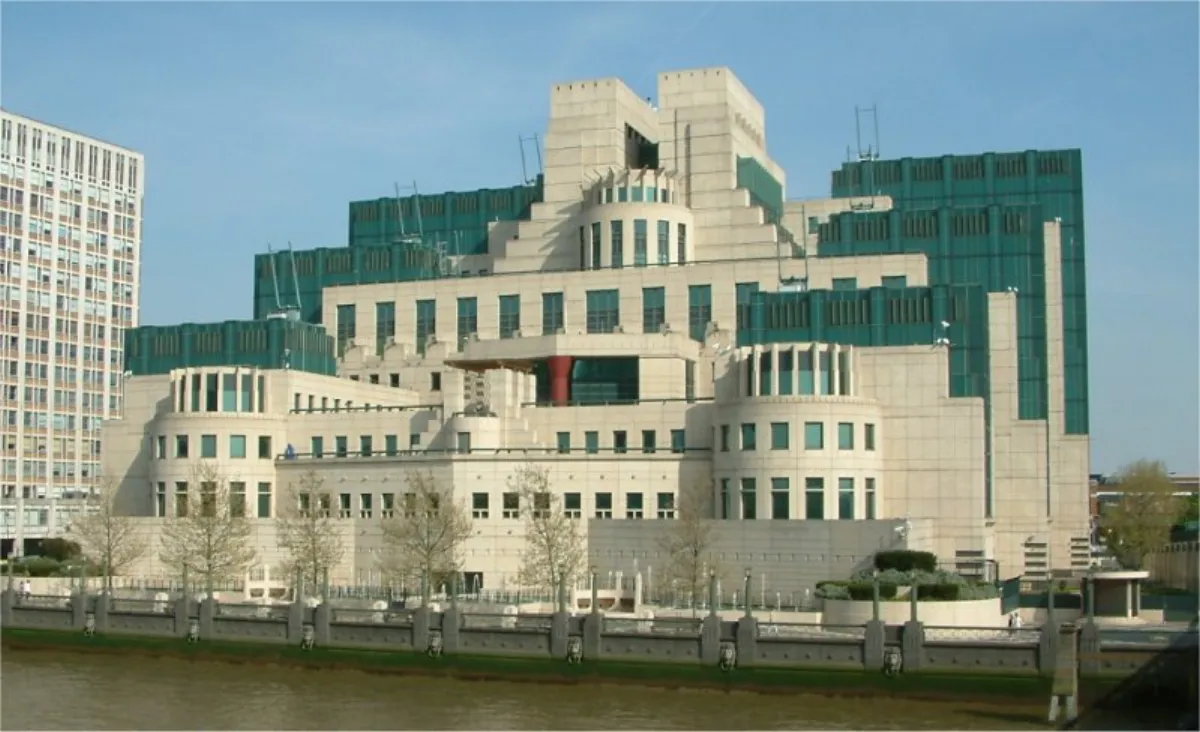
Williams was a GCHQ analyst on secondment to the Secret Intelligence Service, whose headquarters at Vauxhall Cross are shown here. No evidence has been produced connecting his death to his work. Wikimedia Commons — CC BY-SA 3.0

The two findings
This case is unusual in that it does not turn on an absence of official investigation. It turns on two official investigations reaching opposite conclusions, and both remaining on the record.
On 2 May 2012, the coroner Fiona Wilcox returned a narrative verdict. She found the cause of death unnatural and likely to have been criminally mediated, and concluded that on the balance of probabilities Williams had been killed unlawfully. She was satisfied a third party had locked him in the bag, and that he had probably been alive when he was put into it, dying of carbon dioxide poisoning or a short-acting poison that would not have shown up by the time of examination.
On 13 November 2013, eighteen months later, the Metropolitan Police announced the result of a re-investigation. Deputy Assistant Commissioner Martin Hewitt said the most probable scenario was that Williams had died alone in his flat, having accidentally locked himself inside the bag.
Neither finding was withdrawn. The coroner's verdict stands as the verdict of the inquest; the police position stands as the conclusion of the force that investigated. A reader looking for the official answer in this country finds two, and they contradict each other.
The reconstruction problem
The strongest evidence against the accident explanation is not a theory. It is an experiment the police themselves commissioned.
Two experts attempted to lock themselves into a comparable bag, in comparable conditions, to establish whether it could be done. Across roughly four hundred attempts, neither succeeded. One of them allowed that there remained a small chance Williams had managed it.
Four hundred failures is not proof of impossibility, and the expert who conceded the small chance was being properly cautious. But it is a demanding fact for the accident conclusion to carry, and it is the reason that conclusion met the reception it did.
The forensic absence, which cuts both ways
The physical evidence is remarkable mainly for what is not there, and this is the part most accounts handle badly in one direction or the other.
There were no fingerprints on the padlock. None on the bag. None on the rim of the bath. No gloves were found inside the bag.
Read one way, that is evidence of a third party: someone who handled the padlock wearing gloves and took them away, which is also consistent with the flat having been cleaned.
Read the other way, it is a problem for the accident explanation too, and a serious one. If Williams locked the padlock himself, his own fingerprints should be on it. They are not. An accident requires him to have handled the lock; the absence of any prints at all is as awkward for that account as for the other.
What the forensic record actually establishes is that someone — whoever closed that bag — left no trace on the objects they must have touched. That is the finding. It does not point to a perpetrator and it does not clear one.
What this archive can say
Williams worked for GCHQ and was seconded to MI6, and that fact has generated a very large volume of theory: that he was killed by a foreign service, by his own, over work he had done or material he held.
None of that is established, and this entry does not advance it. No evidence has been produced connecting his death to his work, and the inquest, which had access to evidence heard in closed session, did not produce such a connection either. The coroner found an unlawful killing without identifying a killer or a motive.
What can be said is narrower and sufficient to explain why the case has never settled. A man was found dead inside a bag locked from the outside, with the key beneath him. Experts could not reproduce the position by accident in four hundred tries. No fingerprints were on the lock, which is difficult for every account including the innocent one. And the two arms of the British state that examined it disagreed, in public, and never resolved the disagreement.
A case does not need a conspiracy to remain open. It needs an official answer that the available facts do not comfortably support, and here there are two of those.