
Overview
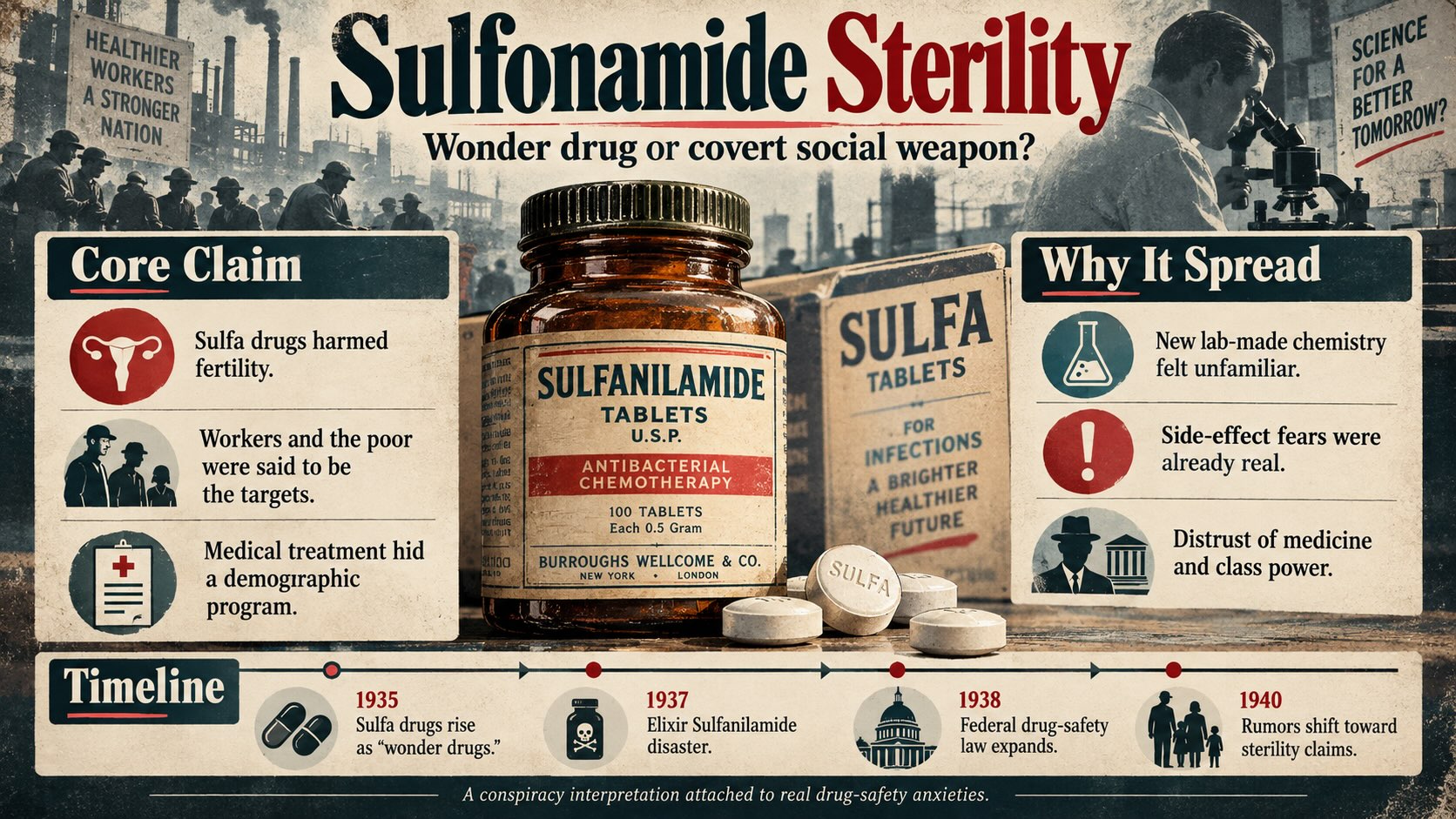
The Sulfonamide Sterility theory treated one of the first major antibacterial drug classes as a covert social weapon. Instead of seeing sulfa drugs as a medical advance against bacterial infection, believers claimed that the medicines carried a hidden reproductive purpose aimed especially at workers, the poor, or other groups thought to be expendable to industrial society.
Historical Context
Sulfonamides entered public consciousness in the mid-1930s as one of the first widely successful antibacterial drug families. Their arrival was dramatic. Newspapers, physicians, and manufacturers presented them as modern “wonder drugs,” and their use quickly expanded in hospitals and private medicine.
That excitement existed alongside public uncertainty. These were powerful new chemical therapies, and the public knew little about long-term effects. The Elixir Sulfanilamide disaster of 1937, which killed more than 100 people, proved that new drug products could be marketed before adequate safety safeguards existed. Although that tragedy involved the toxic solvent used in a liquid preparation rather than the antibacterial principle itself, it intensified public fear that pharmaceutical innovation could hide lethal consequences.
Core Claim
Sulfa drugs harmed fertility
The theory’s central allegation was that repeated use of sulfonamides damaged the ability of men or women to have children.
The damage was selective in social effect
In class-based versions, the intended victims were said to be industrial workers, the poor, relief recipients, migrants, or other populations already subject to public-health supervision.
The therapeutic purpose was only a cover
Believers argued that the visible medical function of the drug disguised a hidden demographic program.
Why the Theory Spread
Chemistry felt remote and untestable
For most patients, sulfa drugs represented a new type of medicine made in laboratories rather than drawn from familiar household remedies.
Side-effect fears were already real
Newspapers and physicians discussed adverse reactions, dosing difficulties, and toxicity. Public rumor often extended those known uncertainties into hidden reproductive harm.
Medicine and class power were already linked in public suspicion
Working-class distrust of institutions could easily absorb a theory in which employers, doctors, and governments used medicine to regulate the bodies of the poor.
Documentary Limits
The general history of sulfonamide adoption and public fear is well documented. The specific claim that sulfa drugs were intentionally designed to sterilize the working class appears mainly as rumor logic rather than as a clearly traceable national campaign with a single founding publication. It is best understood as a conspiracy interpretation attached to a real medical revolution and to real drug-safety anxieties.
Legacy
The theory anticipated later fears that public-health interventions could conceal reproductive control. Later rumors about water fluoridation, vaccines, hormone therapies, and population programs often repeated the same structure: a genuine medical or public-health system was reimagined as covert fertility management.