
Overview
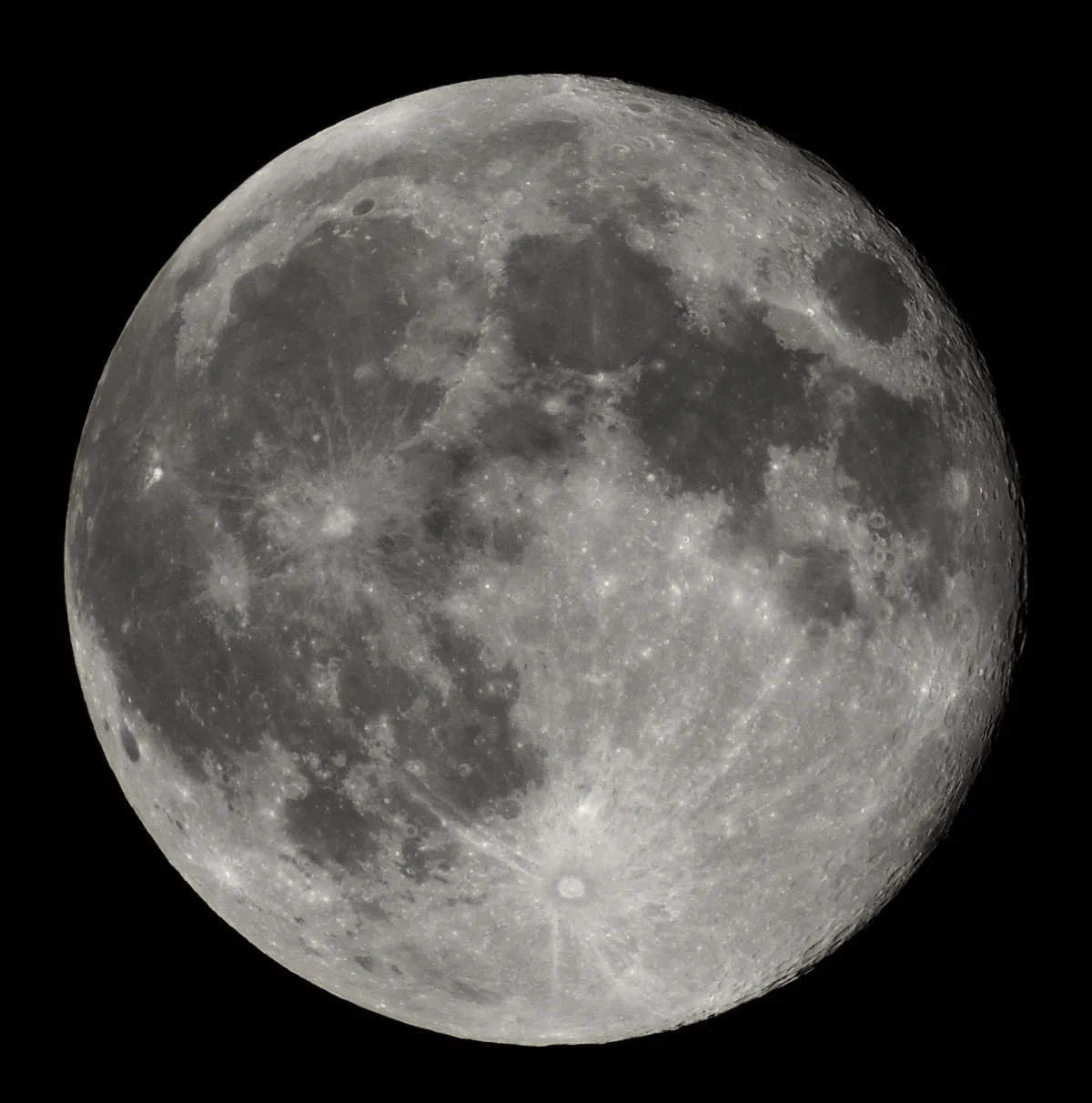
The claim is that the Moon is not a natural body. In its fullest form it is hollow, or built around a metallic shell, and was manoeuvred into Earth orbit by someone — as a watch-station, an archive, or a relay.
Almost everything specific in the theory rests on two things: a Soviet magazine article from 1970, and a phrase that came out of the Apollo programme. Both are real. Neither says what the theory needs it to say, and the second one has since been examined in considerable detail by people who had no interest in the argument at all.
Wikimedia Commons — Luc Viatour, CC BY-SA 3.0

The 1970 article
The idea did not emerge from the fringe. It was published in Sputnik, a Soviet popular-science magazine circulated abroad, in 1970, under the title "Is the Moon the Creation of Alien Intelligence?" The authors were Michael Vasin and Alexander Shcherbakov.
Their argument was a list of things about the Moon that struck them as odd: its size relative to Earth, which is unusual among satellites; its density, which is low; the near-perfect coincidence that makes the solar disc and the lunar disc appear almost the same size from the ground; and the shallow, flat-floored character of many large craters, which they read as impacts stopped by something hard underneath.
It was offered as speculation and framed as such. What happened next is the ordinary life cycle of an idea like this: Don Wilson's Our Mysterious Spaceship Moon carried it to English-speaking readers in 1975 as a book-length case, and by then the hedging had come off.
What the seismometers recorded
The most-quoted fact in the whole subject is real, and it is worth stating precisely rather than as a slogan.
Apollo astronauts left seismometers on the surface. To give those instruments a shock of known size, position and timing, mission controllers deliberately crashed spent hardware into the Moon. On 20 November 1969 the ascent stage of Apollo 12's lunar module Intrepid was steered down and struck the surface at about 1.7 kilometres per second, roughly 76 kilometres from the instrument package.
The signal did not look like an earthquake. It built slowly, peaked several minutes in, and took close to an hour to fade. One of the scientists involved reached for a comparison — a struck bell still sounding half an hour later — and that comparison, not the data, is what travelled.
The theory reads this as the sound of a shell. What it actually indicates is a body that transmits seismic energy with very little loss while scattering it heavily, which is a combination Earth does not offer.
Why the Moon rings and Earth does not
The explanation turns on two properties the Moon has and Earth lacks.
The first is that the Moon is dry. Water in rock is the main thing that absorbs seismic energy on Earth, damping a quake to silence within minutes. Lunar rock contains essentially none, so the energy is not absorbed; it keeps going.
The second is the megaregolith: several kilometres of rock shattered and re-shattered by four billion years of bombardment, with no weather or plate motion to heal it. Energy entering that layer does not travel in a clean line. It scatters off countless fracture surfaces, arriving at the instrument from every direction over a long interval instead of as a sharp first arrival.
A signal that starts weak, builds and decays slowly is exactly what a dry, deeply fractured, low-absorption outer layer produces. Numerical simulations of wave propagation around the Apollo 12 site have since reproduced the recorded waveforms from that structure alone. The ringing is evidence about the Moon's outer few kilometres, and it is genuinely strange by terrestrial standards — but it is not evidence about whether anything is underneath.
The measurement that settles the interior
The hollow claim is unusual among conspiracy theories in that it makes a prediction which can be checked directly, and has been.
Between 2011 and 2012 NASA flew GRAIL: two identical spacecraft in formation around the Moon, measuring the changing distance between themselves to within a fraction of a micron. Mass below them pulled on each one slightly differently, and from that separation the mission produced the most precise gravity map of any body in the solar system, the Moon included.
A hollow interior, or a shell of dense material around a void, would show up in that field unmistakably. It does not. What GRAIL found was an ordinary differentiated interior — a crust of 34 to 43 kilometres, thinner than had been assumed, unusually porous in its upper layers, and a bulk composition consistent with Earth's.
That last point does double duty. It is also the strongest support for the leading account of where the Moon came from: a collision between the early Earth and another body, whose debris coalesced in orbit. That origin explains the low density directly — the Moon formed mostly from mantle material and has only a small core — which was the anomaly Vasin and Shcherbakov opened with.
One older strand of the theory has quietly expired. Much of its early force came from the far side being unseen — the Moon is tidally locked, and until Luna 3 returned the first blurred images in October 1959 nobody knew what was there. That hemisphere has now been photographed to metre resolution, orbited, and in 2019 landed on by China's Chang'e 4. Nothing was on it but craters, which are more numerous there than on the near side.
The case its proponents make
The stronger version of the argument does not claim GRAIL was faked. It concedes the physical findings and shifts to the coincidences.
The eclipse coincidence is the one that does the most work. That the Moon's apparent size matches the Sun's so closely, at this particular moment in a long orbital recession, is a genuine fluke and not one anybody has explained away. It is presented as design rather than accident.
The wider argument is about institutional access: that the only instruments capable of answering the question belong to the agencies with the most reason to manage the answer, and that a reader is being asked to accept a conclusion they cannot independently verify.
That is a fair description of the epistemic situation. It applies to nearly all planetary science, which is the difficulty with it — a standard that rejects GRAIL rejects the measurements the theory itself cites for the Moon's low density.
Where it stands
The Moon-as-artefact theory is one of the few in this area that put a testable claim on the table and then had it tested. The claim was that the interior is not solid. The gravity field says it is.
What keeps the theory alive is that the phrase it was built on is still true. The Moon does ring, for the better part of an hour, and the recordings exist. The explanation for why is real physics about dry fractured rock, and it is less memorable than a bell.