
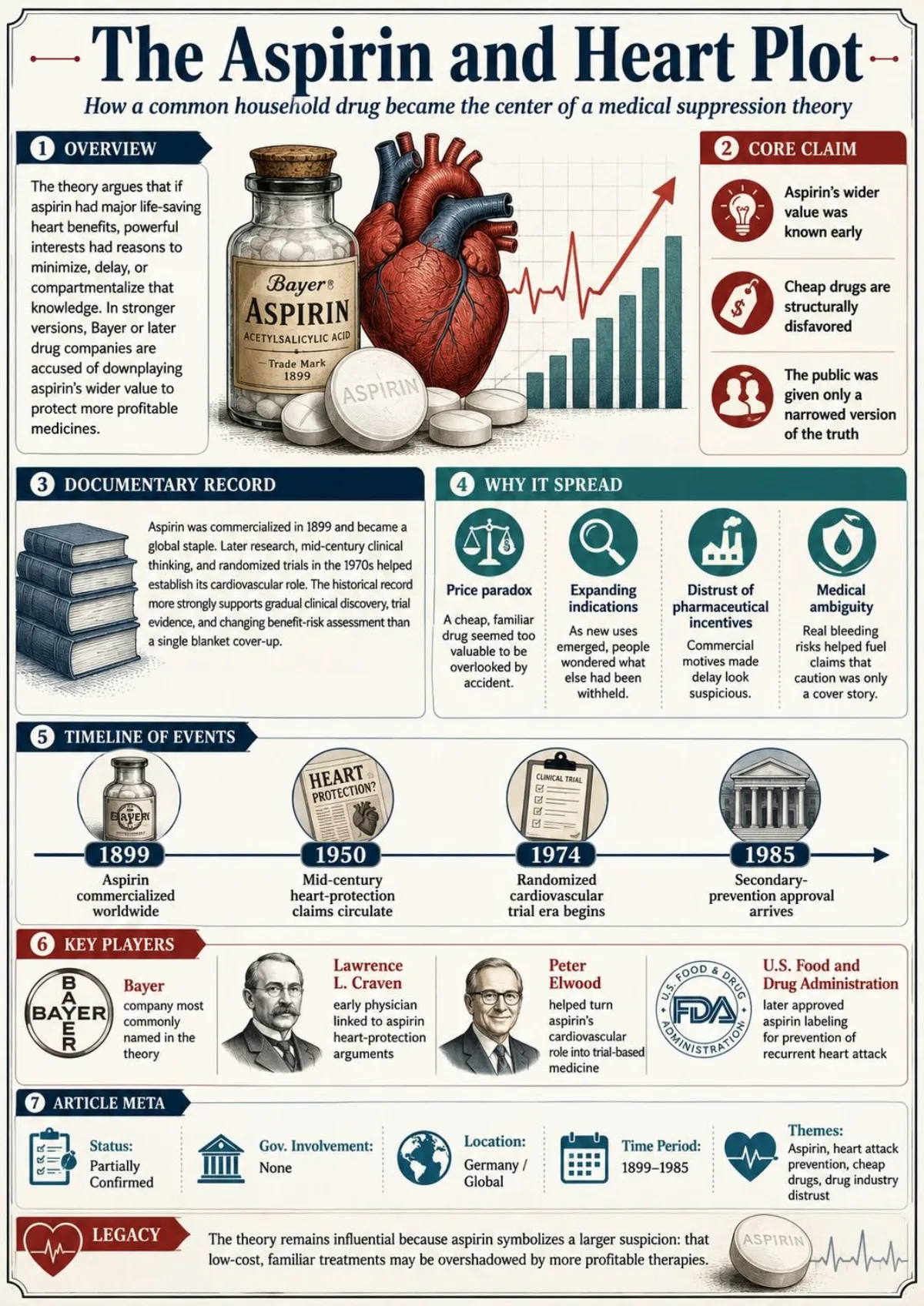
Overview
The "Aspirin and Heart Plot" rests on a simple suspicion: if a cheap, old, widely available drug had major life-saving value, then powerful interests must have had reasons to minimize, delay, or compartmentalize that knowledge. In its strongest popular form, the theory says Bayer or later drug companies knew aspirin "cured everything" but suppressed the truth in order to sell newer and more expensive medicines.
Historical Context
Aspirin entered commercial life at the end of the nineteenth century and quickly became one of the best-known modern medicines. It was used for pain, fever, and inflammatory conditions long before its role in platelet inhibition and cardiovascular prevention was fully worked out. That temporal gap matters. Aspirin was globally familiar, cheap, and ordinary before later generations of doctors and researchers developed stronger evidence about how it could affect clotting and heart attack risk.
During the twentieth century, physicians, epidemiologists, and regulators gradually expanded the therapeutic picture. That slow accumulation of evidence made it easy for non-specialists to reinterpret the history as concealment rather than development.
Core Claim
The theory usually contains three linked ideas:
Aspirin’s wider value was known early
Believers often point to mid-century observations about bleeding and thrombosis as signs that doctors or manufacturers already understood its heart-protective role.
Cheap drugs are structurally disfavored
The theory argues that low-margin medicines attract less institutional enthusiasm than patented or premium therapies.
The public was given only a narrowed version of the truth
In stronger versions, aspirin was intentionally framed as a simple headache remedy while more consequential uses were hidden or underpublicized.
Documentary Record
The historical record supports part of the background but not the strongest suppression claim. Bayer did commercialize aspirin in 1899 and the drug became a global staple. Later work, including mid-century clinical thinking and randomized trials in the 1970s and afterward, helped establish aspirin’s role in preventing recurrent heart attack and other cardiovascular events. Regulatory approval for secondary prevention arrived much later than the drug’s original launch.
This sequence gave the theory its force. To the public, it looked as though a humble tablet had always been sitting in plain view while medicine slowly admitted larger uses. But the surviving record more strongly supports a long process of clinical discovery, trial evidence, and changing benefit-risk assessment than a single intentional cover-up by Bayer.
Why It Spread
Several elements made the theory durable:
Price paradox
The drug was cheap, common, and old, which encouraged the intuition that its true value was being underestimated on purpose.
Expanding indications
Each newly recognized benefit invited the question of what else had been withheld.
Distrust of pharmaceutical incentives
Because the drug industry plainly has commercial motives, delayed or partial uptake of aspirin’s uses could easily be reinterpreted as strategic suppression.
Medical ambiguity
Aspirin is genuinely powerful but also carries bleeding risks, especially in primary prevention. That complexity helped believers argue that caution language was a cover story.
Legacy
The theory continues in modern health discourse whenever older, low-cost compounds are compared with expensive therapies. Aspirin remains especially potent as a symbol because it sits at the intersection of familiarity and seriousness: common enough for a household drawer, consequential enough for heart attack and stroke conversations. Historically, the theory is best treated as partially confirmed only in the limited sense that aspirin’s cardiovascular value was not central to its earliest public identity and emerged over time through research, regulation, and debate. The stronger claim of deliberate blanket concealment remains unproven.