
Overview
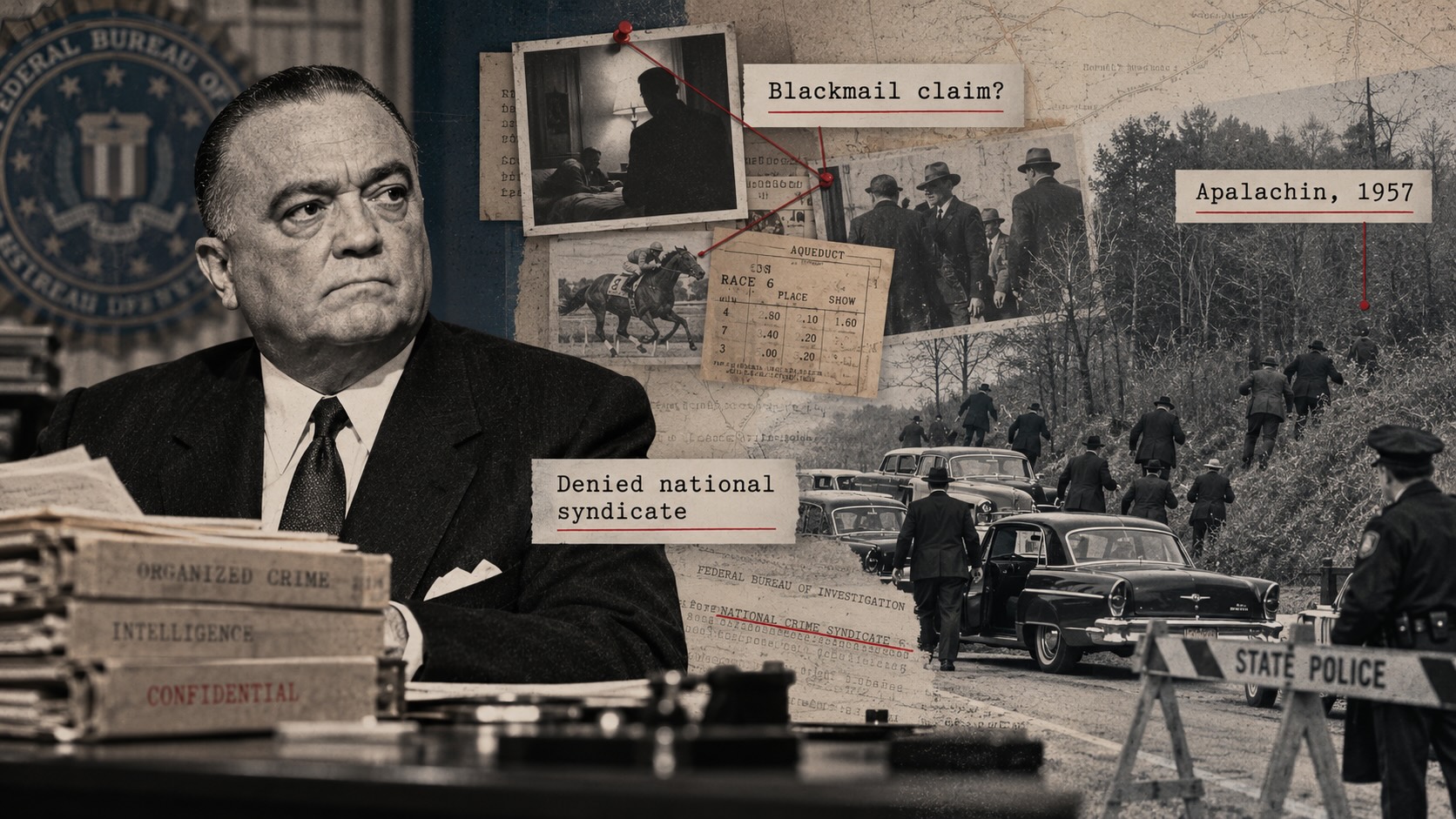
The puzzle is real and it does not depend on any theory to be puzzling. J. Edgar Hoover ran the FBI from 1924 until his death in 1972. Across most of that period he insisted that organised crime, in the sense of a coordinated national syndicate, did not exist. He said so publicly, and he ran the Bureau accordingly: agents were assigned to communists, to the Ku Klux Klan intermittently, to Martin Luther King exhaustively, and to bank robbery, which produced good statistics and good press.
Meanwhile the syndicate operated. Historians have argued about Hoover's reasoning ever since, and the argument has a documented half and a speculative half.
Apalachin
The position became untenable on 14 November 1957. A New York State Police sergeant named Edgar Croswell, acting on local suspicion rather than federal intelligence, noticed unusual traffic around the Apalachin home of Joseph Barbara — expensive cars, out-of-state plates. He set up a roadblock.
What scattered into the woods was roughly sixty senior organised crime figures from across the United States and beyond, gathered for a national meeting. Dozens were detained. The story was on front pages within days.
It is difficult to overstate what this did to the Bureau's public line. A state trooper had, more or less by accident, produced in an afternoon the demonstration that the FBI had spent decades saying was impossible. Hoover moved quickly afterwards, establishing the Top Hoodlum Program and directing field offices to develop organised crime intelligence — a reversal he never described as one.
The Blackmail Claim
The conspiracy explanation is that Hoover's inaction was bought. In this account Frank Costello and Meyer Lansky possessed photographic evidence of Hoover's private life — specifically of a sexual relationship with Clyde Tolson, his associate director and constant companion — and used it to guarantee federal disinterest.
The claim reached its widest audience through Anthony Summers's 1993 biography Official and Confidential, which assembled recollections from figures around the mob and the intelligence world. Among them was the account of Gordon Novel, who said the CIA counterintelligence chief James Angleton had shown him compromising photographs, with the suggestion that the material had originated with wartime intelligence and passed to organised crime.
A quieter version of the same argument requires no photographs at all. Hoover was a serious horse-racing bettor who attended tracks regularly and sent agents to place bets for him. On this reading, what Costello supplied was tips on fixed races — a favour that compromises without requiring blackmail, and that leaves no evidence because none of it was ever written down.
What the Record Supports
The blackmail claim rests on recollection rather than documents. No photograph has ever surfaced. Summers's sourcing has been contested since publication, and other Hoover biographers have said plainly that they pursued the same rumours and could not corroborate them. The Novel account passes through several hands, and Novel was not a reliable narrator on other subjects.
What is documented is the pattern the theory purports to explain. Hoover did deny the syndicate. He did keep extensive files on the private lives of politicians, which he was widely understood to hold as leverage — a man exceptionally alert to the uses of compromising material would be expected to understand his own exposure. He did preserve his position across eight presidencies, several of whom are recorded wanting him gone and concluding it was easier not to try.
The Simpler Explanations
There are readings that require no mob involvement, and serious historians have generally preferred them.
Organised crime cases were slow, dangerous and difficult to win, and corrupted the agents who worked them — a risk Hoover, who prized the Bureau's reputation for incorruptibility above almost everything, understood well. Communist cases produced arrests, headlines and appropriations. Institutional self-interest can account for the whole pattern without a photograph.
There is also the possibility that he simply believed it. Hoover's view of a national syndicate as an Italian import inflating a local problem was not unique to him in the 1940s, and a man of his certainty was unlikely to revisit a conclusion once he had committed the Bureau to it.
Why It Persists
The theory survives because the alternative explanations are administrative and the question is not. The most powerful law enforcement official in American history spent thirty years declining to see the most obvious criminal organisation in the country, and was proved wrong not by his own agents but by a state trooper at a roadblock. Something has to fill that gap, and a compromising photograph is a more satisfying filler than budgetary incentives.
The files that might settle it, if they existed, are the ones Hoover's secretary Helen Gandy destroyed in the days after his death — which is either the end of the evidentiary trail or, depending on the reader, the last item in it.