
Overview
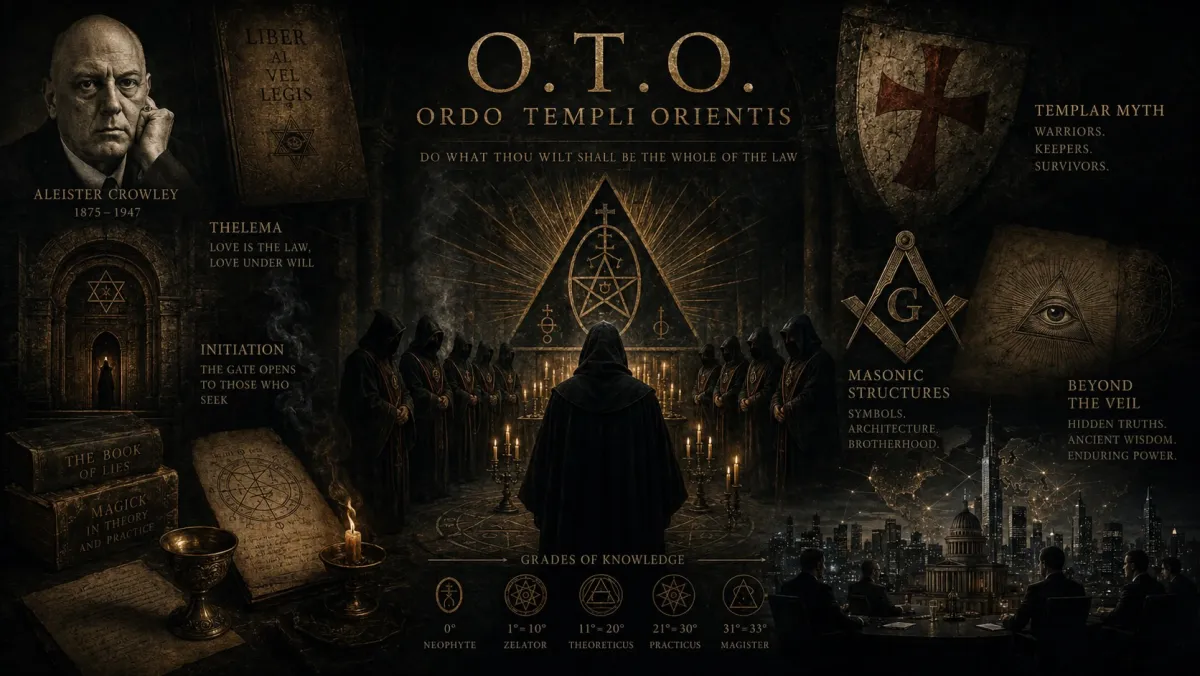
Ordo Templi Orientis, usually abbreviated O.T.O., occupies a distinctive place in modern occult conspiracy theory because it combines several features that repeatedly attract suspicion: secret initiations, graded access to knowledge, ritual language, ties to Aleister Crowley, explicit association with Thelema, and a longstanding reputation for guarding teachings related to sexual magic. To believers in occult-network theories, this combination makes O.T.O. more than a fringe spiritual fraternity. It becomes a plausible vessel for hidden continuity between older mystery schools, Templar myth, Masonic structures, esoteric politics, and modern elite influence.
The order’s own presentation emphasizes initiation, Thelema, and spiritual development through discovery of one’s True Will. In conspiracy literature, however, that public framing is often treated as an outer shell. The deeper claim is that O.T.O. functions as a layered initiatory system in which ordinary members encounter philosophy and ritual, while higher grades access more guarded teachings involving magical power, symbolic reversal, social engineering, and influence through secrecy.
What O.T.O. Says It Is
According to the U.S. Grand Lodge, O.T.O. presents itself as the first of the great old-aeon orders to accept The Book of the Law, received by Aleister Crowley in 1904, and it defines itself through the Law of Thelema: “Do what thou wilt.” The order stresses that this phrase is not meant as impulsive self-indulgence, but as the discovery and fulfillment of one’s True Will while allowing others to do the same.
Its publicly described structure is highly formal. The Minerval degree serves as an introductory stage, the First Degree confers full membership, and advancement beyond certain levels is by invitation. The degree system extends through national leadership and culminates in the office of the Outer Head of the Order. The U.S. Grand Lodge also identifies Ecclesia Gnostica Catholica, the Gnostic Catholic Church, as the ecclesiastical arm of O.T.O.
For conspiracy theorists, these official features are important because they show that the order is not casual, improvised, or merely symbolic. It has an initiatory ladder, a doctrinal law, ritual progression, ordained religious functions, and a guarded internal architecture. That structure itself becomes part of the theory.
Historical Core
O.T.O. originated in the early twentieth century and was shaped first by Theodor Reuss and then, more decisively, by Aleister Crowley. The official history maintained by O.T.O. emphasizes Crowley’s revision of rituals and his desire to adapt the order to spread Thelema. Crowley’s reforms made the order more explicitly Thelemic and less dependent on inherited Masonic forms.
This transition is central to conspiracy interpretations. O.T.O. is often imagined as the moment when older European initiatory systems were fused with Crowley’s antinomian spirituality, magical experimentation, and doctrine of will. Rather than viewing this as a theological shift alone, conspiracy writers frequently treat it as a transfer of hidden authority: a once-esoteric fraternal system becomes a vehicle for a more radical occult current.
Thelema and Suspicion
The Law of Thelema is one reason O.T.O. appears so often in conspiracy writing. The phrase “Do what thou wilt” has long been treated by critics and theorists alike as an encoded doctrine of inversion, elitism, or moral exemption. O.T.O. itself explicitly rejects the idea that the Law means indulgence in every whim, but conspiracy theories often insist that such explanations are exoteric and aimed at outsiders.
In that reading, Thelema becomes a doctrine of selective sovereignty. Those who can discover and assert “True Will” are imagined as moving beyond ordinary moral restraint. This makes O.T.O. appear, in conspiracy logic, as a school for initiates who seek power rather than piety, mastery rather than obedience, and transformation through crossing boundaries rather than respecting them.
Sexual Magic and the Secret-at-the-Center
One of the most persistent theories surrounding O.T.O. centers on sex magic. Academic scholarship on the order has repeatedly noted that sexual magic became one of its most distinctive features and was often described as a core secret of the system. This alone has made O.T.O. a magnet for sensationalism, but in conspiracy literature it becomes something more consequential.
The theory usually goes like this: sexual ritual is not a peripheral practice but the concealed engine of the order’s inner workings. The sexual teachings are treated not merely as mystical symbolism, but as operational techniques for generating power, binding initiates, collapsing taboo, and reshaping consciousness. To conspiracy believers, the secrecy surrounding these teachings suggests that the real center of O.T.O. is not philosophy but controlled ritual transgression.
From that point, larger claims emerge. The order is said to preserve ancient fertility mysteries, left-hand-path initiation, or elite rites disguised as spirituality. What the public sees as occult pageantry, believers read as applied magical technology.
The Crowley Factor
Aleister Crowley is indispensable to the mythology surrounding O.T.O. Because his name is tied to ritual magic, scandal, libertinism, prophecy, and self-conscious notoriety, any organization closely identified with him naturally attracts theories of hidden influence. Crowley’s own role in reconstructing O.T.O.’s rituals, spreading Thelema, and shaping the order’s modern form feeds the belief that O.T.O. became his institutional body.
In conspiracy thought, Crowley functions as more than a historical leader. He becomes a transmitter figure. Through him, O.T.O. is linked to Luciferianism, ritual inversion, magical politics, and anti-Christian esotericism. Even where such claims are exaggerated or symbolic, they shape the order’s image. O.T.O. becomes the order where Crowley’s worldview was not just written but embodied, staged, and passed on.
Templar, Masonic, and Illuminist Continuity
The very name “Ordo Templi Orientis” invites theories of hidden continuity. The Templar reference encourages the claim that O.T.O. is not merely inspired by romantic esotericism but is a modern vessel for remnants of older initiatory currents. Because its history also intersects with Masonic language, degrees, and structural borrowing, conspiracy theorists often treat O.T.O. as a side-channel or inner channel of Masonry.
In some versions, O.T.O. is imagined as a post-Masonic occult correction: a body that took fragments of Templarism, Masonry, Hermeticism, and Gnosticism and reassembled them into a more potent initiatory machine. In more elaborate theories, it is placed alongside Martinists, Rosicrucians, and Illuminist traditions as one of several overlapping organs of a deeper esoteric establishment.
The Parsons-Hubbard Axis
One of the most enduring modern theories involving O.T.O. comes through Jack Parsons, the rocket pioneer and Thelemite who was deeply involved in Crowley’s magical world. Because Parsons helped found major rocket organizations in the United States while also participating in O.T.O.-connected ritual work, the order became entangled with a uniquely modern conspiracy theme: the overlap of occult ritual and advanced technology.
This theory deepened because L. Ron Hubbard became involved in Parsons’s magical circle during the period of the Babalon Working. The result is a powerful triangulation in conspiracy culture:
- O.T.O. and sex magic
- early American rocket science
- the prehistory of Scientology
To believers, this is not an eccentric historical coincidence. It is evidence that occult orders may intersect with scientific and cultural institutions more directly than the public assumes. O.T.O. thus becomes a bridge between ceremonial magic and the technological state.
Hidden Influence Theory
A broader conspiracy theory casts O.T.O. as a subtle influence network rather than a mass organization. It is not imagined as secretly running governments in the crude sense. Instead, it is said to function through recruitment of artists, writers, occultists, cultural intermediaries, and strategically placed elites who carry its symbols and ideas outward into society.
In this model, O.T.O. acts through:
- cultural contamination rather than formal takeover,
- symbolic diffusion rather than public doctrine,
- ritualized networking rather than electoral power,
- and prestige through taboo rather than prestige through respectability.
Its influence is therefore believed to be difficult to map directly, because it spreads through fascination, transgression, aesthetics, and myth rather than public campaigns.
Luciferian and Inversion Narratives
Another central theory is that O.T.O. represents a Luciferian current masked as spiritual liberation. This claim does not always mean explicit devil-worship in a literal theological sense. Often it means that the order is viewed as reversing conventional religious categories:
- will over obedience,
- initiation over faith,
- knowledge over submission,
- transgression over purity,
- and self-deification over humility.
To conspiracy theorists with a Christian or anti-occult framework, this makes O.T.O. an inversion order. Its ceremonies, magical formulae, and sexual teachings are interpreted as deliberate reversals of sacramental religion, designed to shift allegiance away from transcendent divinity and toward empowered, initiated selfhood.
Public Secrecy and the “Open Secret” Problem
O.T.O. produces an unusual effect in conspiracy culture because it is both public and secretive. It has a website, public statements, and a visible institutional presence. At the same time, it maintains initiatory privacy, guarded rituals, and inner teachings not given to outsiders. This creates what conspiracy thinkers regard as the ideal mask: enough openness to appear harmless, enough secrecy to hide what matters.
This “open secret” structure is one reason O.T.O. has remained fertile ground for speculation. It is visible enough to be studied, but closed enough to generate projection. Every hidden degree, ritual boundary, and invitation-only advancement stage reinforces the sense that the real organization lies behind the visible one.
Internal Succession and Fragmentation
O.T.O.’s history includes multiple succession disputes and rival claims following Crowley’s death. The order’s own historical materials discuss figures such as Hermann Metzger, Kenneth Grant, Marcelo Ramos Motta, and Grady McMurtry in relation to succession, reconstitution, and legitimacy. For conspiracy theorists, these struggles are not administrative footnotes. They suggest that control of the order was considered valuable enough to fight over.
This fuels the theory that O.T.O. contains or transmits something of real significance—whether magical authority, archives, ritual formulas, social connections, or symbolic capital. A body does not fragment so intensely, in this reading, unless something worth inheriting is at stake.
Main Interpretive Models
1. Occult-Inner-Core Model
O.T.O.’s public religious and fraternal identity is only an outer shell covering a more secret inner order focused on guarded magical operations and elite initiation.
2. Sex-Magic Power Model
The true center of O.T.O. lies in its sexual-magical teachings, which are believed to function as techniques of empowerment, bonding, taboo transgression, and ritualized control.
3. Crowley Continuity Model
O.T.O. is the institutional continuation of Aleister Crowley’s worldview, preserving his ritual system, his magical doctrine, and his antinomian spiritual politics.
4. Templar-Masonic Survival Model
The order represents a modern survival or recombination of older Templar, Masonic, Hermetic, and Gnostic currents, preserving a concealed initiatory lineage.
5. Parsons-Hubbard Interface Model
O.T.O. is viewed as the occult point of contact between ceremonial magic, early aerospace culture, and the prehistory of Scientology.
6. Symbolic Influence Model
Rather than directly ruling anything, O.T.O. shapes culture indirectly through symbols, myth, aesthetics, taboo, and selective influence among creative and esoteric elites.
Legacy
Ordo Templi Orientis remains one of the most theorized occult organizations of the modern era because it combines historical reality with ritual opacity. It is public enough to be documented, secretive enough to remain suggestive, and symbolically charged enough to serve as a magnet for projections about hidden power. In conspiracy literature, it appears as a place where old mysteries did not vanish but modernized—where Templar legend, Masonic architecture, sexual magic, Crowleyan will, and elite secrecy converged into a living order that still stands at the edge of public view.