
Overview
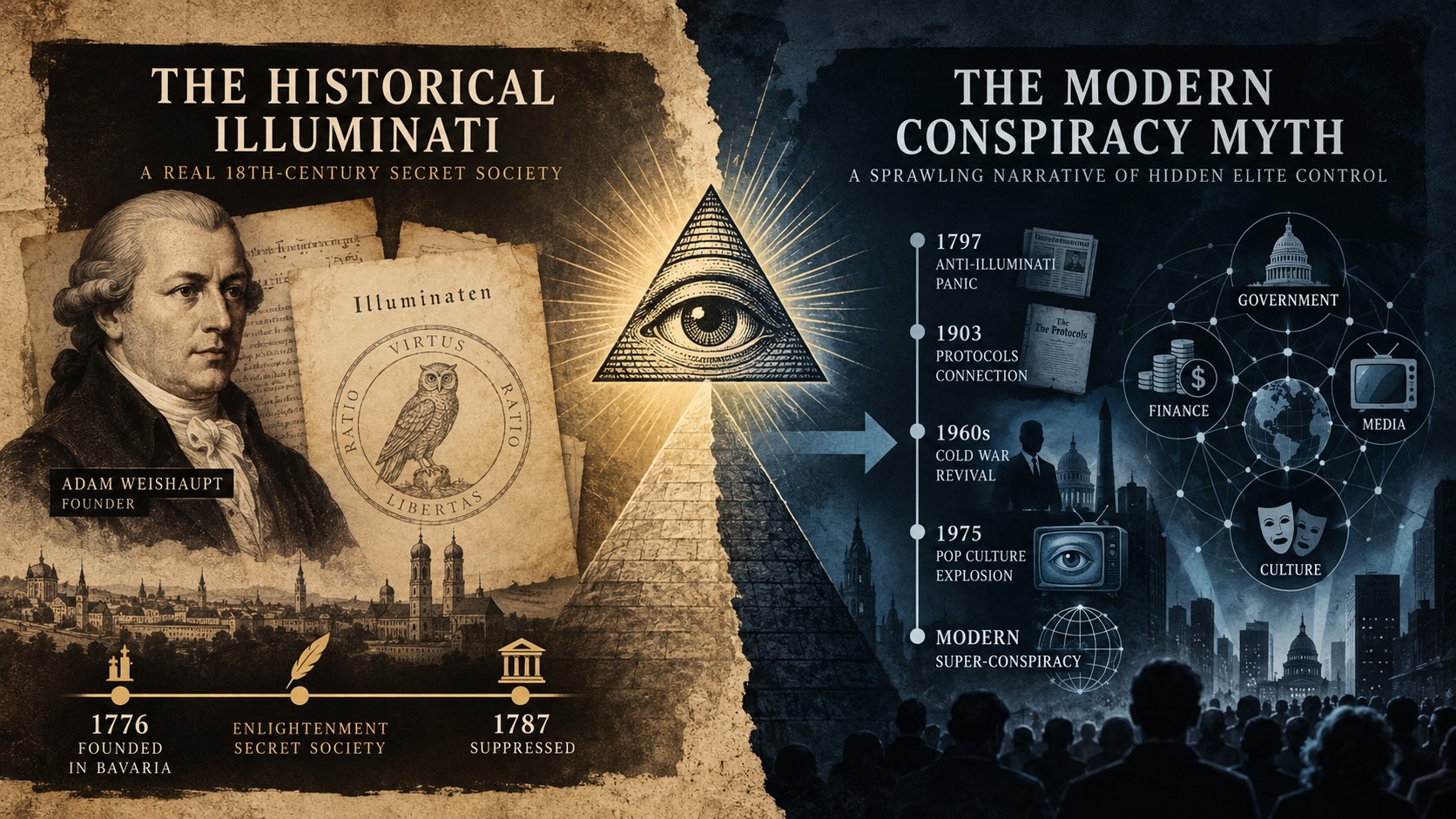
The Illuminati conspiracy theory posits that a secret society of elites controls world events from behind the scenes, manipulating governments, financial systems, media, and culture to advance a hidden agenda — often described as the establishment of a "New World Order" or single world government. While rooted in a real historical organization — the Bavarian Illuminati, founded in 1776 — the modern conspiracy theory bears little resemblance to the original group and serves instead as a catch-all explanation for perceived patterns of elite coordination.
The Historical Bavarian Illuminati
The Order of the Illuminati (Illuminatenorden) was founded on May 1, 1776, by Adam Weishaupt, a professor of law at the University of Ingolstadt in Bavaria. Weishaupt, influenced by Enlightenment rationalism, created the order as a secret society dedicated to opposing superstition, religious influence over public life, and abuses of state power. The organization recruited from among Freemasons and intellectual elites.
At its peak, the Bavarian Illuminati had between 2,000 and 3,000 members across several European countries, including prominent figures such as the writer Johann Wolfgang von Goethe and the Duke of Gotha. The order was organized in a strict hierarchy and used code names (Weishaupt was "Spartacus").
In 1784, Bavarian ruler Duke Karl Theodor banned all secret societies, including the Illuminati. Government raids in 1786-1787 seized Illuminati documents and effectively destroyed the organization. Weishaupt fled to Gotha, where he lived in exile until his death in 1830.
The Conspiracy Theory Evolves
The modern Illuminati conspiracy theory developed through several phases:
The Anti-Illuminati Panic (1797-1800s)
Two influential books published in 1797-1798 — Abbe Augustin Barruel's Memoirs Illustrating the History of Jacobinism and John Robison's Proofs of a Conspiracy — claimed the Illuminati had survived and were responsible for the French Revolution. These works established the template for Illuminati conspiracy theories: a secret group of intellectuals manipulating world events.
The Protocols Connection (1903)
The Protocols of the Elders of Zion, a text that first published in Russia in 1903, described a Jewish conspiracy for world domination.
John Birch Society and Cold War (1960s)
In the 1960s, the John Birch Society and other right-wing organizations revived Illuminati conspiracy theories, linking them to communist infiltration and international banking. Author Gary Allen's None Dare Call It Conspiracy (1971) reached millions of readers.
Pop Culture Explosion (1975-present)
Robert Shea and Robert Anton Wilson's satirical The Illuminatus! Trilogy (1975) injected the Illuminati into popular culture. Since then, the concept has been referenced in countless books, films, video games, and music. The theory experienced another surge with the rise of internet conspiracy communities in the 2000s and Dan Brown's novel Angels & Demons (2000).
Modern Claims
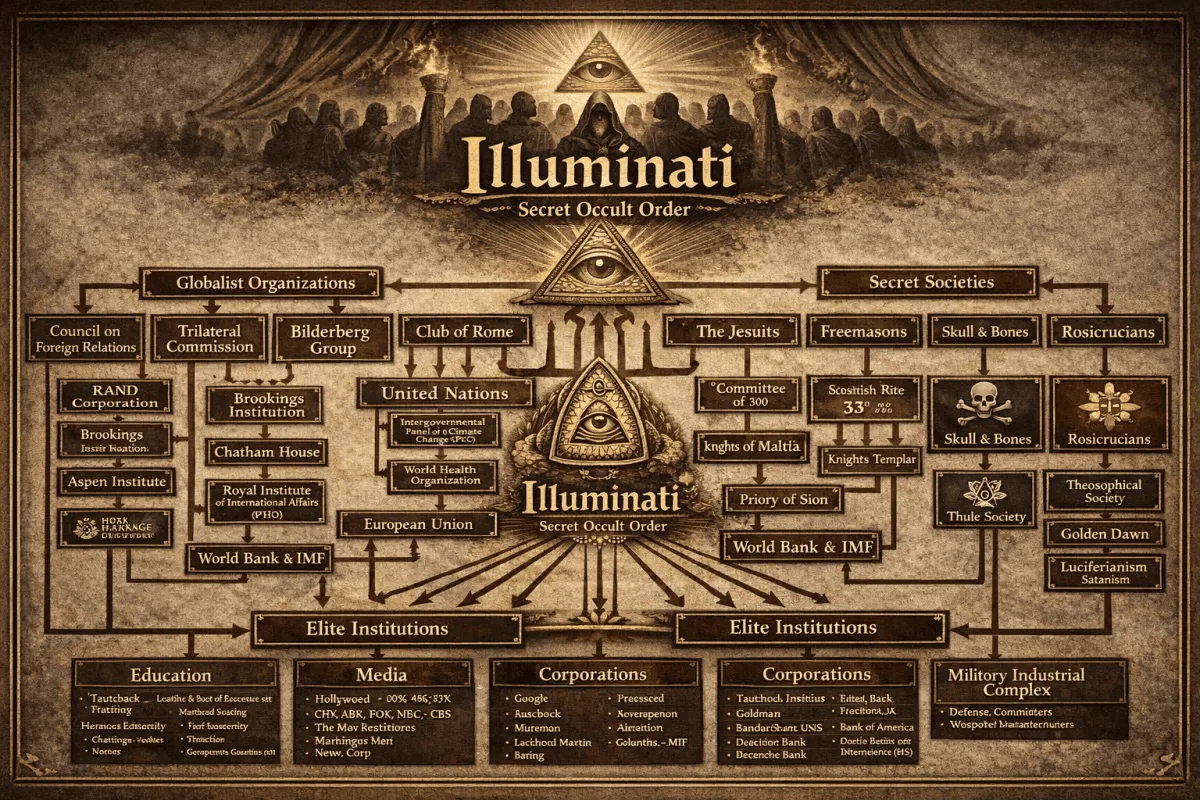
Contemporary Illuminati conspiracy theories typically allege:
- Political control: World leaders are either members of or controlled by the Illuminati, and elections are predetermined
- Financial control: International banking families (often the Rothschilds are named) control the world's central banks and economic systems
- Media control: Entertainment and news media are tools for mass manipulation, with Illuminati symbols (the all-seeing eye, pyramids, the number 666) deliberately embedded
- Population control: Agendas for depopulation, mandatory vaccination, and social engineering are orchestrated by the group
- Celebrity membership: Prominent musicians, actors, and tech moguls are alleged members who display secret hand signals and symbols
Analysis
The Illuminati conspiracy theory functions as what scholars call a "super-conspiracy" — a meta-narrative that subsumes and connects other conspiracies into a unified framework. Its resilience stems from several factors:
- It is based on a real historical organization, giving it a kernel of factual legitimacy
- It provides simple explanations for complex events
- It is unfalsifiable — any evidence against it can be attributed to the Illuminati's effectiveness at concealment
- It adapts to contemporary anxieties, absorbing new events and technologies into its framework
The theory reveals genuine concerns about concentrated power, elite networks, and democratic accountability.