
What happened, and who said it did
In the spring of 1940 the NKVD shot roughly 22,000 Polish prisoners. They were officers of the Polish army, policemen, border guards, officials, doctors, lawyers and academics — the professional class of a country the Soviet Union had occupied the previous autumn under the terms of its pact with Germany. Katyn Forest, near Smolensk, is the best-known of several killing sites, and gives the whole episode its name.
Three years later German forces occupied the area, found the graves, and in April 1943 announced them to the world. This put the Western Allies in an extremely awkward position: the accusation was true, and it was being made by Nazi Germany against a country that was at that moment carrying the weight of the war in the east.
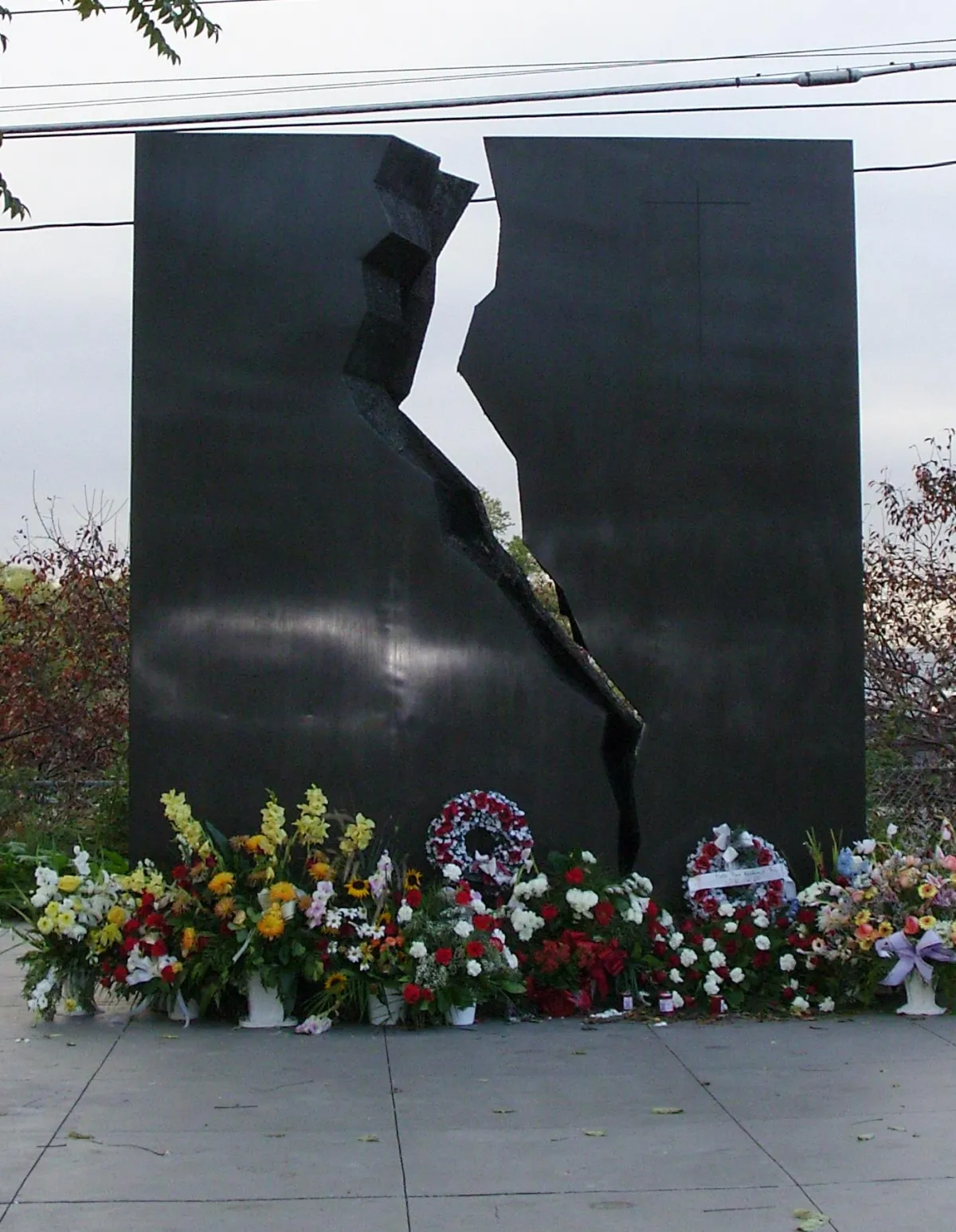
Wikimedia Commons — Alex LaneyAlaney2k, CC BY 3.0

The commission
The Soviet response was not simply to deny it. It was to build a counter-finding with the apparatus of science attached.
In January 1944 the USSR convened a special commission under Nikolai Burdenko, the president of the Soviet Academy of Medical Sciences. It exhumed bodies, examined the site, rejected the German forensic conclusions, and determined that the Poles had been shot in late 1941 — by which time the area was under German control. The killings were therefore a German crime.
This finding was not a passing wartime expedient. It was the official Soviet position for forty-six years, cited by Soviet sources as settled fact, and it was repeated in Western reference works for decades on the strength of it. A state had produced a scientific commission to attribute its own mass killing to its enemy, and the attribution held.
The forensic experts, and what happened to two of them
Germany did not only announce the graves. In 1943 it convened an international commission of twelve forensic specialists drawn from occupied and Axis-aligned Europe — Belgium, Bulgaria, Croatia, Denmark, Finland, Vichy France, Hungary, Italy, the Netherlands, Romania, Switzerland and Bohemia-Moravia — to examine the site.
The commission concluded that the Soviets had done it. Every obvious objection applies: it was convened by Nazi Germany, from countries under German influence, for a propaganda purpose, and that is reason enough to treat its findings with suspicion at the time.
What happened to its members afterwards is the detail that settles the question of whether they were simply telling the occupier what it wanted to hear. Two of them — the Bulgarian Marko Markov and the Czech František Hájek — lived to see their countries become Soviet satellites, and were made to recant and reassign the killings to the Germans.
A finding that has to be coerced out of existence after the fact is not a finding anybody doubted. The pressure applied to those two men is a better indicator of where the truth lay than the commission's own composition.
The cost to Poland, immediately
The Polish government-in-exile reacted to the German announcement in the only way open to it: on 17 April 1943 it asked the International Red Cross to investigate.
Stalin's response was to treat the request itself as the offence. He rejected an independent examination, characterised the Poles' willingness to have the graves examined as evidence of collusion with Germany, and broke off diplomatic relations with the Polish government-in-exile.
The logic is worth naming because it recurs. Asking for a neutral investigation was converted into proof of bad faith, which both avoided the investigation and punished the party requesting it. Poland lost its diplomatic standing with the Allied power occupying its territory for the offence of wanting its dead officers identified.
Nuremberg
In 1946 the Soviet Union tried to make the lie official in the one forum where it would be tested.
The Soviet prosecutor Roman Rudenko put Katyn before the International Military Tribunal as a German crime — the mass execution of Polish prisoners of war by the German fascist invaders. It was an aggressive move: an attempt to have an international court attribute the killings to the defendants.
He could not substantiate it. The American and British judges dismissed the charge, and the attempt failed.
This is a significant fact about the strength of the evidence even in 1946. A tribunal that was convicting the Nazi leadership of enormous crimes, on which the Soviet Union sat as one of four prosecuting powers, would not accept this one. The Burdenko Commission's findings did not survive contact with a court.
What Poland's allies did
The part of this story that gets least attention is the Anglo-American one, and it is the reason this entry sits in a conspiracy archive rather than only in a history of Soviet crimes.
The United States and Britain did not simply fail to work out what had happened. Reports reached them indicating Soviet responsibility, and the material was suppressed rather than pursued, because pursuing it would have damaged relations with an indispensable ally in the middle of a war. The documentary record of that decision stayed classified for the rest of the century. The National Archives released a substantial body of it in 2012, and the files make the handling explicit enough that news coverage at the time described the United States as having helped cover up the massacre.
This is a cover-up with an unusual structure. The perpetrator state denied it, which is what perpetrator states do. Two democracies on the victims' side knew, declined to say, and classified the evidence of their own silence.
The investigation that got it right, and changed nothing
By 1951 the alliance had collapsed into the Cold War, and the political arithmetic reversed. The House of Representatives established a select committee under Ray Madden to investigate Katyn, and it did the work properly: 81 witnesses, 183 exhibits, more than a hundred depositions, through to November 1952.
Its conclusion was unanimous, and it was correct. The NKVD had carried out the killings. The committee called the massacre one of the most barbarous international crimes in world history.
It made no practical difference. The Soviet Union was unmoved, the Burdenko finding remained the official account inside the Soviet bloc, and in Poland — where the truth was widely known privately — saying it publicly remained dangerous for another four decades. A correct finding by a legislature of a state with no power over the perpetrator is a matter of record rather than a remedy.
1990
On 13 April 1990, a TASS statement issued on Mikhail Gorbachev's personal authority accepted Soviet responsibility.
Fifty years is the number worth sitting with. The admission came not from new evidence — the evidence had been sufficient in 1943 and conclusive in 1952 — but from a change in the political usefulness of the lie. That is the general lesson the case supports, and it is a bleak one: the lifespan of an official falsehood is set by what it is doing for the people maintaining it, not by the strength of the case against it.
What is contested now
Not Soviet responsibility. That is established by Soviet admission and by documents released from Russian archives, and attempts to reopen it are the work of a small revisionist literature that argues against the perpetrator's own confession.
What remains genuinely argued is the legal characterisation — whether Katyn constitutes genocide, which Poland has pressed and Russia has resisted — and the question of access. Not all relevant Russian files have been released, Russian investigations have been closed without the outcomes Polish authorities sought, and no one was ever prosecuted. The killing is no longer a secret. The accounting for it never happened.