
The operation
On the evening of 31 August 1939, seven men in Polish uniforms took over the German radio transmitter at Gleiwitz, in Upper Silesia a few miles from the Polish border. They were SS, led by Alfred Naujocks. They tried to put out a prepared statement in Polish, managed it badly, smashed up the interior of the station and fired rounds of ammunition.
On their way out they left two bodies, both dressed in Polish uniform.
The following morning German forces crossed into Poland, and Hitler told the Reichstag that Polish troops had been attacking German territory. Gleiwitz was one incident among several staged along the frontier under the designation Operation Himmler, all of them built to produce the same impression: that Germany was responding rather than beginning.
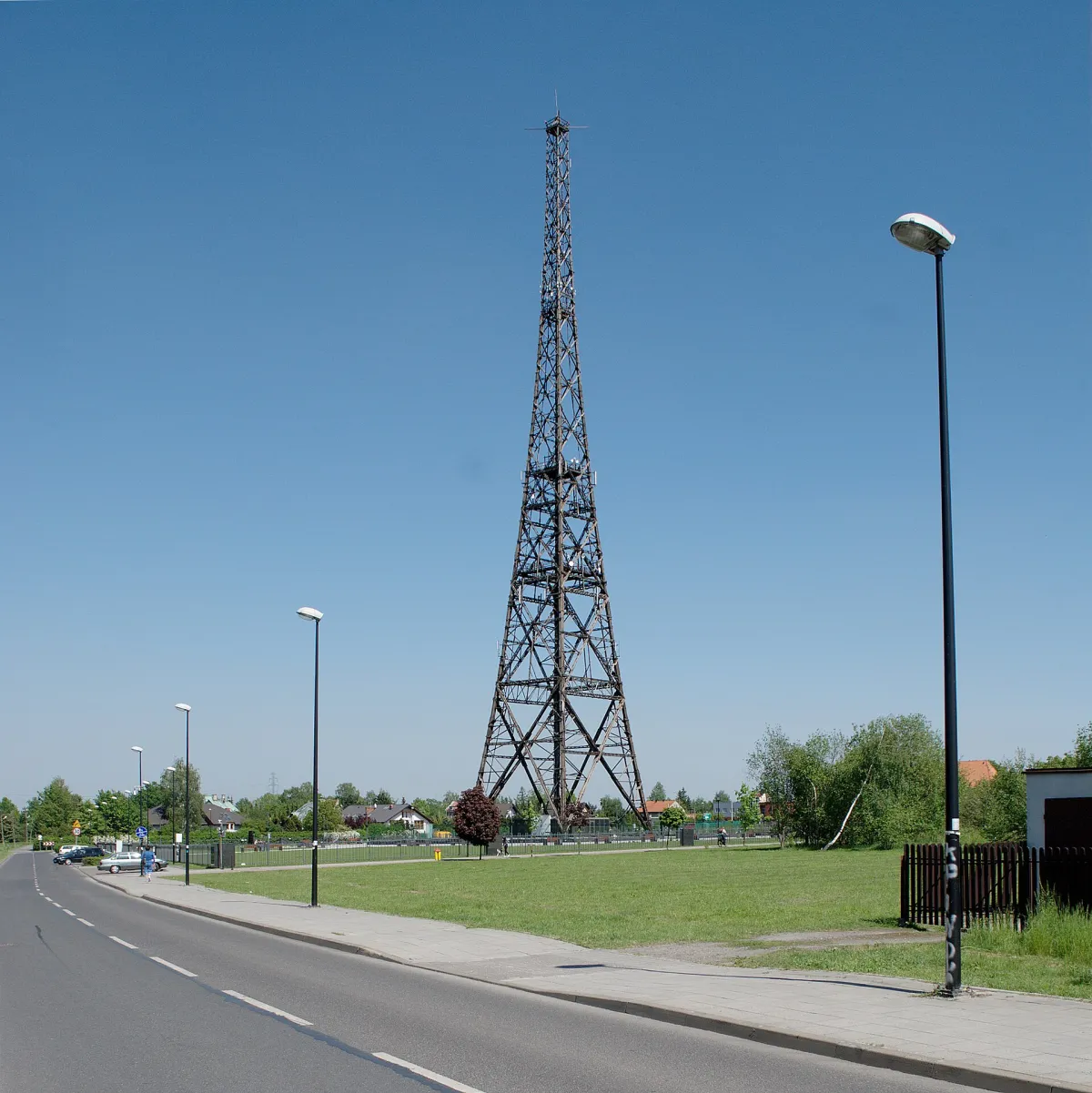
The transmitter at Gleiwitz, seized by SS men in Polish uniforms on 31 August 1939. The tower still stands. Wikimedia Commons — Tomasz Górny (Nemo5576), CC BY-SA 3.0

The man who was killed to be evidence
The detail that distinguishes Gleiwitz from an ordinary deception is Franciszek Honiok.
Honiok was a Silesian farmer, in his early forties, known locally for Polish sympathies. The Gestapo arrested him on 30 August — the day before the operation. He was not a participant in anything. He was taken so that there would be a body at the scene with a plausible biography, and he was killed for that purpose before being put in a Polish uniform and left on the ground at the radio station.
He is generally described as the first person killed in the Second World War. Whether or not that is exactly right, he was killed in order to make a document of himself: a corpse that would read, to anyone who found it, as a Polish raider shot during an attack.
A second body was left alongside his. The man has never been identified.
"Canned goods"
Honiok was not an exception. He was an instance of a method that had a name.
Gleiwitz was one of roughly seven staged incidents carried out along the frontier, mostly on the same night of 31 August 1939: the Jablunka Pass railway, the customs station at Hochlinden, a forest service station at Pitschen, a communications station at Neubersteich, the railway station at Alt-Eiche, an assault on a woman and her companion at Katowice, and the radio transmitter at Gleiwitz. In his Reichstag speech the next day, Hitler put the number of Polish border violations at twenty-one.
The bodies required for these scenes appear in the German planning documents under the word Konserven — canned goods. They were concentration camp prisoners, most of them taken from Dachau, dressed in Polish uniforms, killed by lethal injection, shot afterwards so the corpses would look right, and left where they were needed. The operation is sometimes called Operation Konserve for that reason, alongside Operation Himmler, after the man whose idea it was.
A euphemism of that kind is not incidental to understanding the thing. Someone had to requisition the bodies, and the paperwork needed a term for them. The term chosen treats human beings as stock to be drawn from a store, which is a reasonably exact description of how they were used.
Where the knowledge comes from
This is the part worth being precise about, because it determines how much weight the account can carry.
The staging was not uncovered by investigators working from physical evidence. It is known principally because the officer who ran it described it on oath. On 20 December 1945, at Nuremberg, Alfred Naujocks signed a written affidavit setting out that Reinhard Heydrich had given him the assignment, that Heinrich Müller was involved in the arrangements, and that he had been instructed that a body in Polish military uniform was to be left on the steps of the station to insinuate a Polish connection. The affidavit entered the record of the International Military Tribunal and was published in the official American compilation of trial documents.
So the central source is a perpetrator's statement, given in custody, at a tribunal with the power to prosecute him. That is a category of evidence to treat carefully as a general matter. Here it is corroborated by the shape of everything around it: the body of a man the Gestapo had demonstrably arrested the previous day, the sequence of staged provocations along the border in the same week, and an invasion that began the next morning on precisely the justification the operation was built to supply.
Naujocks himself was never tried for Gleiwitz.
Why it is cited, and what it actually supports
Gleiwitz is probably the most-cited false flag in the world. It appears in support of claims about operations separated from it by decades, continents and circumstances, on the reasoning that because this one happened, the one under discussion could have too.
That inference is weaker than it looks, and the case itself shows why. What made Gleiwitz work was not sophistication. The broadcast failed. The raid convinced nobody who examined it closely. It did not need to: the pretext was for the record and for the German public, not for scrutiny, and the invasion had been decided before the transmitter was touched. A pretext built to be believed for twelve hours is a different kind of object from a long-running concealed operation, and the one does not establish the feasibility of the other.
What the incident does establish is narrower and worth stating plainly. A state staged an attack on its own territory, killed a civilian it had arrested specifically to serve as the body, dressed him in the enemy's uniform, and used the result to announce a war the next morning — and the man who organised it put his name to an account of it six years later.
What remains unsettled
Not much about the mechanics, and that is unusual for an entry in this archive. The open questions are small ones. The second body has never been identified. The precise chain by which Honiok was selected is not fully documented. Accounts of how he was killed differ in detail.
The larger question Gleiwitz raises is not about Gleiwitz. It is what a documented case does and does not license a reader to believe about an undocumented one. The answer here is that it licenses very little, and that the reason this case is known at all is that someone wrote it down under oath. No comparable document exists for most of the operations it is used to argue for.