
Overview
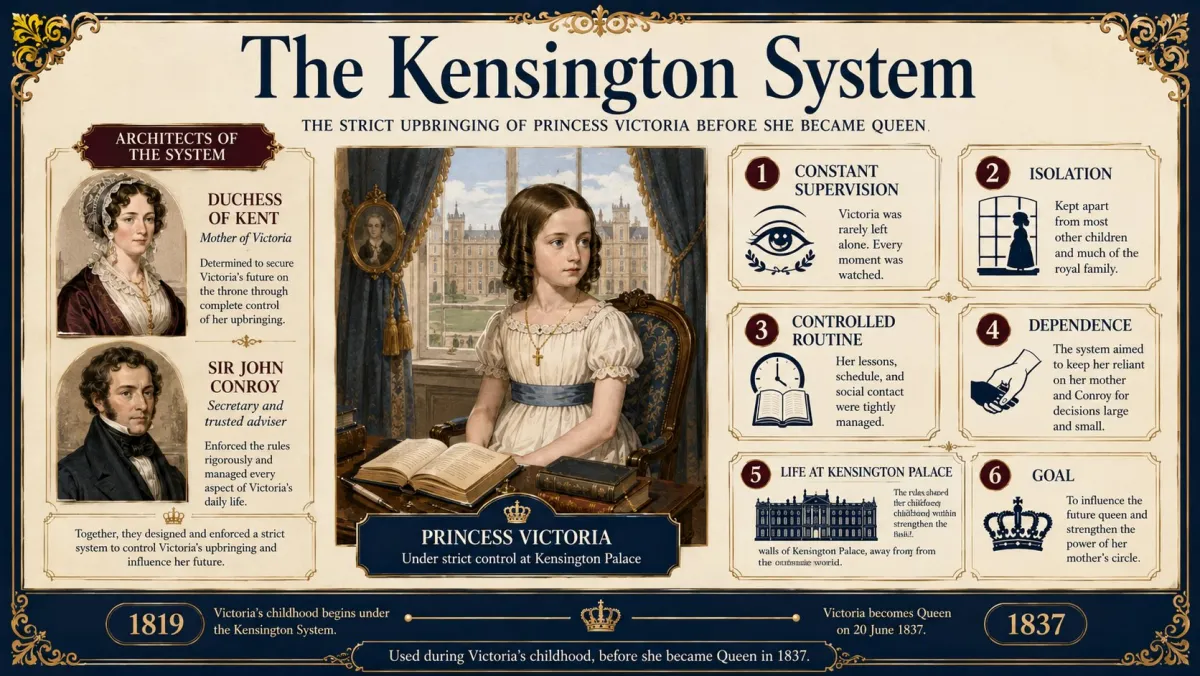
The Kensington System was one of the most famous domestic power schemes in British royal history. It was a system of upbringing rules imposed on the future Queen Victoria in childhood and adolescence by her mother, the Duchess of Kent, and the Duchess’s adviser Sir John Conroy. To critics then and later, it looked less like careful education than controlled confinement.
In conspiracy form, the theory holds that the system was built to produce a dependent queen—or, even better for its architects, a dependent princess whose minority or weakness would allow the Duchess and Conroy to govern as a regency court behind the throne.
Historical Background
Victoria was born in 1819 at a moment when the royal succession was unusually uncertain. As she rose in the line of succession, the political importance of her upbringing increased. Her father was dead, her mother was ambitious and isolated within the royal family, and Conroy became increasingly powerful in the Kensington household.
The future queen’s life was then organized around a strict and often humiliating code. She was rarely allowed to be alone, she slept in her mother’s room, her movement was supervised, and much of her social environment was tightly managed. Historians later gave this regime the name “Kensington System.”
Core Claim
The theory’s central claim is that the system was not neutral education but political conditioning.
Manufactured dependency
The most widely accepted version says the rules were designed to make Victoria emotionally and practically dependent on her mother and on Conroy.
Puppet regency plan
A stronger version argues that the Duchess and Conroy hoped King William IV would die before Victoria reached her majority, allowing the Duchess to rule as regent with Conroy as indispensable power behind the throne.
Mental prison
The most dramatic interpretation frames the system as a psychological prison: a regime of constant observation, isolation, and pressure meant to break resistance before accession.
Why the Theory Spread
The theory spread because the rules themselves were extreme and because Victoria later rejected Conroy so decisively. Upon becoming queen in 1837, one of her first acts was to insist on personal space and to push Conroy away from power. That outcome made later observers conclude that she herself had felt menaced by the system.
The atmosphere around the Duchess of Kent and Conroy also encouraged suspicion. Conroy was deeply unpopular, seemed to act above his station, and was widely thought to be seeking office and power through the princess.
The Real Rules
Modern palace history and biographies confirm the severe nature of the system. Victoria was not to go down stairs alone, was rarely to be without company, and continued to sleep in her mother’s room. Her half-sister Feodora’s departure through marriage intensified her isolation. Every feature of the household pushed toward dependence and supervision.
These details explain why “mental prison” is not merely later melodrama. Even if the term is emotionally loaded, the regime was genuinely restrictive.
Regency Fear and Court Politics
One reason the theory became so durable is that it fit the real constitutional stakes. If William IV died before Victoria turned eighteen, the Duchess of Kent would likely serve as regent. Conroy’s standing in the household made it easy to imagine him becoming the power behind the regency. William IV himself openly feared this possibility and delayed confrontation only so long as he could.
That does not prove a fully worked-out puppet plot, but it gives the theory a concrete political mechanism.
What Is Documented
The Kensington System existed and is recognized by historians, royal sites, and reference works. It was designed by the Duchess of Kent and Sir John Conroy, and it imposed unusually strict supervision and dependency on the young Victoria. Victoria later described her childhood as deeply unhappy and distanced herself from both her mother’s influence and Conroy’s role when she became queen. Historians and palace interpreters alike accept that the system was intended to keep her under close control.
What Is Not Fully Proven
What remains partly interpretive is the strongest version of the theory: that the entire system was consciously engineered as a total regency coup or puppet-governance plan.
The evidence strongly supports political ambition, manipulation, and dependency. It is less conclusive about how fully the endgame had been formalized.
Significance
The Kensington System remains important because it shows how child-rearing, succession politics, and court ambition can fuse into one structure of control. It was not an imaginary cage. It was a real domestic regime that the future queen experienced as captivity and that later generations understood as one of the strangest power struggles ever staged inside a royal nursery.