
Overview
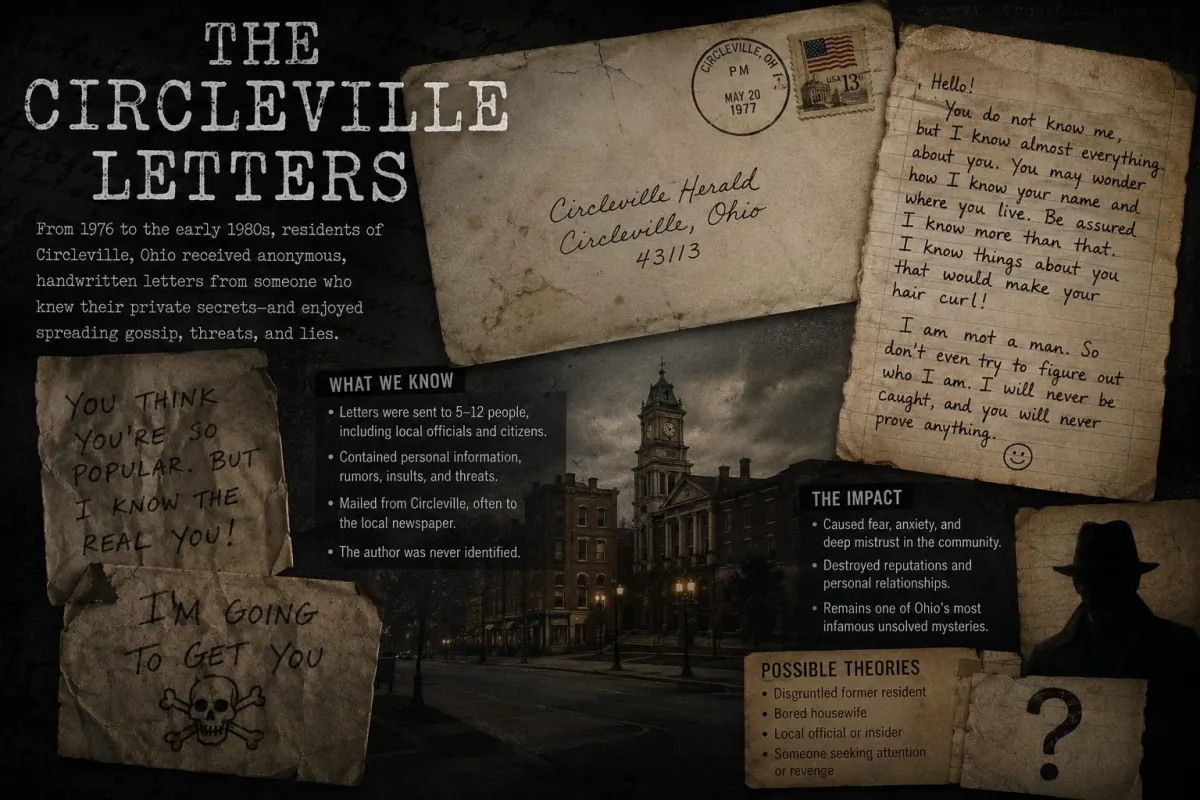
The Circleville Letters case is one of the most unsettling long-form anonymous harassment mysteries in modern American folklore because it unfolded not as a single crime but as a campaign. Beginning in the late 1970s in and around Circleville, Ohio, residents began receiving threatening, accusatory, and deeply personal letters from an unknown writer who appeared to possess intimate knowledge of private lives, local affairs, family tensions, and hidden relationships. The letters named names, demanded action, threatened exposure, and implied a level of surveillance that made the writer seem not merely malicious but omnipresent.
What turned the Circleville letters from local scandal into enduring mystery was the escalation. The campaign did not remain in the realm of poison-pen mail. It intersected with a fatal crash, public signs, a booby-trapped gun rig, a major criminal prosecution, and one of the strangest features in the whole case: letters apparently continued circulating even while the man convicted in connection with the trap was imprisoned under conditions that made outside letter-writing difficult or impossible according to those who later discussed the case.
The Circleville letters therefore occupy a rare position in American mystery culture. They are at once:
- a stalking case,
- a small-town blackmail campaign,
- a domestic and family implosion,
- a possible frame-up narrative,
- and a long-running authorship mystery.
The Setting: Circleville, Ohio
Circleville is a small Ohio town south of Columbus, the sort of place where social reputation, school politics, local relationships, and family connections can become tightly interwoven. In the lore of the case, this setting is essential. The writer’s power depended not only on mail, but on the social structure of a town where secrets travel fast, rumors matter, and public shame can become a weapon.
The letters repeatedly leveraged this environment. They were not random threats sent into a void. They targeted people in ways calibrated to the emotional architecture of a close-knit community:
- marriage,
- infidelity,
- school governance,
- family loyalties,
- and neighborhood observation.
This is one reason the case still feels unusually intimate. The writer did not attack from a distance; the writer wrote from inside the social fabric.
The Early Letters
The campaign is generally placed as beginning in 1976 or 1977. Soon the main target became Mary Gillispie (often also spelled “Gillispie” in reporting and records), a school-bus driver in Circleville. Mary began receiving anonymous letters accusing her of having an affair with Gordon Massie, the local superintendent. The letters were explicit, threatening, and coercive. They warned her to end the relationship and threatened public exposure if she did not.
These early letters are the nucleus of the entire case. From them flowed:
- the pressure on Mary,
- the pressure on her husband Ron,
- the widening circle of recipients,
- and the idea that the writer knew far too much.
A major feature of the letters was their certainty. The writer did not speak like a gossip relaying hearsay. The writer spoke like an observer issuing commands.
The Letters to Ron Gillispie
Mary’s husband, Ron Gillispie, also began receiving letters. These messages reportedly urged him to confront the alleged affair, and some versions explicitly encouraged violence against both Mary and Massie. The tone suggested that the writer was not only exposing scandal but trying to force a reckoning.
This is one of the most psychologically important parts of the case. The writer did not merely reveal. The writer pressed, manipulated, and cornered. Ron was not being informed. He was being pushed.
In the broader lore of Circleville, this transformed the writer from a gossip into an active destabilizer — someone trying to engineer outcomes.
Ron Gillispie’s Death
In August 1977, the case escalated dramatically. According to commonly circulated accounts, Ron received a disturbing phone call, became agitated, left home with a handgun, and drove off in his truck, apparently intending to confront whoever was behind the letters. Soon after, his truck crashed into a tree and he died. His firearm had been discharged once. The death was treated officially as an accident, but in the long afterlife of the case it became one of the core hinges of suspicion.
This event changed everything. After Ron’s death, the Circleville mystery was no longer just a letter campaign. It now included:
- a man driven into direct confrontation,
- a fatal crash,
- a fired gun,
- and no stable resolution regarding what exactly happened in the final sequence.
Within the lore, Ron’s death is one of the strongest reasons the case never settled into ordinary harassment history. A letter writer had entered physical consequence territory.
The Letters Continue After Ron’s Death
One of the most unsettling features of the Circleville case is that the letters did not stop after Ron died. They continued to target Mary, Massie, and others in the community. In many retellings, the continuation of the letters after such a major escalation gave the writer an even more uncanny aura. It suggested persistence, confidence, and perhaps a sense of immunity.
For believers in a larger hidden authorship pattern, this continuation carries enormous weight. A person capable of writing through scandal, death, police attention, and public fear does not feel like a casual grudge-holder. The writer begins to resemble an embedded force inside the town.
The Spread Beyond One Family
Over time, the Circleville letters expanded beyond Mary and Ron Gillispie. Other residents, elected officials, institutions, and newspapers reportedly received hostile or taunting correspondence. The writer’s knowledge seemed broad, and the targets widened enough to make the case feel like a general reign of psychological pressure over the town.
This broader spread matters because it prevents the case from being reduced to one domestic triangle. The writer appears to have had multiple motives or multiple grievances, or at least wished to create that impression. Circleville itself became the audience.
The 1983 Roadside Sign Incident
The most famous physical escalation of the case occurred in January 1983. Mary Gillispie, driving her school bus route, noticed a roadside sign containing an obscene message about her daughter and references to the alleged affair with Gordon Massie. She stopped to remove it. In connection with the sign she discovered a box attached nearby, and inside was a loaded handgun rigged as a booby trap. The device was designed so that interference with the setup could trigger the weapon.
This is the single most dramatic non-fatal event in the case. The writer had moved from letters and signs into engineered violence.
With the discovery of the gun trap, the Circleville mystery crossed from harassment into direct attempted lethality.
The Gun and the Break in the Case
The booby-trapped handgun gave investigators their first major physical clue. Authorities were able to trace the gun by serial number, and it was linked to Paul Freshour, who was Ron Gillispie’s brother-in-law and Mary’s former brother-in-law by marriage connection. This shifted the case decisively. A person now stood at the center of the mystery in a concrete way.
Freshour denied responsibility, arguing that the gun had been stolen. But the presence of the weapon in the trap moved suspicion out of abstraction and into family structure. The Circleville letters, already intimate, now became explicitly entangled with divorce, inheritance, resentment, and kinship conflict.
Paul Freshour
Paul Freshour is the most important named suspect in the case’s public history. He became central not only because the gun was traced to him, but because later proceedings also involved claims that his handwriting matched the letters. His estranged wife Karen Sue reportedly told police that he had written the letters, and she claimed to have found incriminating material around their home. Freshour denied writing them and maintained that he had been framed or falsely implicated.
In the public mythology of Circleville, Freshour is never just a defendant. He is the key to the case’s unresolved structure. Everything turns on him:
- if he was the writer, the mystery narrows,
- if he was not, the mystery becomes more layered,
- and if he was only part of it, the case opens outward into multiple hands and motives.
The Trial and Conviction
In 1984, Paul Freshour was convicted of attempted murder in connection with the booby trap and sentenced to prison. At trial, evidence included the traced gun and handwriting testimony pointing toward similarities between his writing and the anonymous letters. The conviction fixed Freshour publicly to the case in a way that has never fully loosened.
But the conviction did not close the broader mystery. Instead, it produced the central paradox that keeps the case alive.
The Prison-Letter Paradox
After Freshour was imprisoned, letters reportedly continued to circulate — and not merely in vague rumor, but in ways discussed by journalists, later investigators, and even television treatments. Commentators quoted in later coverage have stressed that prison conditions, searches, monitoring, and restrictions on writing materials made it extremely difficult to imagine Freshour maintaining the same campaign from inside. Even more strikingly, Freshour himself reportedly received a letter while incarcerated, taunting him and referring to having “set him up.”
This is the central engine of the Circleville legend.
The prison-letter problem generates several possibilities within the lore:
- Freshour was not the writer at all.
- Freshour was one writer, but not the only writer.
- Someone else continued or imitated the campaign after his conviction.
- The true writer used Freshour’s prosecution as camouflage.
Any one of these keeps the Circleville mystery open.
Karen Sue and the Secondary-Suspect Layer
Because Karen Sue Freshour had accused Paul and because some later commentary suggested she or people close to her might also fit parts of the story, the case developed a strong secondary-suspect layer. Freshour’s own defense logic asked who had motive to see him convicted, especially in the context of a difficult divorce and financial consequences. Later television and print treatments continued to revisit this possibility.
This dimension is important because it pulls the case away from a simple one-writer model. The Circleville letters, in public memory, became a network of accusation:
- Mary and Massie,
- Ron and the fatal confrontation,
- Paul and the trap,
- Karen Sue and the accusation,
- the community and the widening target field.
The more these relationships cross, the less clean the authorship question becomes.
The Letters to Journalists and Media
As the case attracted outside attention, journalists and media figures also reportedly received letters. This includes later authors and investigators who wrote about the case. That expansion into meta-commentary gave the writer a particularly unsettling quality: the writer was not only inside the story, but aware of the story as it spread and willing to address those trying to examine it.
This transformed the letters from a historical campaign into something closer to an adaptive intelligence. Anyone who looked too closely could become another target.
Unsolved Mysteries and National Attention
When Unsolved Mysteries examined the case in the early 1990s, the Circleville Letters moved from regional crime lore into national mystery culture. According to widely repeated accounts, the show itself received a threatening or taunting letter. This was a major turning point in the mythology because it extended the writer’s perceived reach beyond local geography and into the media sphere.
Once a national television show becomes part of the case, the writer’s identity feels larger, more durable, and harder to collapse into one exhausted local grudge.
The Tone of the Letters
One of the reasons the Circleville case remained so disturbing is the tone of the correspondence. The letters often conveyed:
- intimate knowledge,
- authority,
- certainty,
- resentment,
- voyeurism,
- and moralistic control.
They did not simply say “I know something.” They often said, in effect, “I have been watching,” “you have been warned,” and “I can expose you whenever I choose.” This surveillance tone is one of the strongest emotional features of the whole mystery. It creates the sense that the writer was always already nearby.
Surveillance and Omniscience
A recurring feature in the Circleville lore is that the writer seemed to know details too quickly, too specifically, or too broadly. Whether these were truly hidden facts, inferred gossip, or locally circulating secrets, the letters created a psychological field of omniscience. Residents could not easily tell where knowledge ended and bluff began. That uncertainty itself became part of the weapon.
In a small town, perceived omniscience is almost as powerful as real omniscience. If everyone begins wondering who is watching, the writer has already won part of the battle.
Why the Case Felt Bigger Than a Single Author
Even for people who believe Paul Freshour played a role, the case often feels structurally larger than one hand and one motive. Several features push it in that direction:
- the spread of recipients,
- the longevity of the campaign,
- the prison continuation problem,
- the intimate access to multiple networks,
- and the strategic use of signs, calls, letters, and trap mechanics.
This does not require a large organized conspiracy in every version. But it does encourage the view that the case may have had more than one operational layer.
The End of the Campaign
A common element in later summaries is that the letters largely stopped after Freshour’s 1994 release from prison. This timing is one of the most frequently noted features in the case because it links the visible letter campaign to his imprisonment cycle while still leaving unresolved what happened during the years he was inside.
This creates one final structural tension:
- the campaign continuing during prison complicates a one-man theory,
- but the campaign ending after release keeps Freshour tied to the center of the event field.
That ambiguity is one of the reasons the case remains difficult to collapse into a single narrative.
The Case File as Community Memory
The Circleville letters now live partly in crime reporting and partly in folklore. Pickaway County’s real institutions, physical evidence, and court history remain central. But so do photocopied letters, family memory, television retellings, online archives, and the way the town itself became inseparable from the writer’s presence.
The mystery is therefore both documentary and atmospheric. It survives not only in files, but in a social feeling: someone in Circleville knew too much and never fully stopped watching.
Main Interpretive Models
1. The Single-Writer Model
One person authored most or all of the letters and the physical escalations, with Freshour as the central operational figure.
2. The Partial-Freshour Model
Freshour was involved in at least one major violent episode, but the full letter campaign extended beyond him or was continued by someone else.
3. The Frame-Up Model
Freshour was set up through the traced gun and related evidence while the true writer remained active in the background.
4. The Multi-Actor Model
Different people contributed to the letter campaign at different times, using the existing climate of fear and accusation to pursue separate motives.
5. The Community-Surveillance Model
The writer’s real power came from intimate social knowledge and a small-town environment where observation, gossip, and coercion could imitate omniscience.
Conclusion
The Circleville Letters case remains one of the most layered anonymous-writer mysteries in American criminal lore because it combines authorship uncertainty, domestic scandal, family fracture, direct violence, and a long-running correspondence campaign that never fit cleanly into a single solved shape.
The letters moved from exposure to intimidation, from intimidation to death-shadow, from death-shadow to booby trap, and from prosecution to the prison paradox. In that sequence, the case became more than a letter mystery. It became a question about who can control a town by controlling what people think is known about them.