
Overview
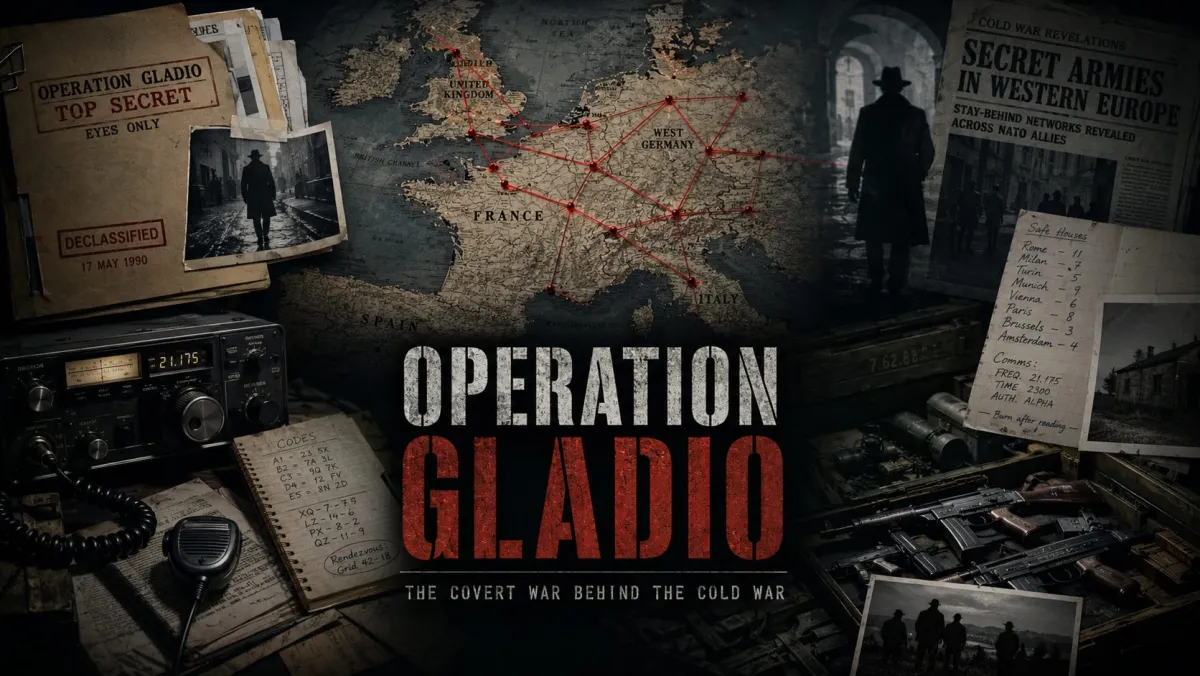
Operation Gladio is the codename for a clandestine NATO-coordinated program that maintained secret "stay-behind" paramilitary networks across Western Europe during the Cold War. Originally conceived to provide an organized resistance capability in the event of a Soviet invasion or communist takeover, these networks operated largely outside normal democratic oversight for decades. The program became a major political scandal in 1990 when Italian Prime Minister Giulio Andreotti publicly acknowledged its existence to parliament, triggering investigations across Europe and a resolution of concern from the European Parliament.
Background
In the years immediately following World War II, Western governments and the newly formed NATO alliance feared that Soviet-backed communist parties — which held significant electoral support in countries like Italy and France — might either win power through elections or seize it by force. To prepare for these scenarios, the CIA, Britain's MI6, and national intelligence services collaborated with NATO to establish covert "stay-behind" networks: caches of weapons, explosives, and communications equipment buried across Western Europe, along with trained networks of agents who would remain in place if their countries fell under enemy occupation.
The concept drew on wartime resistance experience. Former resistance fighters, military officers, and in some documented cases individuals with extreme right-wing backgrounds were recruited as the human component of these networks. Their official purpose was to conduct sabotage, intelligence gathering, and guerrilla warfare behind enemy lines in a post-invasion scenario.
The Stay-Behind Networks
Italy's network, which operated under the Gladio codename, was among the most extensively documented. It was administered through a classified branch of the Italian military intelligence service (SIFAR, later SID and SISMI) in coordination with CIA station Rome. Similar networks existed in virtually every NATO member state and in neutral countries that were informally aligned with the West, including Sweden, Switzerland, Austria, and Belgium. Each network operated under its own national codename — "SDRA8" in Belgium, "P26" in Switzerland, "Absalon" in Denmark, and others.
The networks typically maintained buried arms caches stocked with weapons, communications equipment, and forged documents. Personnel were trained in sabotage techniques and clandestine communications. Funding and supply often came through classified CIA channels, with national governments maintaining varying degrees of formal awareness of operations. In some countries, elected officials and cabinet ministers were kept entirely uninformed.
Revelation and Investigations
The existence of Gladio was publicly confirmed in Italy on October 24, 1990, when Prime Minister Andreotti, responding to a parliamentary inquiry, revealed that a secret NATO stay-behind network had operated in Italy since the late 1940s. The admission prompted immediate political uproar and a formal investigation by a parliamentary commission on terrorism (the Commissione Stragi, or "Massacre Commission"), which had been examining unsolved political violence from Italy's "Years of Lead" in the 1970s and 1980s.
Shortly after Andreotti's disclosure, the European Parliament passed a resolution in November 1990 condemning the secret networks, demanding full investigations by member states, and expressing concern that the networks had in some countries operated outside any democratic supervision. The resolution called on national governments to clarify the extent of these programs.
Journalist and investigator Daniele Ganser examined the Gladio networks in detail in his 2004 book NATO's Secret Armies, drawing on parliamentary records, declassified documents, and interviews to chronicle how each national network was organized. The book became a key secondary reference, though some of its more speculative conclusions regarding operational involvement in terrorism remain contested among historians.
Allegations and Controversy
The most contentious and disputed aspect of Gladio involves allegations that elements of these stay-behind networks were implicated in acts of domestic terrorism as part of a "strategy of tension" — a concept holding that covert actors staged or facilitated political violence to destabilize public confidence, radicalize opinion, and prevent left-wing parties from gaining power.
In Italy, parliamentary and judicial investigations examined whether individuals connected to Gladio or its associated networks had links to far-right terrorist attacks during the Years of Lead, including the 1980 Bologna railway station bombing, which killed 85 people. Italian courts convicted neo-fascist militants for the Bologna attack, and some investigations pointed to possible collusion involving elements of Italian intelligence. However, establishing direct operational links between the formal Gladio network and specific terrorist acts has proven difficult, and the full chain of responsibility remains disputed in Italian historiography.
In Belgium, a parliamentary inquiry into the Brabant massacres of the 1980s — a series of violent supermarket robberies that killed more than 28 people — explored possible connections to the local stay-behind network. The inquiry documented organizational failures and found evidence of extreme-right infiltration of security services, but did not conclusively establish that the stay-behind network directed the attacks.
Some researchers and investigative journalists allege that CIA backing for these networks included deliberate support for destabilization operations beyond their defensive mandate. These claims are based largely on circumstantial evidence, the testimony of former operatives of variable credibility, and selective declassified documents. Official NATO has never formally acknowledged a strategy of tension, and the evidentiary basis for the broadest versions of these allegations remains contested.
Legacy
The Gladio revelations had lasting consequences for civil-military relations and intelligence oversight in Europe. Several countries — notably Italy, Belgium, and Switzerland — convened formal parliamentary inquiries. Switzerland's investigation led to significant reforms in its intelligence arrangements. Italy's Massacre Commission produced extensive reports without, in most observers' assessments, fully resolving the most sensitive questions about state complicity in terrorism.
The episode accelerated debates about democratic accountability for intelligence services and covert operations during the Cold War, debates that have continued as further documents have been declassified in subsequent decades. Gladio also became a reference point in broader discussions about state secrecy, the limits of Cold War anti-communist strategy, and the tension between national security imperatives and democratic governance.
Today, "Operation Gladio" is frequently cited in academic and journalistic work on Cold War covert operations, and it remains a significant case study in intelligence history — one where the core facts of the program's existence are firmly established, while questions about the full scope of its activities continue to attract scholarly and investigative attention.