
Overview
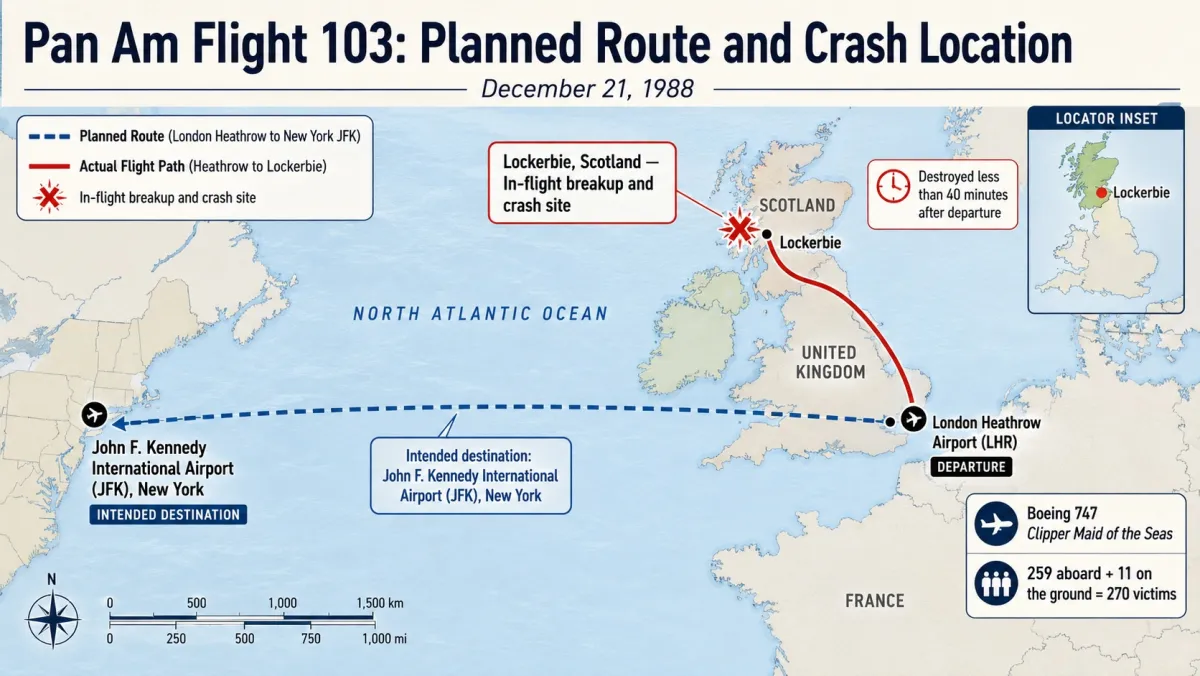
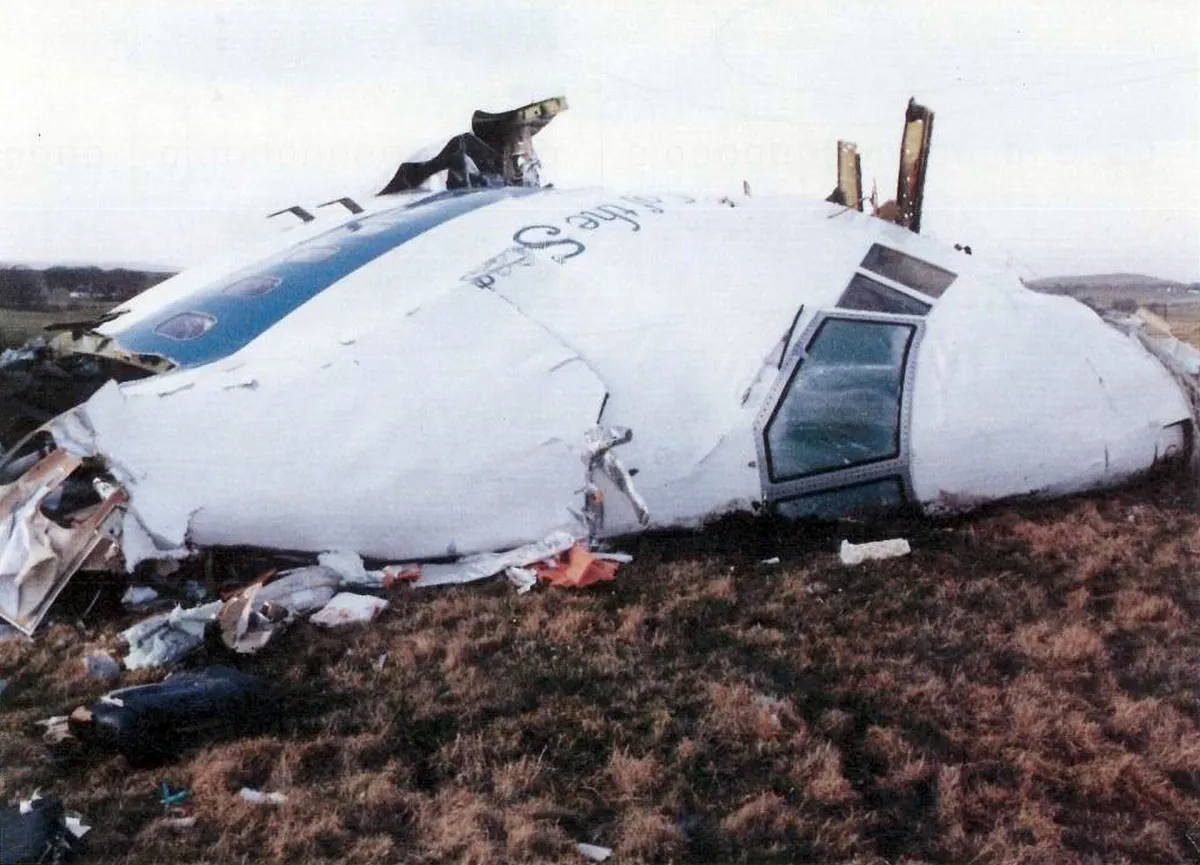
Pan Am Flight 103 was destroyed by a bomb over Lockerbie, Scotland, on December 21, 1988. The Boeing 747, en route from London Heathrow to New York's John F. Kennedy International Airport, broke apart at altitude and crashed into the town of Lockerbie and the surrounding countryside, killing all 259 people on board and 11 residents on the ground — 270 victims in total. It remains the deadliest terrorist attack ever committed on British soil and the deadliest aviation attack in history at the time. The official investigation ultimately attributed the bombing to Libyan intelligence, and a Scottish court convicted Libyan agent Abdelbaset al-Megrahi in 2001. Doubts about that verdict, however, have persisted for decades among bereaved families, legal scholars, and former investigators — and a prominent strand of alternative analysis holds that the true perpetrators had ties to Iran, Syria, or a combination of state and intelligence interests that Western governments were motivated to obscure.
Wikimedia Commons — Air Accident Investigation Branch, OGL 2

Background
On July 3, 1988 — roughly six months before the Lockerbie bombing — the U.S. Navy guided-missile cruiser USS Vincennes shot down Iran Air Flight 655 over the Persian Gulf, killing all 290 people on board. The Reagan administration maintained the action was taken in self-defense after the aircraft was misidentified as a hostile military jet. Iran condemned the incident as a war crime and vowed retaliation. This context is central to the most widely discussed alternative theory about who was responsible for bombing Flight 103.
Forensic investigators established that the explosive device was concealed inside a Toshiba radio-cassette player packed into a Samsonite suitcase. The bomb contained Semtex plastic explosive and was detonated by a timer. Evidence recovered from the crash site eventually led investigators to a fragment of circuit board they identified as part of a timing device, a type allegedly linked to Libyan intelligence procurement.
The Investigation and Conviction
Scottish and American investigators worked jointly on what became one of the longest and most complex criminal investigations in history. In 1991, the United States and the United Kingdom indicted two Libyan intelligence officers: Abdelbaset al-Megrahi and Al Amin Khalifa Fhimah. Libya refused to extradite the two men for nearly a decade. After prolonged diplomatic negotiations — during which United Nations sanctions were imposed on Libya — Libyan leader Muammar Gaddafi agreed to hand the suspects over to a neutral Scottish court convened in the Netherlands under Scottish law, at Camp Zeist.
In January 2001, the three-judge panel acquitted Fhimah but convicted al-Megrahi of murder, sentencing him to life in prison. The court found that al-Megrahi, acting as a Libyan intelligence officer, had introduced the bomb-laden suitcase into the baggage system at Malta's Luqa Airport, from where it was transferred — unaccompanied — onto connecting flights and eventually onto Flight 103. In 2003, Libya formally accepted responsibility for the bombing and agreed to pay compensation to victims' families, though Libyan officials later disputed whether this constituted an admission of guilt. Al-Megrahi was released on compassionate grounds by Scottish authorities in 2009 after being diagnosed with terminal prostate cancer; he died in 2012 in Tripoli.
Alternative Theories and Disputed Claims
The Iran-Syria-PFLP-GC Theory
The most extensively argued alternative theory attributes the bombing not to Libya but to a network involving Iran and Syria. According to this account, Iran commissioned the attack as revenge for the USS Vincennes shootdown of Iran Air Flight 655, and the operation was subcontracted to the Popular Front for the Liberation of Palestine — General Command (PFLP-GC), a Damascus-based Palestinian militant faction led by Ahmed Jibril.
Proponents of this theory point to the fact that, in October 1988 — just two months before the Lockerbie bombing — West German police conducted a raid known as Operation Autumn Leaves and arrested several PFLP-GC members in Germany. Among the items recovered, according to investigators and journalists who have written on the case, were bomb components including Toshiba radio-cassette players rigged with Semtex — strikingly similar to the device used to destroy Flight 103. Critics of the official verdict allege that the West German and British intelligence services were aware of the PFLP-GC plot in advance and that this prior warning was not acted upon, or was deliberately suppressed.
Former Scottish police officers and at least one member of the original investigation team have publicly stated their belief that the PFLP-GC, rather than Libyan intelligence, was responsible. Former detective chief inspector Tony Gauci, who was a key prosecution witness in the Camp Zeist trial, was later the subject of allegations that his identification of al-Megrahi had been unreliable and that financial inducements had been offered to him and his brother by American authorities, allegations that the Scottish Criminal Cases Review Commission (SCCRC) found gave grounds for a miscarriage of justice referral.
The CIA Drug-Smuggling and "Protected Suitcase" Allegation
A separate but sometimes overlapping alternative claim — often called the "CIA-DEA drug war gone wrong" or "protected suitcase" theory — alleges that a covert narcotics or intelligence operation had created a protected baggage channel on transatlantic Pan Am flights. According to this account, a DEA or CIA-linked operation targeting a Lebanese drug network used the luggage system as part of a controlled, low-scrutiny corridor, and the bomb was introduced into a suitcase that bypassed normal security because handlers or security personnel believed it was part of this sanctioned arrangement. The theory's defining feature is the claim that the vulnerability was created by the state's own hidden operations rather than by terrorists simply defeating airport security.
Unlike theories that reject the official evidence outright, this one typically accepts that covert networks, Middle Eastern groups, and Western agencies overlapped in the background — and situates the bombing within the late-Cold War world of Iran-Contra, Lebanon hostage negotiations, and off-the-books intelligence logistics. It was amplified by writers such as Lester Coleman, a former intelligence operative who alleged a compromised DEA channel, and by the broader family of "protected suitcase" allegations.
These allegations have never been substantiated in court. They are treated by mainstream investigators as unproven and by some as unfalsifiable, and later official reviews rejected or minimized them. Nonetheless, they have been raised by a small number of bereaved family members and investigative journalists and remain a durable part of the contested landscape surrounding the case — in part because they tie the mass casualties to covert infrastructure rather than to ordinary terrorist penetration.
Doubts About the Conviction
The SCCRC completed a lengthy review in 2007 and concluded that al-Megrahi's conviction may have resulted in a miscarriage of justice on several grounds, including concerns about the reliability of witness identification and the non-disclosure of evidence to the defense. Al-Megrahi himself dropped a pending second appeal at the time of his compassionate release, a decision that drew criticism from some campaigners who believed an appeal might have overturned the verdict.
The timer fragment — officially designated PT/35(b) — was central to the prosecution case, linking the bomb to a batch of timers allegedly supplied to Libyan intelligence. Defense lawyers and independent analysts have argued that questions remain about the fragment's chain of custody and whether it could have been introduced into evidence after the fact. The Swiss manufacturer of the timers, MEBO, also attracted scrutiny; its owner later claimed publicly that the fragment had been manipulated, though those claims remain disputed.
Legacy
The Lockerbie bombing fundamentally reshaped aviation security worldwide, accelerating the introduction of matched baggage procedures — requiring that checked luggage travel on the same aircraft as its owner — and hardening protocols around unaccompanied bags. Diplomatically, it led to prolonged sanctions against Libya and ultimately contributed to Gaddafi's decision to abandon his weapons of mass destruction program in 2003, which he linked to the process of normalizing relations with the West.
For the families of the 270 victims, closure has remained elusive. In 2020, U.S. and Scottish prosecutors announced charges against a second Libyan suspect, Abu Agila Mohammad Masud, described as the bomb-maker; Scottish authorities sought his extradition. Whether that case will resolve the enduring questions about the full chain of responsibility — or only deepen them — remains to be seen. The Lockerbie case continues to be studied as a case study in the intersection of geopolitics, criminal justice, and the limits of official narratives.