
A filing error is why any of this is known
In January 1973 the Director of Central Intelligence, Richard Helms, ordered the MKULTRA records destroyed. They were destroyed. When two Senate committees went looking two years later, no one could tell them what had been done — not Helms, who had ordered the destruction, not the chemist who had run the programme, not any of his staff.
What survived survived by accident. Seven boxes had been filed in a financial records building rather than with the operational files, and so were not where the order reached. Admiral Stansfield Turner, by then Director, reported their discovery to the Senate in a letter dated 15 July 1977.
That accident shapes everything that can be said about MKULTRA, and it is the first thing to understand about it. The material that came back is the accounting. Project proposals, audit reports, financial statements from the cut-out foundations used to hide the Agency's sponsorship — the paperwork that moved the money. In Turner's own description, it does not include status reports or documents relating to progress in the various subprojects. The invoices outlived the findings.
So the programme is not in any doubt. Its results are, permanently, and for a reason that is itself part of the record.
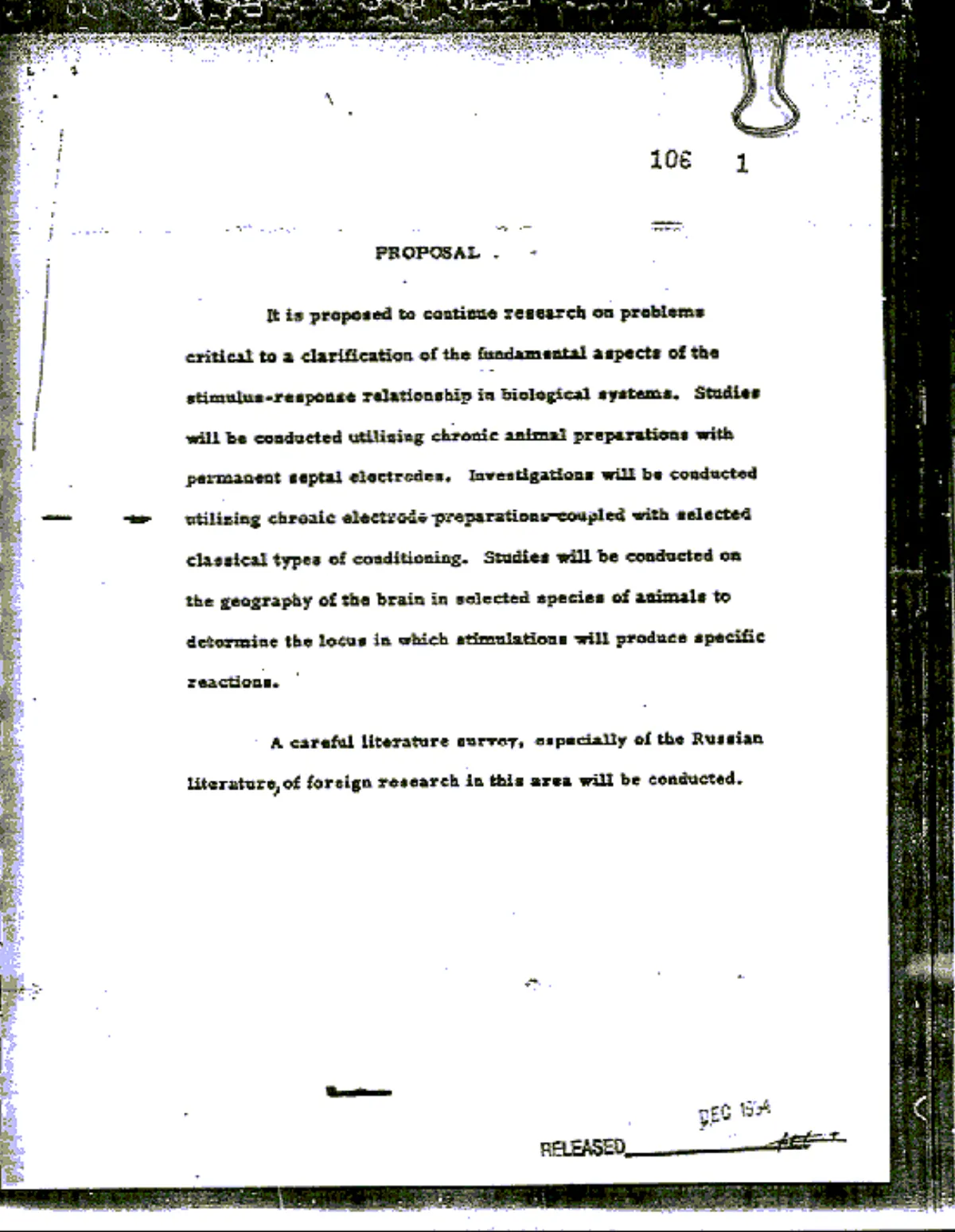
Wikimedia Commons — Central Intelligence Agency, Public domain

What was authorised
Allen Dulles approved MKULTRA on 13 April 1953. It was an umbrella: not one experiment but a funding mechanism under which sensitive subprojects could be run at arm's length. Sidney Gottlieb, a chemist in the Technical Services Staff, ran it.
It followed two earlier efforts, BLUEBIRD in 1950 and ARTICHOKE in 1951, and it came out of a particular Cold War fright. American prisoners in Korea had made confessions their government did not believe, and the conclusion drawn was that the other side had learned something about the control of a human mind that the United States had not. Much of what the Agency then spent a decade doing is best understood as an attempt to close a gap that may never have existed.
The duration is routinely overstated. Turner told the Senate the project ran from 1953 to 1964 — eleven years, not the two decades often cited. Work continued afterwards under the cryptonym MKSEARCH until 1973, which is where the longer figure comes from.
The size of it, in the only terms that survived
Because the accounting is what came back, the scale of MKULTRA is known with unusual precision while its substance is not.
The recovered material covers 149 subprojects, with a further 33 previously funded under MKULTRA that had nothing to do with behaviour or drugs. In it the Agency identified 185 non-government researchers and assistants, working at 80 institutions: 44 colleges and universities, 15 research foundations or chemical and pharmaceutical companies, 12 hospitals and clinics beyond those attached to universities, and 3 prisons.
A separate figure comes from the Agency's own 1963 Inspector General report, which recorded that the Technical Service Division had initiated 144 subprojects relating to the control of human behaviour between 1953 and 1963. The two numbers count different things and are often confused for each other.
Most of those institutions did not know whose money they were taking. That was the purpose of the cut-outs, and it is why the 1977 disclosure of the names mattered: a great many researchers learned from a newspaper that their funding had come from the CIA.
What was done
The best-documented element is the one requiring least apparatus. LSD was administered to people who had not agreed to take it and in many cases did not know they had.
In Operation Midnight Climax the Agency ran safe houses in San Francisco and New York where men were brought by prostitutes on the Agency's payroll, dosed, and watched through one-way glass. Senator Edward Kennedy summarised the 1975 testimony on the record: tests on unwitting citizens "at all social levels, high and low, native Americans and foreign," and among the subjects, heroin addicts induced to take LSD with heroin as the reward.
Under Subproject 68, the Agency funded Donald Ewen Cameron at the Allan Memorial Institute in Montreal. Cameron's patients had come to him for conditions as ordinary as anxiety and postpartum depression. What he practised on them he called psychic driving and depatterning: repeated electroconvulsive shock at many times the conventional dose, drug-induced sleep for weeks, and taped messages played back on a loop for days. Some never recovered the memories it removed.
Other subprojects covered hypnosis, sensory deprivation, and a pharmacopoeia well beyond LSD — mescaline, psilocybin, scopolamine, barbiturates.
The 1963 Inspector General report is the closest thing to an internal verdict. Its recommendations led to the unwitting testing of drugs on American citizens being discontinued, which tells you what the Agency's own inspectors made of it.
Frank Olson
Frank Olson was a civilian Army scientist at Fort Detrick. In November 1953 he attended a meeting of researchers convened by the CIA and was given LSD without being told. About a week later he went through the window of a tenth-floor room at the Statler Hotel in New York and died in the street.
It was recorded as a suicide. The family were told nothing of the LSD for twenty-two years, until the Rockefeller Commission's report in 1975 made the circumstances public — which is also how the cryptonym MKULTRA first reached the newspapers. President Ford apologised to them at the White House. In 1976, having agreed not to sue, they received $750,000.
In 1994 Olson's body was exhumed and examined by a forensic team at George Washington University, which reported injuries it considered inconsistent with a fall through glass. A later suit brought by his sons was dismissed. The death remains officially what it was in 1953.
3 August 1977
The seven boxes produced a joint hearing before the Senate Select Committee on Intelligence and the Subcommittee on Health and Scientific Research, chaired by Daniel Inouye with Kennedy alongside him.
The hearing is worth reading rather than summarising, but one exchange carries the whole affair. Kennedy observed that the records had been destroyed, that no single individual could be found who remembered the details, and that both committees had been told the record was as complete as it was ever going to be. Then, he said, one individual, through a Freedom of Information request, accomplished what two United States Senate committees could not.
That individual was the journalist John Marks, whose request surfaced the misfiled boxes and whose book on the subject followed in 1979.
Gottlieb, who had run the programme, testified. The Agency's position, in a senator's summary of it, was that the man responsible for the whole programme had a fuzzy memory of the whole area.
Montreal, in court
Cameron's former patients sued. Orlikow v. United States was brought in the District of Columbia by nine Canadian plaintiffs, among them Velma Orlikow, the wife of a member of the Canadian Parliament. The United States settled in 1988 for $750,000 between them. The Canadian government later paid compensation of its own.
What the record will carry
MKULTRA is the case most often produced to show that a government will experiment on its own citizens without telling them, and for that it is sufficient: it is declassified, congressionally documented, and settled in court twice.
It is also produced to show something else — that the techniques worked, and that what was learned is still in use. The surviving record cannot carry that, and the reason it cannot is the point. The research findings were destroyed in January 1973 on the order of the Director of Central Intelligence. What came back from the financial records building was the money: who was paid, through which foundation, at which university. Whether any of it achieved anything is a question the Agency made permanently unanswerable, and then could not answer when asked under oath.
Both of those are in the record. Only one of them is usually quoted.