
Overview
President John F. Kennedy was assassinated on November 22, 1963, while riding in a presidential motorcade through Dealey Plaza in Dallas, Texas. The Warren Commission, established by President Lyndon B. Johnson, concluded in September 1964 that Lee Harvey Oswald acted alone in firing three shots from the sixth floor of the Texas School Book Depository. However, polls consistently show that a majority of Americans believe there was a broader conspiracy. The 1979 House Select Committee on Assassinations (HSCA) concluded that Kennedy was "probably assassinated as a result of a conspiracy," though it could not identify the other conspirators.
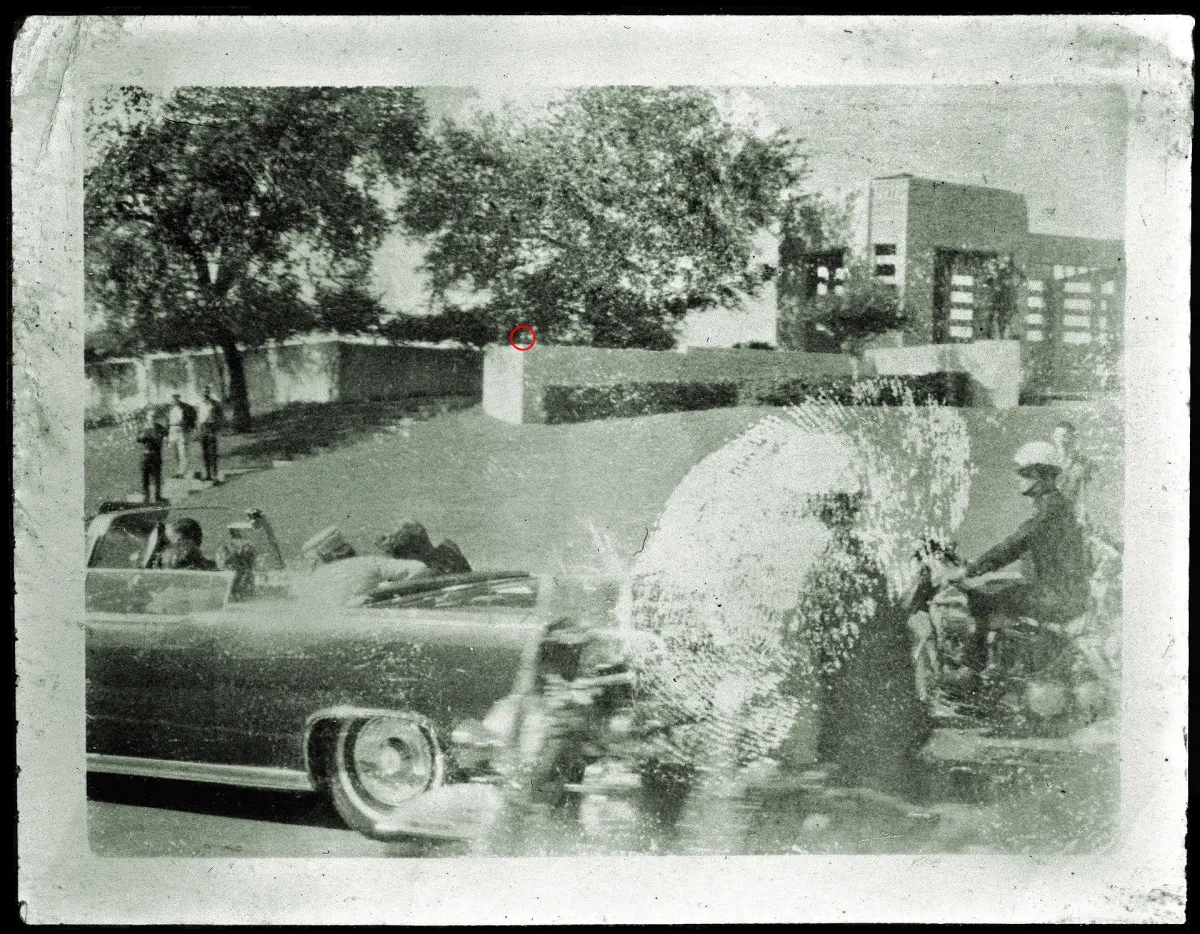
Wikimedia Commons — Mary Ann Moorman, Public domain

The Official Account
According to the Warren Commission Report (published September 1964), Lee Harvey Oswald fired three shots from a 6.5mm Mannlicher-Carcano rifle from the southeast corner window of the sixth floor of the Texas School Book Depository. The first shot missed, the second struck Kennedy in the upper back and exited through his throat (also wounding Governor John Connally — the "single bullet theory"), and the third struck Kennedy in the head, killing him. Oswald was arrested approximately 80 minutes later in the Texas Theatre after allegedly killing Dallas police officer J.D. Tippit. On November 24, Oswald was shot and killed by nightclub owner Jack Ruby during a jail transfer broadcast on live television.
Major Conspiracy Theories
The Grassy Knoll / Multiple Shooters
Numerous eyewitnesses in Dealey Plaza reported hearing shots from the area of a grassy knoll to the right front of the presidential limousine. Witness testimony, including that of railroad workers on the overpass, indicated smoke and the sound of gunfire from that direction. The Zapruder film, an 8mm home movie capturing the assassination, shows Kennedy's head moving backward and to the left upon the fatal impact — which some interpret as evidence of a shot from the front. The HSCA's acoustical analysis of a Dallas Police Department dictabelt recording initially suggested a 95% probability of a fourth shot from the grassy knoll, though this finding was later disputed by the National Academy of Sciences.
CIA Involvement
Theories of CIA involvement cite Kennedy's strained relationship with the agency following the Bay of Pigs invasion (April 1961) and his reported desire to "splinter the CIA into a thousand pieces." Key evidence includes: CIA officer E. Howard Hunt's deathbed confession (2007) alleging knowledge of a conspiracy involving CIA agents; the agency's documented contacts with anti-Castro Cuban groups that had motive to target Kennedy; and allegations that Oswald had connections to intelligence operations, including his defection to the Soviet Union and return — unusual for a former Marine — without apparent consequence.
Mafia Connection
The Mafia theory centers on organized crime figures who felt betrayed by the Kennedy administration. Despite alleged mob support for JFK's 1960 election campaign (particularly through Sam Giancana's influence in Chicago), Attorney General Robert Kennedy aggressively pursued organized crime. Key figures cited include Carlos Marcello (New Orleans), Santos Trafficante (Tampa), and Jimmy Hoffa (Teamsters). Jack Ruby's connections to organized crime figures add weight to this theory, as his killing of Oswald eliminated the only person who could have revealed co-conspirators.
LBJ Conspiracy
Some researchers allege that Vice President Lyndon B. Johnson was involved in or had foreknowledge of the assassination. Proponents cite Johnson's political ambitions, his facing potential criminal investigations before becoming president, and statements by his mistress Madeleine Duncan Brown claiming Johnson told her the night before the assassination that "those Kennedys will never embarrass me again."
Key Evidence and Disputes
- The "Magic Bullet" (CE 399): Found on a stretcher at Parkland Memorial Hospital in nearly pristine condition, this bullet allegedly caused seven wounds in two men. Critics argue this trajectory is physically impossible, while defenders have produced computer simulations and wound ballistics tests supporting the single-bullet theory.
- Autopsy controversies: The autopsy was performed at Bethesda Naval Hospital rather than in Dallas as required by Texas law. Discrepancies between the observations of Parkland Hospital doctors (who reported an entrance wound in the throat and a large exit wound in the rear of the skull) and the official autopsy findings fuel ongoing debate.
- Oswald in Mexico City: Declassified documents reveal CIA surveillance of Oswald during a visit to the Soviet and Cuban embassies in Mexico City weeks before the assassination, raising questions about what intelligence agencies knew.
- Classified documents: The JFK Records Act of 1992 mandated the release of all assassination-related records by October 2017. While most have been released, thousands of documents remain partially or fully redacted, fueling ongoing suspicion.
Cultural Impact
The JFK assassination has generated more books, films, and investigations than any other event in modern American history. Oliver Stone's 1991 film JFK was instrumental in prompting the JFK Records Act. The event is often cited as a turning point in American public trust in government institutions.