
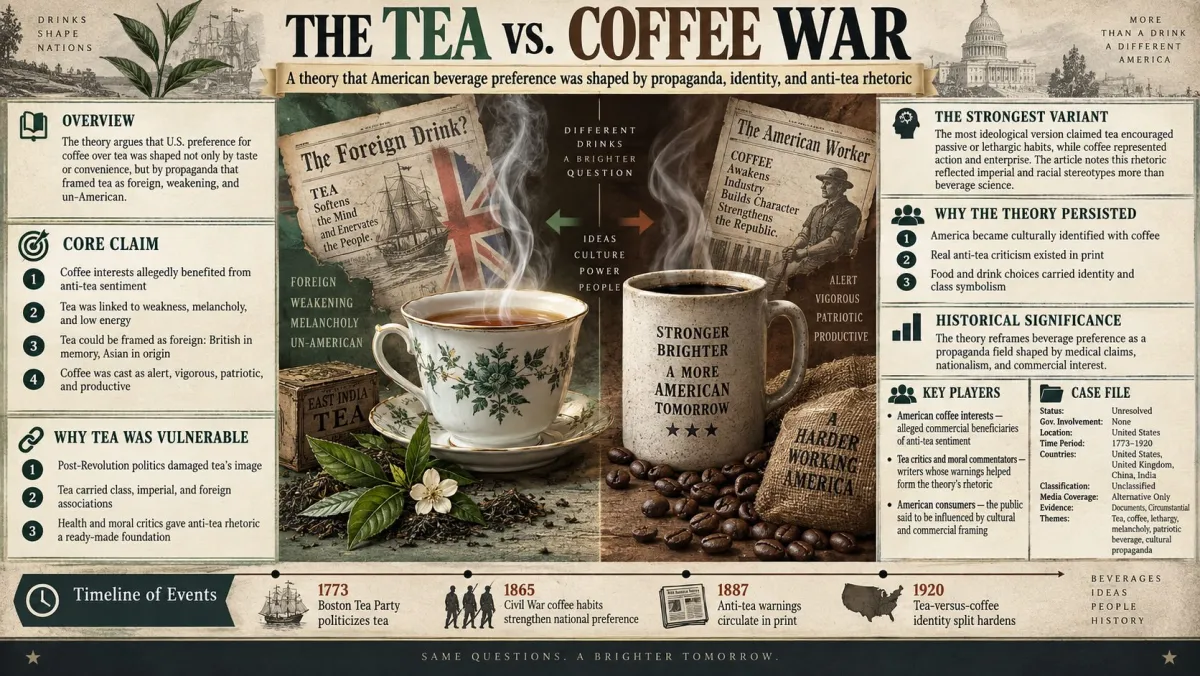
Overview
The Tea vs. Coffee War theory argues that beverage preference in the United States was not shaped only by taste, custom, or market convenience. It was shaped by active propaganda. Under this interpretation, coffee interests helped spread negative ideas about tea as foreign, weakening, overly feminine, or socially passive.
The most charged version claimed that tea produced a kind of civilized but enervated languor associated in racialized rhetoric with Asia or the British world, while coffee represented alertness, republican vigor, and productive American energy.
Historical Background
Tea was politically damaged in British North America by the revolutionary struggle, and coffee gained symbolic strength in the United States afterward. Over the nineteenth century, coffee consumption expanded further, especially with military and frontier culture. Tea, meanwhile, remained common but often carried different class and cultural associations.
At the same time, tea also attracted health criticism. Various writers and critics blamed it for weakness, melancholy, low spirits, or lost productivity. These claims were real and circulated well before the twentieth century.
Why Tea Became Vulnerable
Tea was vulnerable because it could be framed as foreign twice over: British in political memory and Asian in origin. That made it easier to link tea with dependency, softness, or passive habits in nationalist or racialized discourse. Coffee, by contrast, could be represented as rougher, stronger, and better suited to modern work or republican independence.
The theory argues that these contrasts were not just cultural drift. They were cultivated.
Melancholy, Weakness, and Lethargy
Historical critiques of tea often used medical language, blaming excessive tea drinking for weakness, melancholy, low spirits, or wasted energy. These charges did not need a formal coffee lobby in order to circulate, but conspiracy theory supplies one. Coffee interests, under this reading, amplified such warnings because they stood to gain from tea’s loss of prestige.
This is the theory’s key move: scattered criticism becomes coordinated commercial propaganda.
The “Asian-Style Lethargy” Variant
The strongest and most ideologically loaded version racialized tea consumption. Tea was said to produce a passive, contemplative, or weakened condition associated with stereotypes about Asia. Coffee, in contrast, supposedly sharpened action and enterprise. This rhetoric reflected older imperial and racial thought more than beverage science.
The theory claims coffee promoters weaponized those stereotypes to turn American consumers against tea by making tea feel un-American in body and spirit.
Why the Theory Persisted
The theory persisted because the United States really did become more strongly associated with coffee than tea, and because anti-tea rhetoric really existed in print and public health criticism. These facts made it possible to imagine not only cultural preference but strategic displacement.
It also persisted because food and drink choices often carry more identity symbolism than consumers consciously recognize. Coffee and tea both came to stand for lifestyles, classes, and temperaments larger than themselves.
Historical Significance
The Tea vs. Coffee War is significant because it reframes beverage preference as a propaganda field in which medical claims, national identity, and racial stereotypes were used to influence appetite and cultural status. It suggests that drink markets were shaped by more than flavor.
As a conspiracy-history entry, it belongs to the family of dietary-propaganda theories, in which commercial or ideological interests are believed to weaponize health narratives and cultural stereotypes against rival consumptions.