
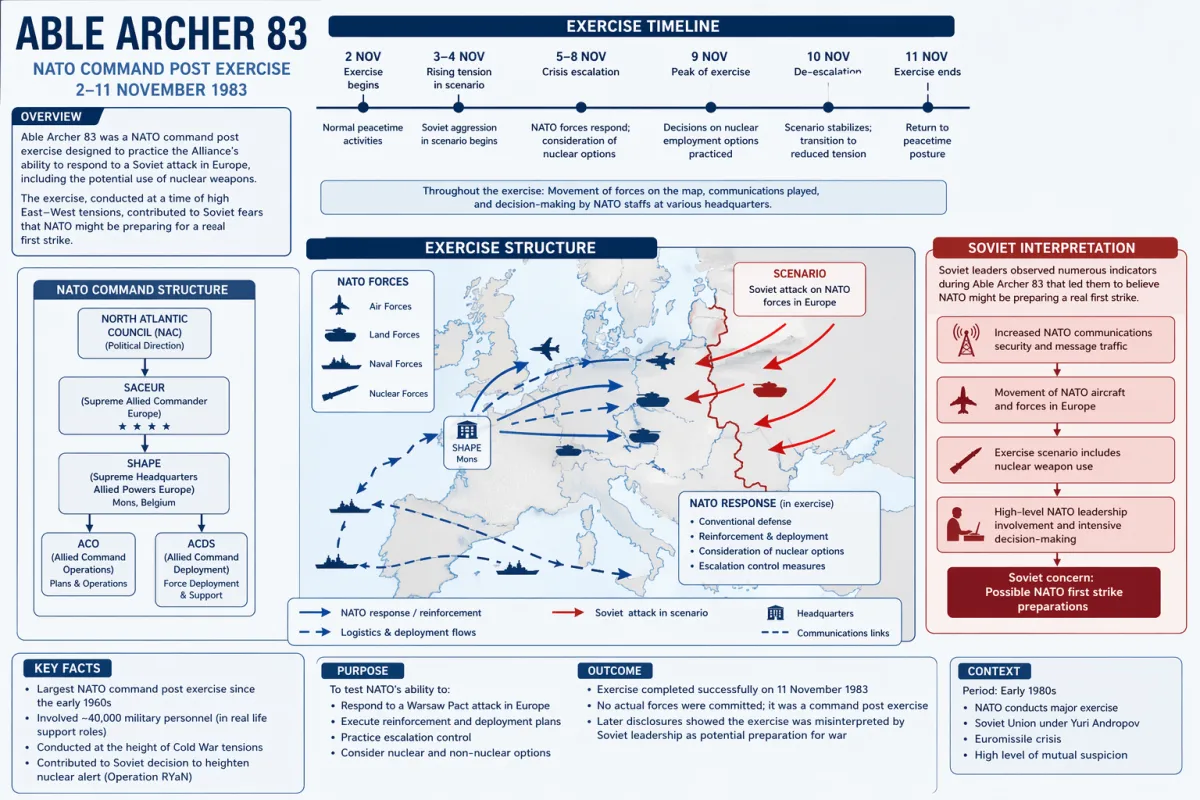
Overview
In November 1983, NATO conducted a command-post exercise codenamed Able Archer 83, designed to simulate the procedures by which the alliance would authorize and execute a nuclear strike in the event of a Soviet conventional invasion of Western Europe. On its face, the exercise was a routine element of NATO's annual training calendar. Yet the geopolitical climate in which it unfolded was anything but routine. A confluence of factors — escalating Cold War rhetoric, the recent destruction of a South Korean civilian airliner by Soviet air defense forces, and an active Soviet intelligence program predicated on the belief that the United States was planning a nuclear first strike — created conditions in which the exercise was reportedly interpreted by elements of the Soviet leadership as potential cover for an actual attack. According to declassified assessments produced years later, the episode may represent one of the most dangerous moments of the Cold War, though historians continue to debate the true scale of the risk.
Background
By the early 1980s, relations between the United States and the Soviet Union had deteriorated sharply. President Ronald Reagan had accelerated defense spending, announced the Strategic Defense Initiative (popularly called "Star Wars"), and publicly described the Soviet Union as an "evil empire." The KGB, in close collaboration with Soviet military intelligence, had launched Operation RYaN (an acronym for the Russian phrase for "nuclear missile attack") in the late 1970s and intensified it in the early 1980s. The program directed KGB officers worldwide to monitor Western capitals for signs of preparations for a surprise nuclear first strike — an indication of how deeply the Soviet leadership had internalized the fear of preemptive American action.
The atmosphere worsened dramatically in September 1983, when Soviet air defense forces shot down Korean Air Lines Flight 007, a civilian Boeing 747 that had strayed into Soviet airspace, killing all 269 people aboard. The international outcry was severe, and the diplomatic fallout further poisoned the bilateral relationship. Just weeks later, NATO began Able Archer 83.
The Exercise
Able Archer 83 ran for approximately ten days in November 1983, involving military commands across Western Europe. The exercise was more elaborate than its predecessors in several respects. It simulated a realistic escalation scenario from conventional conflict through to nuclear release, employed new and more detailed communication procedures, and — according to some accounts — included participation by high-level political figures in a manner that made it structurally resemble an actual mobilization more closely than previous iterations of the exercise had.
NATO participants understood the exercise to be a training event. Procedures were followed, simulated authorization codes were transmitted, and the scenario concluded without incident from the alliance's perspective. What NATO planners did not fully appreciate at the time was that Soviet intelligence services were monitoring the exercise closely, and that portions of the Soviet military establishment interpreted the signals with acute suspicion.
The Soviet Reaction
According to declassified documents and later accounts from former intelligence officials on both sides, Soviet military intelligence detected the Able Archer exercise and flagged it to senior leadership. KGB reporting from the period, portions of which have since been made available through declassification and through the testimony of former officers, indicates that Soviet analysts debated whether the exercise was a genuine operational cover. A Soviet intelligence officer assigned to London, who later defected and provided information to Western intelligence, reportedly warned his handlers that the KGB was treating the exercise with unusual seriousness.
The most frequently cited Soviet response involved aircraft of the Soviet Sixteenth Air Army stationed in East Germany and Poland, which were reportedly placed on a heightened alert status during the exercise. According to declassified assessments, nuclear-capable aircraft may have been prepared for rapid deployment. The precise scope and duration of this alert, and whether it reflected a genuine belief that war was imminent or was itself a precautionary military measure of a more routine character, remains a subject of scholarly dispute.
How Close Did It Come — The Debate
The question of whether Able Archer 83 brought the world close to nuclear war is genuinely contested among historians and former officials, and assessments have shifted as more material has been declassified.
A landmark assessment came from the President's Foreign Intelligence Advisory Board (PFIAB), a body charged with reviewing intelligence community performance. A report produced by the PFIAB in the mid-1980s — portions of which were declassified decades later — concluded that the Soviet war scare during this period was real, not performative, and that American intelligence had underestimated the degree to which Soviet leadership genuinely feared a Western first strike. The report described Able Archer 83 as a potentially significant flashpoint.
Some analysts and former officials have gone further, arguing that the episode rivaled or exceeded the Cuban Missile Crisis in terms of proximity to unintended nuclear conflict — a claim that rests on the argument that the 1962 crisis, for all its danger, involved deliberate decision-making by leaders who understood they were in a crisis, whereas 1983 involved the risk of the Soviet side acting on a misperception that a nuclear attack was already underway.
Other historians are more skeptical. They note that the evidence for Soviet forces being placed on genuine nuclear alert is fragmentary and secondhand, that Soviet leaders may have been engaging in signaling behavior rather than genuine preparation, and that the "near miss" framing has at times been overstated in popular accounts. According to this view, Operation RYaN reflected institutional anxiety within the KGB rather than a true belief among top Politburo members that NATO was about to launch a first strike.
Declassification and Legacy
The full dimensions of the Able Archer war scare remained largely unknown to the public and to many officials for years after the event. Information trickled out gradually through the 1990s and accelerated through document releases in the 2000s and 2010s, including materials from British, American, and former East Bloc archives. A significant tranche of documents related to the episode was made more widely available following declassification reviews in the United States and the United Kingdom.
The episode had practical policy consequences even before it was publicly known. According to some accounts, Reagan himself was sobered by intelligence briefings in late 1983 and early 1984 indicating that the Soviets had genuinely feared an attack, a realization that reportedly influenced his subsequent shift toward more direct diplomatic engagement with Moscow. Whether Able Archer 83 was a direct cause of that shift or one of several contributing factors is a matter historians continue to examine.
The exercise is now routinely cited in discussions of nuclear risk, crisis stability, and the dangers of misperception in high-tension environments. It has influenced how security scholars think about the gap between intended signals and received signals in military exercises, and has contributed to arguments for greater transparency and communication between nuclear-armed states during large-scale military activities.