
Overview
Developing theory built around a cluster of deaths and disappearances involving individuals said to have ties to sensitive U.S. research programs. In its most current form, the theory holds that scientists, contractors, military officials, and laboratory personnel connected to nuclear, aerospace, or defense work are being removed, silenced, or otherwise targeted.
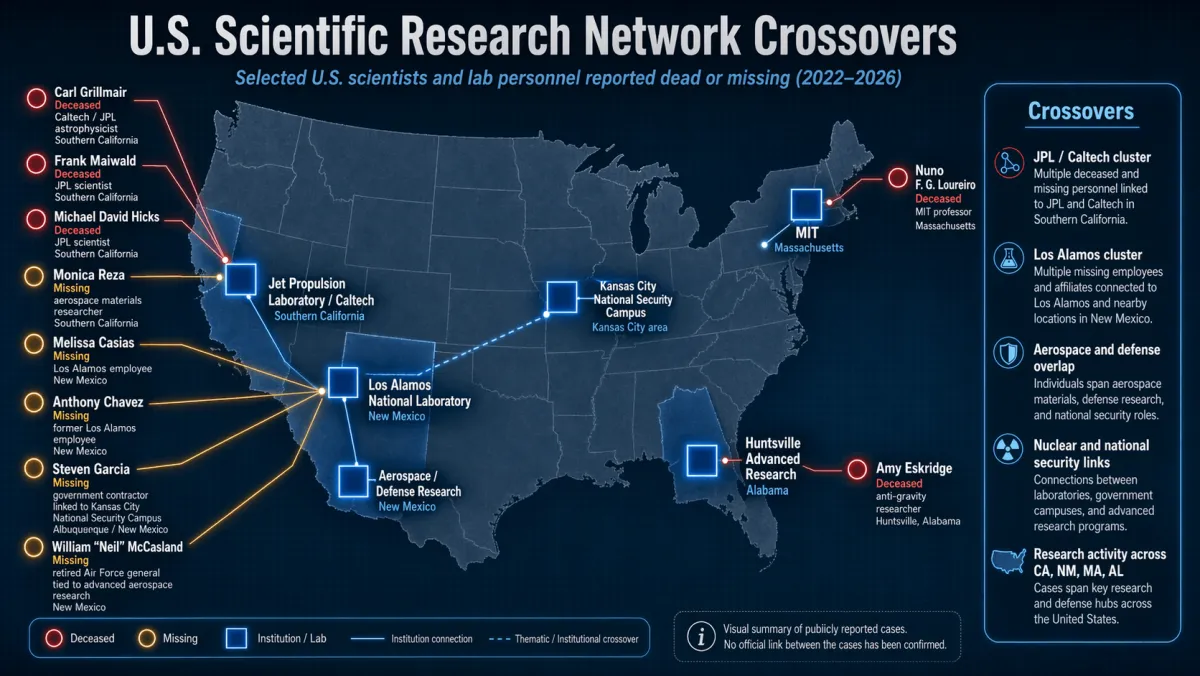
The theory gained momentum in April 2026 after reports framed Steven Garcia as the “tenth person” to go missing or die under unusual circumstances while having some connection to secretive or strategically important research. From there, online discussion groups, alternative media, and some mainstream outlets began grouping Garcia with earlier cases involving retired Air Force Major General William Neil McCasland, Anthony Chavez, Monica Reza, Melissa Casias, Frank Maiwald, Michael David Hicks, Carl Grillmair, Jason Thomas, and Nuno Loureiro.
Core Claim
At the center of the theory is the belief that these cases are not random. Different versions of the theory propose different mechanisms:
Silencing or containment
One version argues that individuals with knowledge of classified aerospace, nuclear, or advanced technology programs are being prevented from speaking, either by state actors, private contractors, or foreign intelligence services.
Espionage and counterintelligence
Another version proposes that the pattern reflects espionage activity surrounding highly sensitive U.S. defense research, especially in New Mexico, where institutions tied to nuclear weapons, Air Force research, and national laboratories are concentrated.
Disclosure-adjacent interpretation
A third version, especially common in UFO and UAP circles, treats the disappearances as connected to personnel believed to know about buried or compartmentalized programs involving recovered technology, black-budget projects, or long-running secrecy around aerospace systems.
Why Steven Garcia Became Central
Steven Garcia’s case became the newest focal point because it was used to extend the public count to ten. Reports described him as a missing Albuquerque-area government contractor with access to sensitive assets connected to the Kansas City National Security Campus’ New Mexico operations.
That mattered to theorists because the Kansas City National Security Campus is not a speculative institution. It is a real National Nuclear Security Administration site whose publicly stated mission includes manufacturing the majority of the non-nuclear components that support the U.S. nuclear stockpile. Once Garcia was placed in that environment by recent reporting, his disappearance was quickly folded into an existing narrative about missing or dead personnel around sensitive research.
Commonly Cited Cases
The exact list varies by outlet, but the following names are frequently grouped together in the conspiracy narrative:
Michael David Hicks
A former NASA Jet Propulsion Laboratory scientist whose 2023 death later became part of retrospective pattern-building. His case was not initially treated as part of a larger cluster, but later reporting incorporated it as an early point in the sequence.
Frank Maiwald
A longtime JPL researcher who died in July 2024. His death is often cited because relatively little public detail circulated beyond obituary material, which conspiracy theorists interpret as unusual silence around a senior research figure.
Anthony Chavez
A Los Alamos man reported missing in May 2025. Because he was described in later media aggregation as a former Los Alamos National Laboratory employee, his disappearance became one of the core New Mexico cases in the theory.
Monica Reza
A missing California hiker who became important to the theory because later reporting tied her professional background to aerospace materials work and to circles that overlapped with defense or government-funded rocket projects.
Melissa Casias
Another New Mexico disappearance frequently cited because she worked at Los Alamos and vanished in 2025 under circumstances that online commentators consider difficult to explain.
William Neil McCasland
McCasland became the central name in the developing theory after his February 2026 disappearance. His Air Force career, which included senior research, acquisition, and special-program roles, made him the most prominent missing figure in the cluster.
Carl Grillmair, Jason Thomas, and Nuno Loureiro
These deaths are frequently added to broaden the pattern from disappearances alone into a wider theory involving unexplained deaths of scientists or researchers working in strategically important fields.
Steven Garcia
Garcia became the latest and symbolically important case because his disappearance allowed the narrative to harden into a numbered pattern: first eight, then nine, then ten.
Why the Theory Spread So Quickly
Several factors made the theory spread rapidly:
Geographic clustering
New Mexico appears repeatedly in the narrative through Albuquerque, Los Alamos, Kirtland-associated military circles, and national-security infrastructure. That concentration gave the theory a geographic center.
Sensitive institutions
The theory draws strength from the fact that the institutions mentioned are real and genuinely important: Air Force Research Laboratory, Los Alamos-linked personnel, and the Kansas City National Security Campus.
Sparse public explanations
In some of the deaths and disappearances, the amount of publicly available detail has been limited. Conspiracy communities tend to interpret silence, routine privacy restrictions, or incomplete reporting as evidence of suppression.
Numbered escalation
The shift from “a strange series of cases” to “the ninth case” and then “the tenth case” gave the theory a memorable structure and made it easier to circulate.
What Is Actually Established
Several points are publicly documented and do not depend on the theory being true.
Steven Garcia is listed in New Mexico’s public missing-person system. William Neil McCasland remains the subject of an active missing-person investigation. The Kansas City National Security Campus openly states its role in producing non-nuclear components for the nuclear stockpile. Recent mainstream coverage has acknowledged public speculation around these cases.
What is not established is a proven operational link among all the individuals now grouped together. The list itself varies between outlets, and some of the case-linking comes from later media aggregation rather than from a single law-enforcement or government determination.
Federal Review and the Skeptical Case
By late April 2026 the story had climbed from anonymous forum lists to cable news, comments from members of Congress, and the White House — and the FBI announced it would review the cases for any connection, coordinating with the Department of Energy, the Department of War, and state and local police. Officials were careful to note that opening a review to rule connections out is not the same as finding them.
The review cut against the conspiracy reading. On April 29, 2026, the FBI concluded that the killing of MIT plasma physicist Nuno Loureiro had "no nexus to terrorism": he was shot at his home outside Boston by a former engineering classmate acting on a personal grievance, not silenced over what he knew.
Skeptics have focused on how the list was assembled. The common criticism is that it was built backwards — theorists started from the conclusion that scientists were being killed, then searched for anyone who had recently died or vanished and scraped each biography for some thread tying them to sensitive work. Medical sociologist Robert Bartholomew described the pattern as apophenia, the human tendency to read meaning into unrelated events; across a large population of researchers, a handful of deaths and disappearances over several months is statistically ordinary, and the "pattern" appears only once the cases are curated for it. Several families have publicly objected to seeing their relatives folded into the narrative.
Interpretive Importance
Even without a confirmed link, the theory has become notable because it reflects how modern conspiracy narratives form. A handful of real missing-person cases, several underexplained deaths, a concentration of defense-related institutions, and repeated mention by media outlets were enough to generate a broader narrative of coordinated suppression.
That makes this theory less about one single event than about pattern recognition. Its believers argue the pattern is too specific to dismiss. Skeptics counter that sensitive professions, selective media amplification, and retrospective grouping can create the appearance of a coherent network where none has been demonstrated.
Open Questions
The theory remains active because several questions are unresolved:
Are the cases genuinely connected?
No public authority has confirmed that they are, but that absence of confirmation is itself treated by believers as suspicious.
Why do the lists differ?
The frequently cited roster has changed over time, suggesting the theory is still forming and that its boundaries are not fixed.
Is New Mexico coincidence or signal?
For supporters, the repeated appearance of Albuquerque and Los Alamos is one of the strongest indicators that something more than coincidence may be involved.
Will future reporting stabilize the theory?
If additional disappearances or deaths are grouped into the same pattern, the theory may solidify further. If cases are resolved individually with ordinary explanations, the theory may fragment into several smaller narratives.