
The claim
A number of skulls carved from quartz are held in major museums and private collections, and have been described since the nineteenth century as Aztec, Maya or Mixtec. Around them has grown a body of claim that goes well past archaeology: that they hold recorded knowledge, that they heal, that there are thirteen of them, and that bringing the thirteen together will avert or explain the end of the world.
There is a simpler question underneath all of that, and it has an answer.
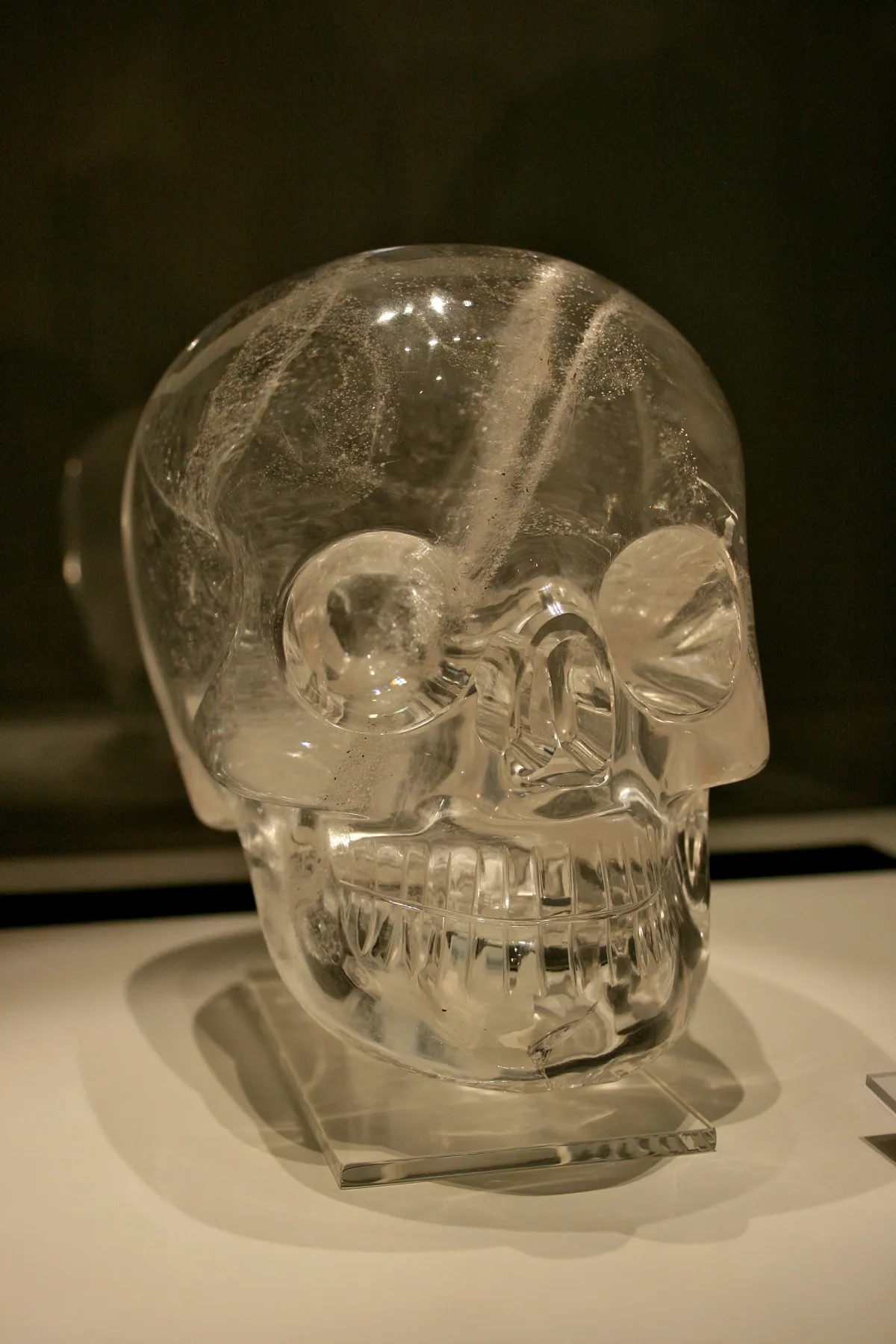
The British Museum skull, acquired from Tiffany & Co. in 1897. The very regular ruling of the teeth is the kind of surface the 2008 tool-mark study examined. Wikimedia Commons — Photograph by Mike Peel (www.mikepeel.net)., CC BY-SA 4.0

None of them were excavated
This is the fact that does most of the work and it is rarely stated plainly.
Not one crystal skull in any museum collection comes from a documented archaeological excavation. None was recovered by an archaeologist from a known site, in a known layer, with a record of its removal. Every one arrived through the antiquities market.
That is not in itself proof of forgery — a great many genuine objects passed through dealers in the nineteenth century. But it removes the only thing that could establish they are pre-Columbian, and it means the question has to be settled on the objects themselves.
The dealer
The market has a recurring name. Eugène Boban was a French antiquities dealer working in Mexico City between about 1860 and 1880, during two decades when European and American appetite for pre-Columbian material was far larger than the supply of it.
The major museum skulls run through him. He sold at least three to the ethnographer Alphonse Pinart, whose collection went to the Trocadéro in Paris and from there to the Musée de l'Homme. The British Museum's skull passed through his inventory before reaching Tiffany & Co., which sold it to the museum in 1897.
One dealer, in one city, in one twenty-year window, standing behind the objects now held on three continents.
What the microscope found
In the 2000s a team including Margaret Sax of the British Museum and Jane Walsh of the Smithsonian examined several of the major skulls using scanning electron microscopy and X-ray diffraction, and published the results in the Journal of Archaeological Science in 2008.
The surfaces carry microscopic circular grooves — on the teeth, around the eyes, across the cranium. Concentric scoring of that kind is the signature of a rotary grinding wheel. Pre-Columbian lapidary work was done by hand, with abrasives worked back and forth, and leaves a different and well-characterised set of marks.
The materials were analysed too, and the two principal skulls turned out to have been made differently from one another. The British Museum skull had been worked with a hard abrasive such as corundum or diamond, shaped with a rotary disc of some suitable metal.
The Smithsonian skull had been worked with silicon carbide.
Why the silicon carbide settles it
Silicon carbide — carborundum — occurs in nature only in vanishingly rare traces. The material used as an industrial abrasive is synthetic, and it was not manufactured until the 1890s.
An object bearing the working marks of a substance that did not exist before the 1890s was not carved by the Aztecs. The published suggestion for that skull is the 1950s or later.
This is a different order of evidence from a stylistic judgement about whether a carving looks right. It is a date floor established by chemistry, and it does not depend on anyone's opinion of the object's artistry.
The most famous one
The Mitchell-Hedges skull is the one most often pictured, and the account attached to it is that F. A. Mitchell-Hedges's daughter Anna found it at Lubaantun in British Honduras in 1924, on her birthday, under a collapsed altar.
The paper record says something else. Mitchell-Hedges bought the skull at a Sotheby's auction in London on 15 October 1943, from the dealer Sydney Burney. The earliest published reference to it appears in a journal in 1936, identifying Burney as its owner since 1933 — nine years after the discovery it is supposed to have been excavated in.
A purchase receipt and two prior references to a different owner are not the sort of evidence that requires interpretation.
What is left
The skulls are real objects and some of them are beautiful. They are also, on the evidence, nineteenth and twentieth century carvings that entered the world through a market that wanted pre-Columbian antiquities more quickly than Mexico could supply them.
No evidence has been produced that any of them is pre-Columbian. The thirteen-skulls material, the healing claims and the prophecy attached to them postdate the objects by a long way and rest on nothing the objects themselves provide.
What the case does document, and document well, is something less mystical and more useful: how a demand for a kind of object can call that object into existence, how a single dealer can seed three national collections, and how long an attribution can survive once a museum has printed it on a label.