
Overview
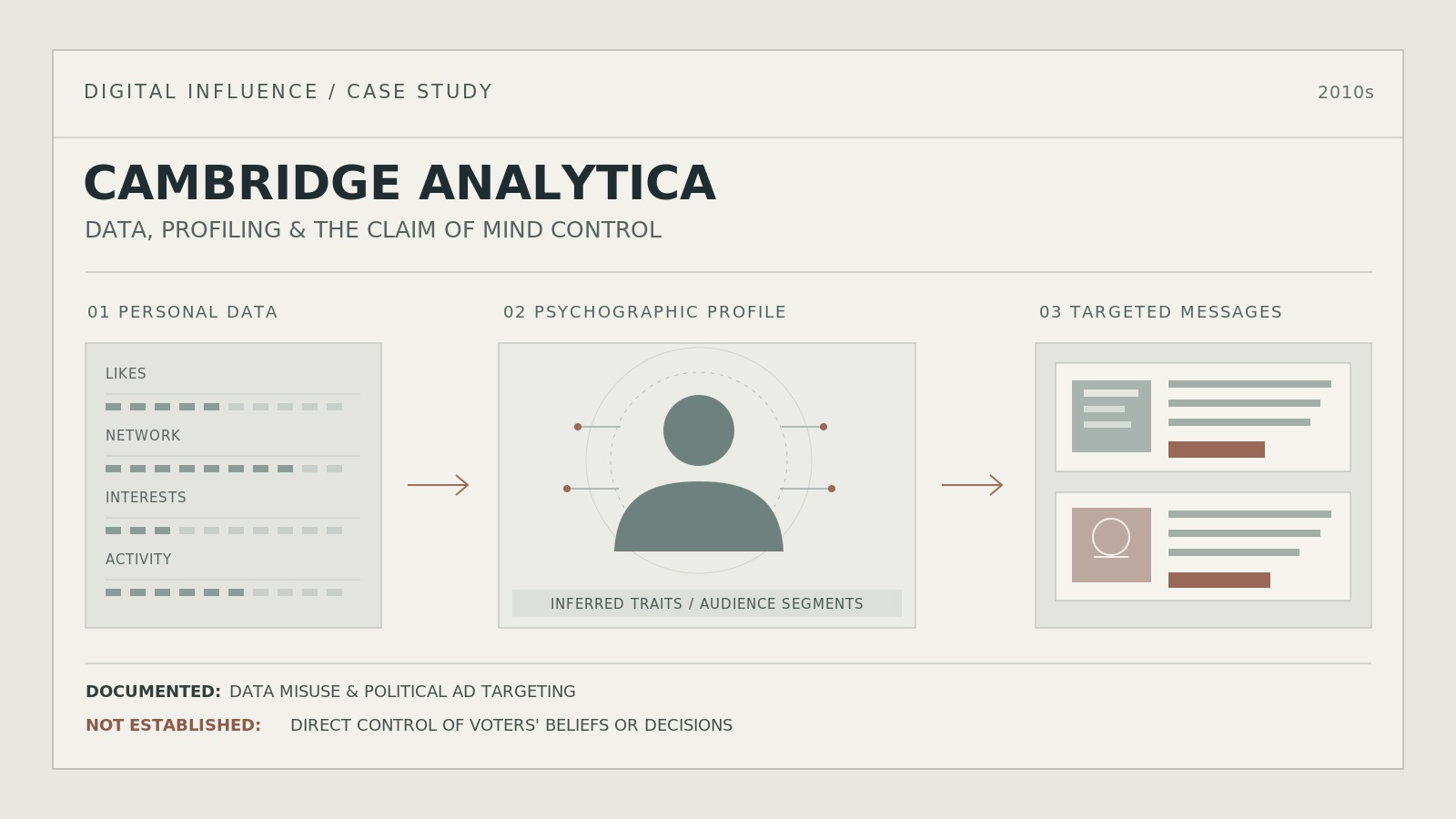
The Cambridge Analytica Mind Control theory turns a real data scandal into a weaponized-behavior narrative. Instead of focusing only on unlawful harvesting, consent violations, or opaque political targeting, believers argue that the company had already crossed into direct psychological control.
Historical Context
The Federal Trade Commission found that Cambridge Analytica engaged in deceptive practices to harvest personal information from tens of millions of Facebook users for voter profiling and targeting. This was a major documented scandal, and it gave the company a uniquely sinister reputation.
What made Cambridge Analytica especially vulnerable to mind-control interpretations was its own rhetoric. The company and its associates spoke about psychographics, personality modeling, and message tailoring in ways that sounded unusually powerful. That language made it easy to believe that the firm had developed a kind of election-era remote influence weapon.
However, subsequent scholarly and journalistic assessments were much more cautious. Nature described the science behind Cambridge Analytica’s controversial marketing techniques as “scant,” and The New Yorker noted that whether the company’s targeting actually swayed election outcomes remained a matter of debate and had not been definitely shown. Academic discussion of psychographic targeting emphasized its potential to shape influence environments, but not a demonstrated ability to flip a person’s political identity with a few ads.
Core Claim
The company could reprogram political identity
Believers argue that Cambridge Analytica’s profiling was strong enough to transform party alignment or voting intention quickly and reliably.
A few highly targeted ads were enough
In the strongest versions, persuasion becomes almost mechanistic: identify the profile, deliver a small number of customized messages, and change the person.
Data harvesting was only the outer scandal
The theory says the real breakthrough was not stolen data itself, but the behavioral weapon supposedly built on top of it.
Why the Theory Spread
The real scandal was already alarming
Because Cambridge Analytica actually did misuse data for political targeting, it was easy to imagine that its capabilities were even deeper than regulators uncovered.
The language of psychographics sounds totalizing
Terms like “psychographic profile” and “behavioral targeting” make campaign work sound closer to psychological programming than ordinary persuasion.
Political outcomes felt uncanny to many people
When elections surprise the public, explanations that emphasize hidden behavioral machinery become more attractive.
Documentary Record
The public record strongly supports that Cambridge Analytica deceptively harvested Facebook data and used it for voter profiling and targeting. FTC findings document this clearly. The public record also supports that the company’s psychographic marketing claims generated intense attention.
What the public record does not support is the strongest “mind control” version of the theory. Nature questioned the scientific strength behind the company’s claims, and later commentary emphasized that its influence may have been exaggerated or at least not conclusively demonstrated at the level of flipping people wholesale with a few ads.
Historical Meaning
This theory matters because it represents the point where political advertising begins to feel like cognitive warfare. It is the fear that elections have become battles over programmable personality rather than persuasion among citizens.
Legacy
The Cambridge Analytica Mind Control story remains important because it stands at the threshold between real data abuse and imagined psychographic omnipotence. It continues to influence how people interpret algorithmic campaigns, social-media persuasion, and AI-assisted political targeting.