
The list
On 17 March 1981 Italian police searched Licio Gelli's house and office at Arezzo, in Tuscany. Among what they took away was a list of 962 names.
It was the membership roll of a masonic lodge called Propaganda Due, and the names on it were the reason the search became one of the defining events of postwar Italian politics. There were three serving cabinet ministers. There were the heads of all three of Italy's intelligence services. There were generals and other senior military officers, magistrates, police officials, bankers, newspapermen. There was a Milanese property developer named Silvio Berlusconi, who at that point had not entered politics and would become prime minister thirteen years later.
The list is the hard centre of this entry. It is not an allegation, a leaked summary or a reconstruction. It was seized by police, it was published, and it produced a government crisis in a country whose state institutions turned out to be substantially represented on it.
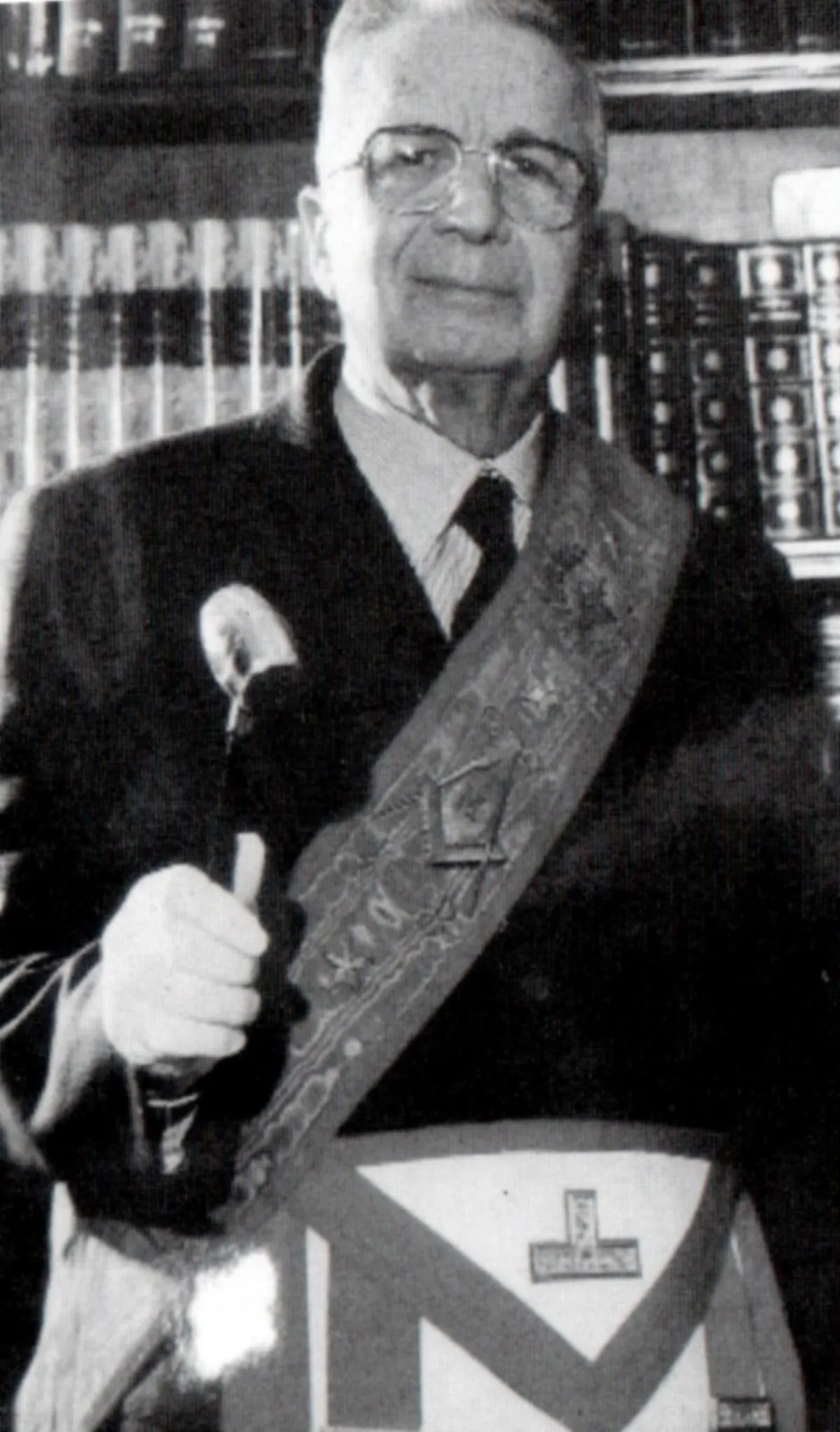
Wikimedia Commons — Unknown author, Public domain

What the lodge was
Propaganda Due had a legitimate origin and lost it.
It operated from 1945 under the jurisdiction of the Grand Orient of Italy, the country's principal masonic body. In 1976 the Grand Orient withdrew its charter. The lodge did not stop; it carried on for another five years with no masonic standing at all, which is the detail that tends to get lost when it is described simply as a masonic conspiracy. By 1981 it was not a lodge in any formal sense. It was a private network with a lodge's vocabulary.
Gelli ran it. He had volunteered at eighteen for the expeditionary force Mussolini sent to fight for Franco in Spain, and his politics stayed where that suggests: the organisation he built was emphatically anti-communist, in a country with the largest communist party in Western Europe and a decade of political violence behind it.
Banco Ambrosiano
The lodge's most consequential documented association is a bank.
Roberto Calvi was chairman of Banco Ambrosiano, which was closely tied to the Vatican's finances, and he was a member of P2. In June 1982 he was found hanging beneath Blackfriars Bridge in London, his pockets weighted with masonry. The death was initially recorded as suicide. Later investigation moved away from that finding, and Italian prosecutors came to treat it as a murder carried out by the Sicilian Mafia. Within weeks Banco Ambrosiano collapsed, with very large sums unaccounted for.
That sequence — a lodge member running a Vatican-linked bank, the bank failing, the chairman dead in London under a bridge — is why P2 occupies the place it does in conspiracy literature. It does not require embellishment to be strange.
The programme document
Four months after the raid on Villa Wanda, the question of what the lodge intended acquired a documentary answer.
On 4 July 1981 investigators found a document in the false bottom of a suitcase belonging to Gelli's daughter, Maria Grazia Gelli, along with a memorandum on the Italian political situation. The document is titled Piano di Rinascita Democratica — the Plan for Democratic Rebirth — and it was subsequently published in the acts of the parliamentary commission of inquiry.
It reads as a programme. It identifies the centres of power to be worked on — the political parties, the press, the trade unions, parliament, the government and the judiciary — and proposes economic and financial pressure as the instrument. Its objectives include the consolidation of media ownership, the breaking of the Italian trade unions, and the rewriting of the constitution.
Two things should be said about it, and they pull in opposite directions.
It is not a plan for a coup. It is a plan for capture: changing who owns the newspapers, weakening organised labour, amending the constitution — the sort of programme that could in principle be pursued through entirely lawful politics, and much of which later happened in Italy without anyone needing a lodge. That is the uncomfortable part, and it is why the document is quoted so often.
It was also found in a suitcase with a false bottom, belonging to the daughter of a man whose membership list included the heads of all three intelligence services. A programme pursued openly does not need concealing that way.
What is established and what is argued
The distinction matters here more than usual, because the lodge is routinely described as having controlled the Italian state, and the record supports something more specific than that.
Established: the organisation existed, operated without a charter after 1976, and had 962 named members including ministers, service chiefs, magistrates and officers. A parliamentary commission of inquiry, chaired by the Christian Democrat Tina Anselmi, investigated it. Criminal proceedings ran against Gelli for decades. The Ambrosiano collapse and Calvi's death are matters of court record.
Also established: the programme document existed, was seized, and is published. What it shows is intent of a particular kind — institutional capture through ownership and pressure — and intent is not the same as execution.
Argued: what the network actually did. The strongest claims attach it to the strategy of tension — the campaign of bombings and provocations across Italy in the 1960s and 1970s — and to plans for an authoritarian restructuring of the Italian state. Those claims are not baseless, and they are not uniformly proven either. A membership list demonstrates that a great many powerful people belonged to the same private body. It does not by itself demonstrate what any of them did at its instruction, and the subsequent litigation did not resolve that question uniformly across all of it.
The honest position is that this is a documented organisation with an extensively documented membership and a partially documented programme. Treating the membership list as proof of everything later alleged skips the step where each allegation has to be made good on its own evidence — and it is a step that the list, being genuine and astonishing, makes very easy to skip.
Why it matters beyond Italy
Most secret-society entries in this archive concern organisations whose influence is asserted and whose membership is unknown. P2 inverts that. The membership is known, by name, because it was found in a filing cabinet in Arezzo and printed in the newspapers.
What that produced was not a settled account of a conspiracy. It produced forty years of argument about what the list meant, conducted in courtrooms and a parliamentary commission, much of it unresolved. That is worth sitting with: even when the roll of a secret organisation is seized intact and published, establishing what the organisation did remains a separate and much harder problem.