
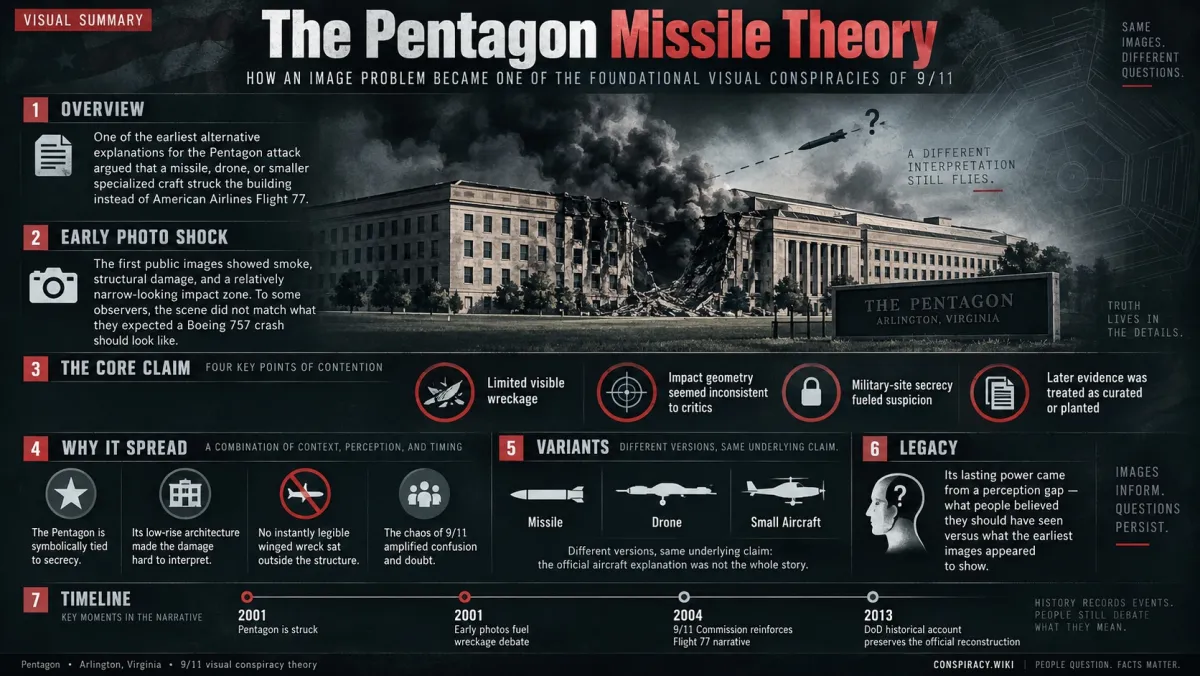
Overview
The Pentagon Missile Theory is one of the earliest and most widely circulated alternative explanations for the attack on the Pentagon. Rather than claiming the building was hit by a Boeing 757, the theory argues that a missile, drone, or smaller specialized craft struck the structure. In popular form, it often begins with a visual question: where was the obvious airplane wreckage in the first public images?
That question became the theory’s emotional core. The Pentagon was a low, massive masonry-and-concrete building, and the first images showed fire, smoke, structural damage, and a relatively narrow-looking entry zone rather than the dramatic airframe remains some people expected.
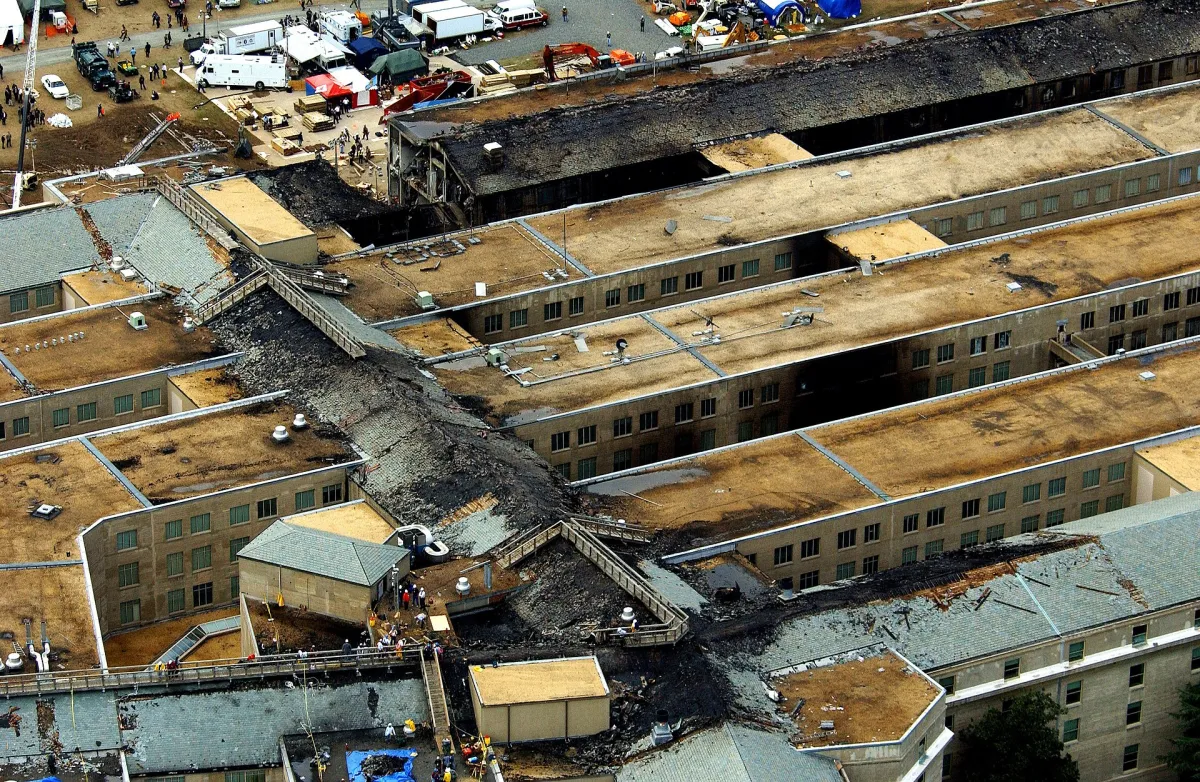
Wikimedia Commons — DoD photo by Tech. Sgt. Cedric H. Rudisill., Public domain
.jpg)
Early Photo Shock
Much of the theory’s power came from the earliest aftermath photographs and television footage. Before parts of the damaged section collapsed further, the visible hole seemed to some observers too small for a 757. Firefighting conditions, debris distribution, and the camera angles of the first images amplified this impression.
In the opening hours after the attack, most observers had little experience imagining what a high-speed airliner impact into a hardened low-rise structure would look like. This gap between expectation and image created a fertile environment for an alternative-weapons theory.
The Core Claim
The theory usually advances several linked ideas:
lack of visible wreckage
The first images did not show what some viewers considered enough recognizable aircraft debris.
impact geometry
The damage pattern, before additional collapse, was treated as more consistent with a missile or smaller craft than with a Boeing 757.
official secrecy at a military site
Because the target was the Pentagon, the theory assumed immediate information control and the possibility of a false explanation.
planted or curated evidence
Later-released images, recovered data, and official reports were often treated as after-the-fact reinforcement rather than primary evidence.
Why It Spread So Quickly
The Pentagon Missile Theory spread quickly for several reasons:
- the Pentagon is symbolically tied to military secrecy,
- the building’s architecture made the visual scene unfamiliar,
- there was no instantly legible winged wreck sitting outside the structure,
- and the attack occurred amid overwhelming confusion on the same morning as the World Trade Center strikes.
It also benefited from the broader 9/11 environment, in which many people already believed the official story would not capture everything important about the day.
Missile, Drone, or Small-Aircraft Variants
Over time, the theory split into multiple forms. Some versions insisted on a cruise missile. Others proposed a military drone or modified smaller aircraft. Still others treated “missile” as shorthand for anything other than Flight 77. These variations allowed the theory to survive even when one specific version came under pressure, because the underlying claim remained the same: the official aircraft explanation was not the whole story.
What the flight left in the record
The theory begins with an absence — the wreckage people expected to see and did not. The documentary record of the aircraft itself is not an absence, and the article's own sources carry it.
The 9/11 Commission places the impact to the second. American 77 pushed back from its gate at Dulles at 8:09 and took off at 8:20. At 9:32 the Dulles tower observed the radar track of a fast-moving aircraft later identified as Flight 77, and at 9:37:46 it "crashed into the Pentagon, traveling at approximately 530 miles per hour." The aircraft was a Boeing 757 flown that morning by Captain Charles F. Burlingame and First Officer David Charlebois, with four flight attendants and 58 passengers aboard. The Commission's account of the damage is blunt: "All 64 people aboard the airliner were killed, as were 125 people inside the Pentagon (70 civilians and 55 military service members)."
An identification made from the air
One piece of the record sits awkwardly with a missile, a drone or a substituted smaller craft, and it was made in the air rather than assembled afterwards from photographs.
An unarmed National Guard C-130H cargo aircraft, which had just taken off for Minnesota, was vectored to identify and follow the suspicious aircraft. Its pilot, in the Commission's words, "spotted it, identified it as a Boeing 757, attempted to follow its path, and at 9:38, seconds after impact, reported to the control tower: 'looks like that aircraft crashed into the Pentagon sir.'"
That is a trained pilot, airborne, tracking the aircraft deliberately, naming the type before anybody knew there would be an argument about it.
The calls from the cabin
The aircraft was also reported hijacked from inside itself, while it was still flying. Between 9:16 and 9:26 Barbara Olson called her husband Ted Olson, the solicitor general of the United States, told him the flight had been hijacked and that the hijackers had knives and box cutters. The call was cut off after about a minute; she reached him again shortly afterwards, said the pilot had announced the hijacking, and asked what she should tell the captain to do. Another passenger had already called a relative, who alerted American Airlines.
These are ordinary, checkable things — a manifest, a radar track, a pilot's sighting, phone calls placed by named people to named people — and they exist independently of any photograph of the building.
The offices that were hit
A second claim often travels with this one: that the aircraft struck precisely where the records of the Pentagon's missing trillions were kept. The premise has a real basis, and it is worth stating exactly, because the specifics cut in more than one direction.
The day before the attack, 10 September 2001, Donald Rumsfeld gave a speech on Pentagon bureaucracy in which he said: "Our financial systems are decades old. According to some estimates, we cannot track $2.3 trillion in transactions. We cannot share information from floor to floor in this building because it's stored on dozens of technological systems that are inaccessible or incompatible." The figure is real and so is the timing. What he described was an inability to reconcile transactions across incompatible systems — not money discovered missing, and not a filing room.
The impact point did contain the Army's money. The Defense Department's own history of the attack places, "On the 1st Floor of the E Ring and part of the D Ring, directly in the path of the oncoming airliner, the U.S. Army's Resource Services-Washington (RSW) office," employing 65 to 70 people, which "managed money and personnel for the headquarters staff." The cost to that office was severe and specific: its Program and Budget Division "lost 25 of its 28 members," and of the Managerial Accounting Division's twelve people present "only 3 survived." In all, 34 of the 40 members of those two divisions present that morning were killed. It was the Army office that suffered the largest number of fatalities.
Two facts complicate the reading that this destroyed an inquiry. The RSW director and much of his staff were not there: the same history records that Robert Jaworski "and many of his people from the personnel, financial management, and accounting staffs, had not yet moved into their new spaces and were still working in the D Ring, Corridors 6 and 7 area, 500 feet or more removed from their colleagues." And the accounting problem itself did not end. Five years later, a Senate hearing on Defense financial management was still describing "the Department's inability to produce auditable financial statements. In other words, they can't undergo an audit, much less pass one."
What the record shows, then, is a budget and accounting office destroyed with great loss of life, a department-wide systems failure that long outlived it, and no reconciliation of the two into a records archive that the impact could have erased. The site covers the accounting claim on its own terms in The Missing 2.3 Trillion.
The exercises before the attack
A second claim frequently travels alongside this one: that the Pentagon had rehearsed the attack in advance. The exercises are real, and they are described in the Defense Department's own history of the day. The building's two medical clinics ran mass casualty exercises whose scenario changed each time, and the history records that "presciently, training carried out the previous May supposed casualties resulting from an accidental crash of a twin-engine airliner into the west side of the building." A separate tabletop exercise held in 2000 by the Pentagon's own police force supposed a single-engine aircraft hitting the roof.
The two claims sit awkwardly together. A rehearsal read as foreknowledge is a rehearsal of an airliner striking the west face — which is the impact this theory displaces. The site covers the exercises on their own terms in The Pentagon MASCAL Exercise.
What the theory has to account for
The theory's starting instinct is not unreasonable, and it is worth separating from its conclusion. A low masonry-and-concrete building absorbing a high-speed airliner does not look like the wreck people picture, the earliest images were taken in smoke and confusion, and a military headquarters is exactly the kind of site where information control would be expected. Anyone looking at the first photographs and feeling that something did not match was responding to a real gap between expectation and image.
What the alternative-weapon versions have to carry is everything above. A missile, a drone or a smaller substituted aircraft has to account for a Boeing 757 that departed Dulles with 64 people aboard and never landed, for a radar track followed into Washington, for a pilot in another aircraft naming the type seconds before impact, and for calls placed from the cabin by passengers whose families received them. The photographic question the theory is built on is one question; these are the others it inherits by answering it that way.
Legacy
The Pentagon Missile Theory remains one of the foundational visual conspiracies of 9/11. It does not depend first on hidden plans or think-tank documents, but on an image problem: what people believed they should have seen versus what the earliest public images appeared to show. That gap between expectation and perception gave the theory lasting power.
Photographs from the site
Photographs of the Pentagon response operation, September 2001. Courtesy of George News, used with permission. Revisiting 9/11 — George News
Aerial view along the roofline of the damaged section, with the response area beyond. Night view through a burned-out window frame on an upper floor; response tents lit outside. The west face seen from a nearby roadway, smoke still rising; buses and emergency vehicles in the foreground. Interior office space, a worker in protective coveralls among burned filing cabinets marked in spray paint. An excavator working at the collapsed facade after dark; workers with a flag in the foreground. Four workers in protective suits and hard hats crossing the site at night. Fire crews directing water onto the collapsed section of the facade. An investigator in an FBI jacket taking notes beside a breach in the exterior wall. Two engines pouring water onto the smoking collapsed section. Interior office space gutted by fire, with collapsed ceiling and burned equipment. An interior corridor filled with debris and standing water. Aerial view over the damaged section, with the response camp set up alongside. Excavators clearing structural debris piled against the damaged wall. Recovery workers sifting a debris field in a courtyard between wings. A breach in the exterior wall at ground level, search markings sprayed on the limestone either side. Two firefighters working a rubble slope with a search dog. A debris field banked against the exterior wall at night, search markings on the wall above. Workers on a debris-covered surface beside the building, standing water in the foreground. A blackened breach in the exterior wall, debris piled across the foreground. Looking out through a breach in the outer wall at night, a crane and a skid-steer loader working under floodlights beyond. The collapsed section under floodlights, an excavator at the right and firefighters at the foot of the debris slope.
Footage from the site
Emergency response, recovery and investigative operations at the Pentagon. Hosted on YouTube; each clip opens only when you press play.
Emergency Response at the Pentagon, Part 1 Emergency Response at the Pentagon, Part 2 Emergency Response at the Pentagon, Part 3 Emergency Response at the Pentagon, Part 4 Security camera view of the Pentagon Civilian footage following the attack Pentagon work, Part 1 Recovery and investigative operations at the Pentagon Pentagon work, Part 2