
Overview
The Philadelphia Experiment is an alleged U.S. Navy experiment at the Philadelphia Naval Shipyard in October 1943, in which the destroyer escort USS Eldridge (DE-173) was supposedly rendered invisible using electromagnetic fields derived from Einstein's unfinished unified field theory. In the fuller versions the ship teleports to Norfolk, Virginia and back, and crewmen are found fused into its steel.
The story has an unusually clean provenance problem: everything in it is traceable to one correspondent writing twelve years after the fact, and the organisation usually blamed for the experiment did not exist when it is said to have happened.
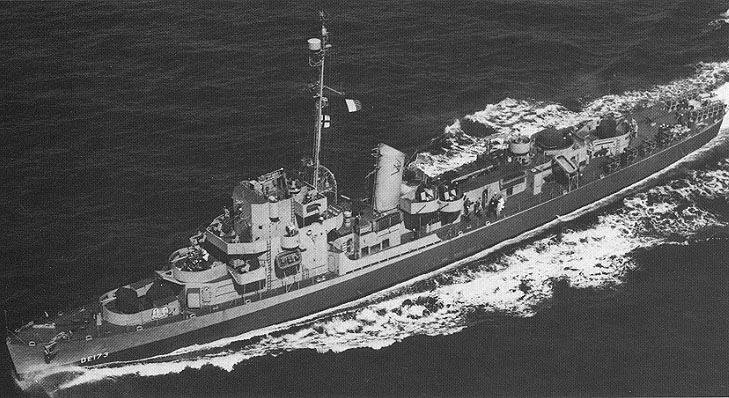
Wikimedia Commons — U.S. Navy, Public domain
_underway,_circa_in_1944.jpg)
Where the story came from
The Office of Naval Research dates the origin precisely. The myth "dates back to 1955 with the publication of The Case for UFO's by the late Morris K. Jessup." After publication, Jessup received letters from a correspondent giving the name Carlos Miguel Allende and an address at R.D. #1, Box 223, New Kensington, Pennsylvania. Those letters described the alleged 1943 experiment and claimed Allende had watched it from another ship.
Allende said the incident had been reported in a Philadelphia newspaper. In ONR's words, "the identity of the newspaper has never been established. Similarly, the identity of Allende is unknown."
In 1956 a copy of Jessup's book was mailed anonymously to ONR, its pages annotated by hand in what appeared to be three sets of handwriting, discussing UFO propulsion and the experiment. ONR's interest in that annotated copy — it had a small number reproduced — is the single fact that gives the story its air of official involvement, and it is the thinnest thread in it: curiosity about a strange package is not an investigation.
Jessup died in 1959, in a death recorded as suicide. That has since been folded into the story by people who find the timing suggestive.
What the ship was actually doing
The Navy's own Dictionary of American Naval Fighting Ships gives Eldridge's record without reference to any of this. She was launched on 25 July 1943 by Federal Shipbuilding and Dry Dock Company at Newark, New Jersey, and commissioned on 27 August 1943 under Lieutenant C. R. Hamilton, USNR.
The official history then records that "between 4 January 1944 and 9 May 1945 Eldridge sailed on the vital task of escorting to the Mediterranean men and materials," making nine convoy voyages to Casablanca, Bizerte and Oran. She went to the Pacific in May 1945, was placed out of commission in June 1946, and was transferred to Greece in 1951 under the Mutual Defense Assistance program.
It is worth being exact about what that does and does not prove. The published ship history is a summary, not a deck log; it does not narrate the autumn of 1943 in detail, and the detailed movement records are the deck logs themselves. What it does establish is that the Eldridge was a new escort working up in the second half of 1943 and in Atlantic convoy service from the start of 1944 — a schedule with no room in it for the events described, and no trace of them in the record the Navy publishes.
The organisation that did not exist
The most economical objection is one sentence from ONR's own information sheet:
ONR has never conducted any investigations on invisibility, either in 1943 or at any other time (ONR was established in 1946.)
The Office of Naval Research is the body most often named as having run or covered up the experiment, in part because the annotated Jessup book was sent there. It was created three years after the experiment is supposed to have taken place.
The plainer explanations
ONR offers two, and neither requires anyone to be lying.
The first is degaussing — running current through cables around a hull to cancel its magnetic signature, which makes a ship "undetectable or 'invisible' to magnetic mines." It was routine wartime practice at the shipyard, it was described to sailors in exactly those terms, and "invisible to mines" is a short walk from "invisible."
The second concerns experiments with a destroyer's generating plant, where a higher-frequency generator "produced corona discharges, and other well known phenomena associated with high frequency generators" — visible electrical effects of the kind the legend describes as a green glow or enveloping fog. ONR notes of that work: "None of the crew suffered effects from the experiment."
On the physics, ONR's position is that "in view of present scientific knowledge, ONR scientists do not believe that such an experiment could be possible except in the realm of science fiction." Einstein's unified field theory, the claimed basis, was never completed.
A legend built backwards
The most useful thing about this story is when it appeared. Nothing about it surfaced in the wartime press or in wartime records. Its public life begins in 1955, twelve years after the date it describes, and its most famous imagery — the fused crewmen, the teleportation — arrived later still, through paranormal and UFO writing rather than anything contemporary.
That makes it a clear case of retroactive legend-building: a story assembled after the fact and projected backward onto a named ship and a specific month. The 1943 setting is doing the work, because wartime secrecy explains the absence of records, which is the one thing the legend requires.
Carl Allen was later identified by the writer Robert Goerman, who found that Allen was a member of a family Goerman knew personally. Accounts of what Allen then said about his own story vary, including reports that he admitted inventing it and afterwards took the admission back — a sequence consistent with a correspondent whose defining trait, on the record that survives, is unreliability.
What would settle it
The claim is unusually testable for a conspiracy theory, which is part of why it has not survived contact with historians.
A warship's movements are not a matter of recollection. Deck logs record position and activity daily, they were kept for the Eldridge as for every commissioned vessel, and they are archival records rather than press accounts. Anyone asserting the ship was at Philadelphia on 28 October 1943 is making a claim those logs can confirm or refute, and the people who have gone to them have come back with a ship on ordinary duty.
The counter-argument available to the theory is that the logs were altered — which is coherent, and also removes the last thing either side could check. At that point the claim has stopped being about the Eldridge and become an argument about whether documentary evidence means anything, which is a different subject.
Legacy
The story reached a mass audience through Charles Berlitz and William Moore's 1979 book The Philadelphia Experiment: Project Invisibility, and through films in 1984 and 2012. It has become the template for later secret-military legends involving portals, invisibility and human experimentation.
Its staying power is not archival. It comes from the vividness of the imagery and from a genuine feature of the period: the wartime Navy really was doing classified electromagnetic work on ships at that shipyard, and really did tell sailors it made vessels invisible to something. The legend takes a true sentence and removes the last two words.