
Overview
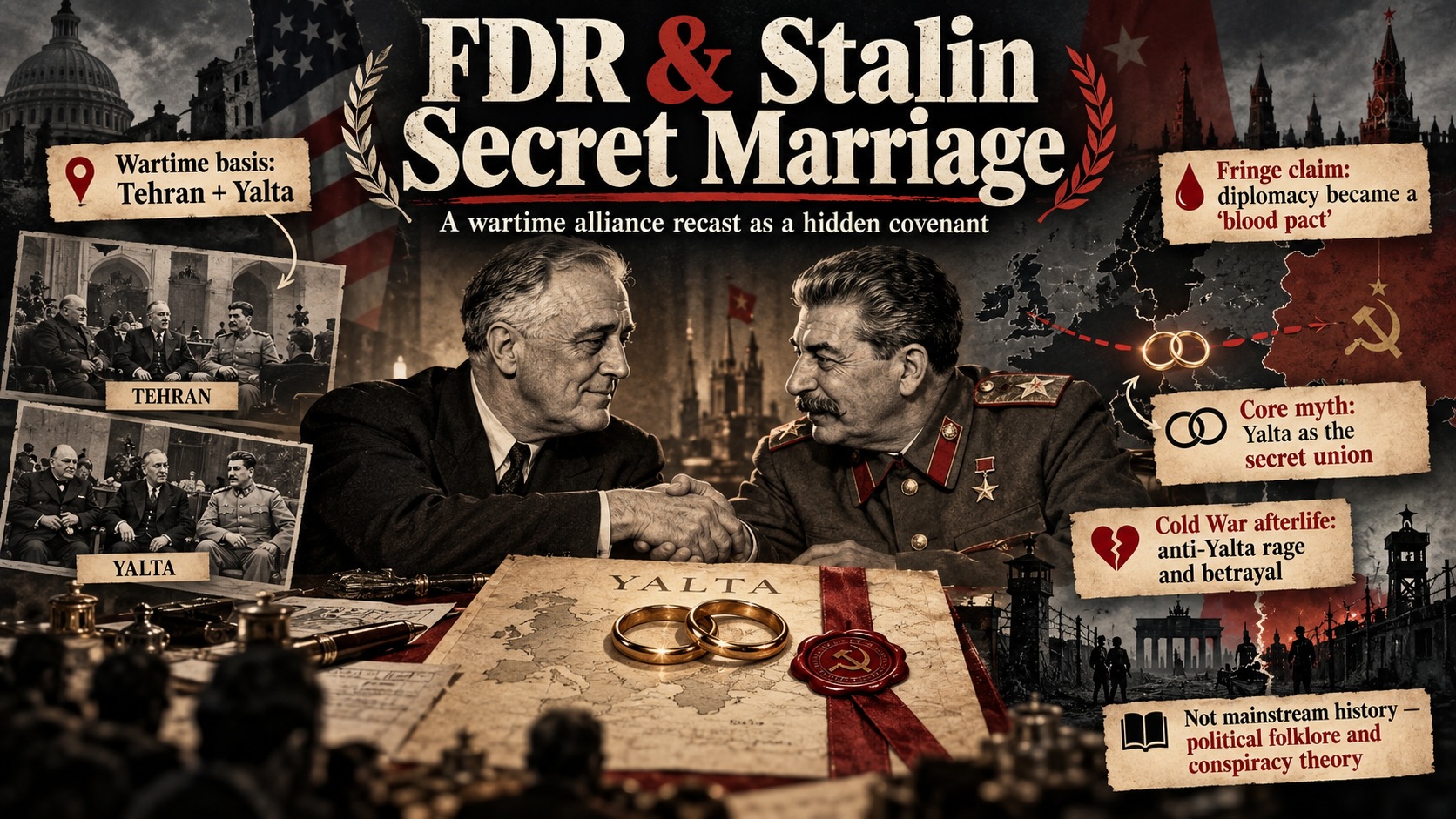
The “FDR and Stalin Secret Marriage” theory belongs to the most theatrical edge of anti-communist political folklore. It took the real wartime alliance between the United States and the Soviet Union and converted it into an image of personal union: not merely diplomacy, but a hidden covenant. In some versions the language was symbolic, with Roosevelt and Stalin described as politically “married” against American interests. In more extreme versions the metaphor hardened into a literal secret pact, blood ritual, or concealed plan to merge the United States and the USSR into a single postwar order.
The theory was never a mainstream interpretation of Allied diplomacy. Its power came instead from the emotional charge surrounding Roosevelt’s dealings with Stalin and the later argument that Yalta had “given away” Eastern Europe.
Wartime Basis of the Rumor
Roosevelt met Stalin repeatedly in the wartime conference system that shaped Allied strategy. Tehran and Yalta, along with the diplomatic machinery surrounding them, produced an enormous record of negotiation over Germany, Poland, the United Nations, reparations, and the Soviet entry into the war against Japan.
To critics, especially after the war, the tone of Roosevelt’s dealings with Stalin seemed too trusting. The claim that Roosevelt believed personal rapport could help stabilize postwar cooperation became a seedbed for harsher accusations. Once Soviet control over Eastern Europe hardened, anger over those wartime decisions was often retroactively personalized.
From Alliance to “Blood Pact”
The theory’s central move was to reinterpret Allied cooperation as concealed union. What official records describe as strategic bargaining was recast in fringe anti-communist language as evidence of prior commitment. The “secret marriage” motif dramatized this accusation by suggesting something sacramental or irreversible had taken place behind closed doors.
The “blood pact” version sharpened the imagery further. Rather than ordinary diplomacy, it presented Roosevelt and Stalin as bound by hidden oath. That language reflected a broader postwar political style in which defeats, concessions, or strategic compromises were described not as misjudgments but as betrayal.
Yalta as the Theory’s Core Scene
Although the rumor could attach to Tehran as well, Yalta became the primary symbolic site for the theory. There, Roosevelt, Churchill, and Stalin discussed postwar settlement questions that later became central to Cold War argument. Because Yalta involved private meetings, partial agreements, and later retrospective bitterness, it became fertile ground for myth.
The theory treated the conference not as bargaining among unequal wartime partners but as a concealed ceremony of transfer. In that retelling, Eastern Europe, Manchurian concessions, and postwar institutional design became the dowry of the hidden union.
Anti-Communist Afterlife
As the Cold War developed, accusations that Roosevelt had been naive about Stalin mixed with stronger claims that he or his advisers had been compromised, infiltrated, or ideologically aligned. The “secret marriage” story belongs to this more fevered zone of anti-communist imagination.
It also drew strength from the language of emotional betrayal. The allegation was not only that policy had failed, but that the American state had been bound intimately and secretly to its future rival. In that sense the theory functioned less as a literal diplomatic proposition than as a maximal expression of anti-Yalta rage.
Legacy
The theory persists because it compresses the entire Yalta argument into one image: a hidden marriage between Roosevelt and Stalin. The factual scaffolding beneath it is the real sequence of wartime conferences, concessions, strategic hopes, and postwar disappointment. The conspiratorial layer is the claim that those events reflected not contested diplomacy under wartime pressure, but a concealed and deliberate union of power.