
Overview
The Business Plot refers to an alleged conspiracy in 1933 in which a group of wealthy American industrialists and financiers were said to have approached retired Marine Corps Major General Smedley Butler with a proposal to lead a veterans' army in a coup against President Franklin D. Roosevelt's administration. Butler alleged that the plotters intended to install a fascist-style government modeled on movements then rising in Europe, with Roosevelt either displaced or reduced to a powerless figurehead. The McCormack-Dickstein Committee, a special House committee, investigated Butler's claims in 1934 and reported that it found his testimony credible and that attempts of the kind he described had been discussed — yet no criminal prosecutions followed, and the true scope and seriousness of the alleged conspiracy has been debated by historians ever since.
Background
The early 1930s were years of acute economic and political instability in the United States. The Great Depression had wiped out savings, shuttered businesses, and pushed unemployment to catastrophic levels. Franklin Roosevelt took office in March 1933 on a promise of a "New Deal" — a sweeping program of federal intervention in banking, agriculture, labor, and relief. Many in the American business and financial establishment viewed the New Deal with alarm, believing Roosevelt's reforms threatened private enterprise, devalued the dollar through abandonment of the gold standard, and represented a slide toward socialism or worse.
This climate of elite hostility toward Roosevelt provides the context in which Butler's allegations must be understood. Across Europe, fascist movements had demonstrated that business-friendly authoritarian governments were capable of suppressing labor movements and Communist parties. In the United States, organizations such as the American Liberty League — funded in part by prominent corporate figures — openly campaigned against New Deal policies, though through legal political means.
The Alleged Plot
Butler alleged that in the summer of 1933 he was approached by Gerald MacGuire, a bond salesman and American Legion official, acting as a representative of wealthier interests. According to Butler's account, MacGuire and an associate named Bill Doyle initially proposed that Butler use his influence to pressure the American Legion into passing a resolution demanding restoration of the gold standard — a policy that would benefit certain financial interests. Butler alleged that MacGuire subsequently visited him multiple times, eventually outlining a far more radical scheme.
Butler alleged that MacGuire described a plan to raise a private army of 500,000 veterans, funded by wealthy backers, which Butler would lead in a march on Washington. The intent, Butler alleged, was to force Roosevelt to accept a new "Secretary of General Affairs" who would take over executive functions, leaving Roosevelt as a ceremonial figurehead — or, if Roosevelt refused, to remove him entirely. Butler alleged that MacGuire cited the example of European fascist movements and referenced figures he claimed were prepared to finance the operation.
Among the names Butler alleged were connected to the scheme were members of prominent American business families and Wall Street figures. Butler took no part in the plot and ultimately reported what he had been told to the authorities and to Congress.
Smedley Butler's Testimony
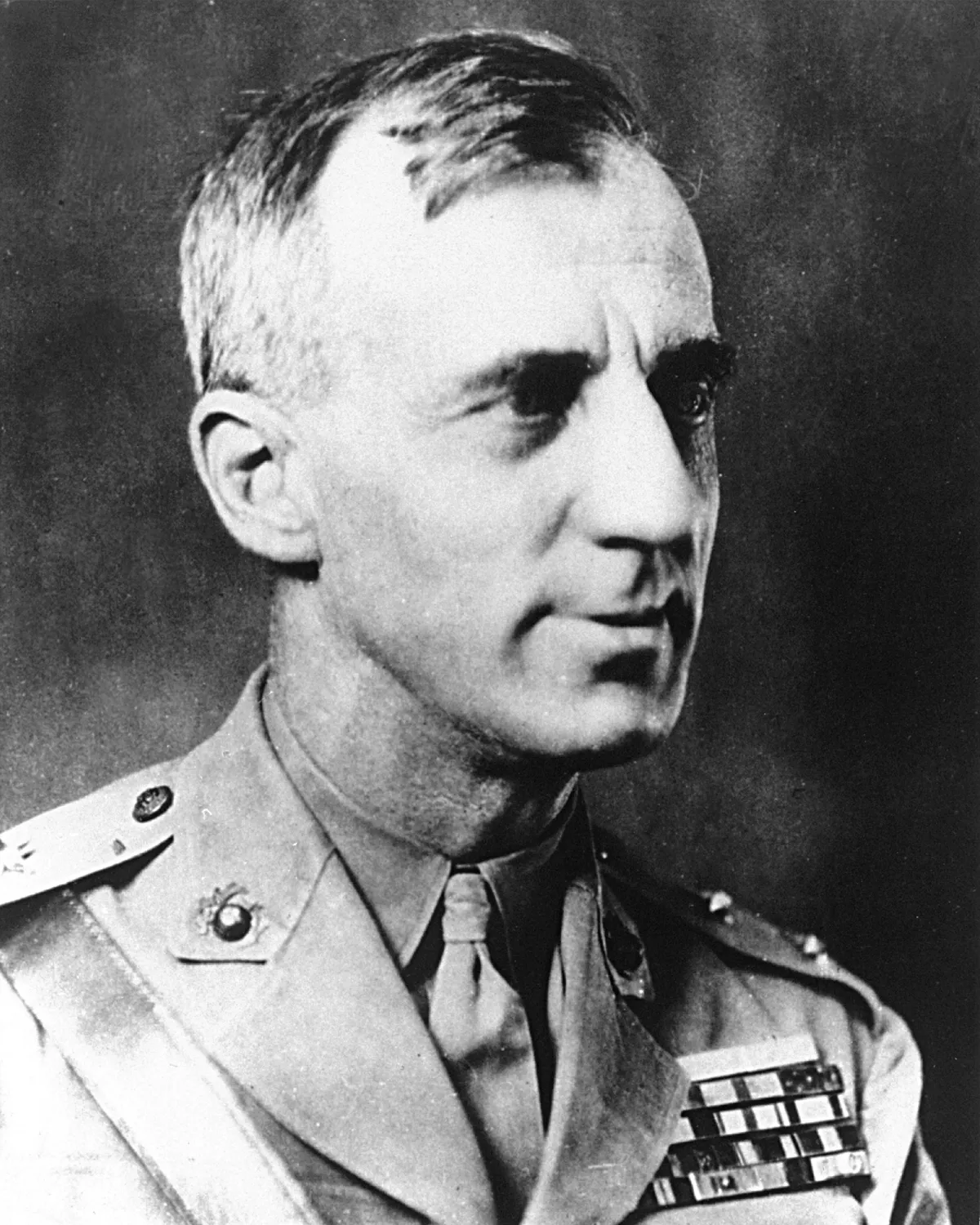
Smedley Butler, twice awarded the Medal of Honor — the standing that made him useful to the scheme he described, and hard to dismiss when he described it. Wikimedia Commons, public domain.

Smedley Butler was one of the most decorated and publicly credible military figures in American life. He had served for thirty-three years in the Marine Corps, fought in numerous conflicts from the Philippines to France, and had been awarded the Medal of Honor twice — a distinction held by very few. After retirement, Butler became a vocal critic of American foreign policy, famously arguing that war was a racket waged in the interests of corporate profits. His public stature made him a plausible candidate to lead a veterans' movement, and also made his testimony before Congress difficult to dismiss outright.
Butler testified before the McCormack-Dickstein Committee in November 1934. His account was detailed and consistent, naming MacGuire as his principal contact and describing the escalating nature of the approach. Journalist Paul Comly French, who had spoken with MacGuire at Butler's request, also testified and corroborated elements of what Butler described. MacGuire denied the most serious allegations when he testified, claiming conversations had been misunderstood.
The Congressional Investigation
The McCormack-Dickstein Committee — formally the Special Committee on Un-American Activities — had been established partly to investigate fascist and Communist activities inside the United States. After taking testimony through late 1934, the committee issued a report stating that it found Butler's testimony credible and that the evidence before it indicated that a plot of the type he described had been in the planning stages. The committee found that the more extreme aspects of the alleged scheme had not been fully developed and that no overt action had been taken.
No individual was indicted or prosecuted as a result of the investigation. Several newspapers at the time dismissed or ridiculed Butler's claims, and the names of alleged high-level backers were reportedly redacted from the publicly released version of the committee's findings. Critics have pointed to this outcome as evidence that the investigation was incomplete or that political pressure limited its reach. Defenders of the outcome argue that the evidence of an actionable criminal conspiracy, as distinct from loose talk among disaffected elites, was insufficient.
Debate Over Its Seriousness
Historians debate whether the Business Plot represented a genuine, organized threat to American democracy or a far more preliminary and disorganized set of conversations that Butler — or subsequent interpreters — elevated into something more dramatic. Some historians argue that the documented financial connections of those allegedly involved, combined with the committee's own finding of credibility, indicate that at minimum a serious conversation about extra-constitutional action was occurring among elements of the American elite. Others contend that the plan never advanced beyond vague discussion, that MacGuire was a minor figure acting without authority from any organized conspiracy, and that the alleged "plot" was never close to execution.
The absence of prosecutions and the handling of the committee's report leave key questions unresolved. Whether wealthy principals named by Butler had actually authorized MacGuire's approaches, or whether MacGuire was overstating his connections, cannot be definitively answered from the available record.
Legacy
The Business Plot entered popular historical memory as a striking example of elite anti-democratic politics during the Depression era. It is frequently cited in discussions of how economic crises can generate authoritarian temptations even within established democracies, and as a case study in the relationship between concentrated private wealth and political power. Butler's own subsequent fame as the author of the pamphlet "War Is a Racket" has kept his role in the episode in circulation.
The episode is sometimes invoked as a reminder that conspiracy against democratic institutions is not merely a phenomenon of foreign governments or marginal actors, and that the congressional investigation — incomplete as many consider it — nonetheless stands as an instance of the legislative branch taking such allegations seriously enough to investigate and report on them.