
Overview
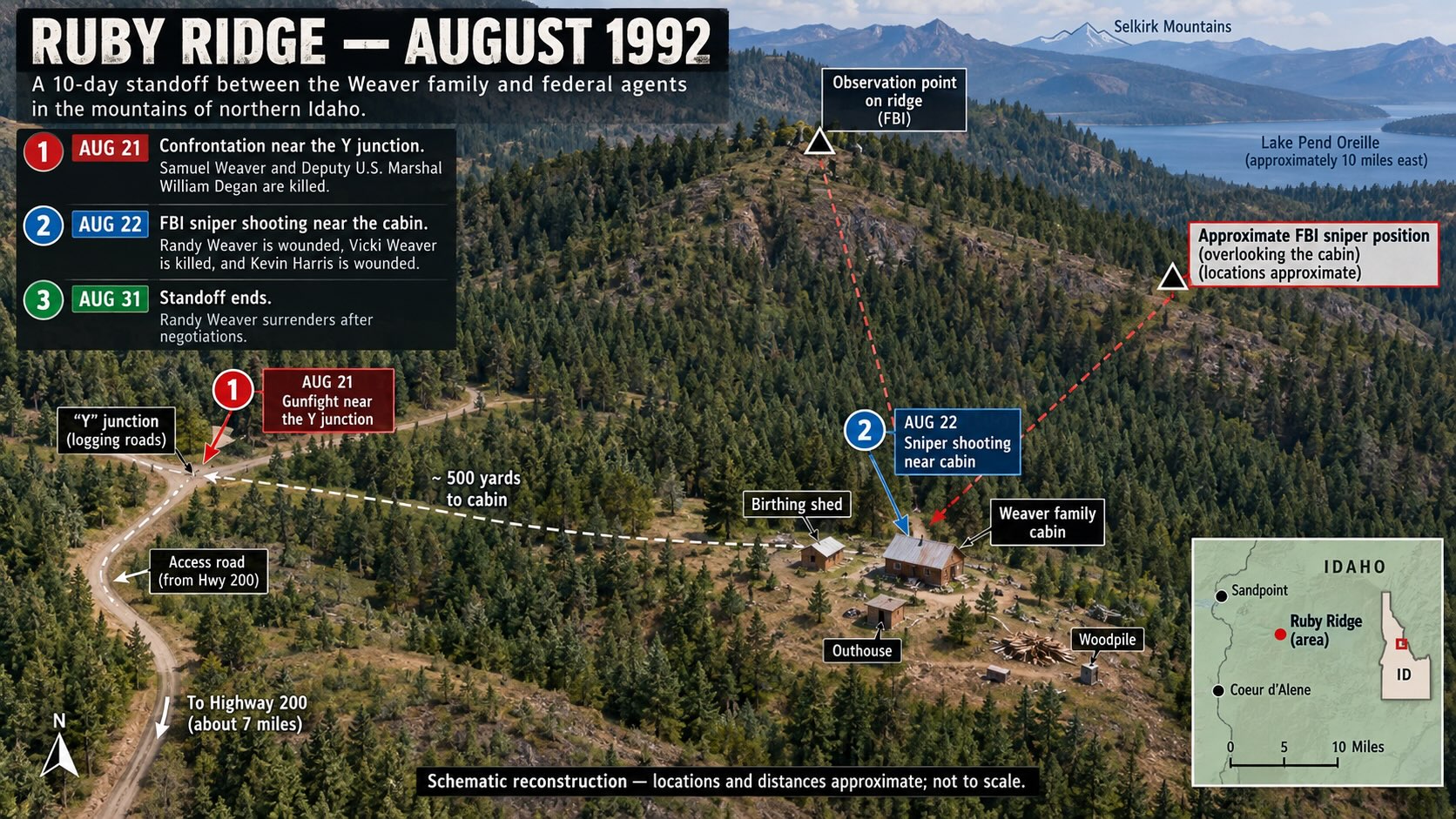
Ruby Ridge is the name of a mountain in Boundary County, Idaho, and of eleven days in August 1992 that killed three people: a fourteen-year-old boy, a deputy United States marshal, and a woman standing behind a door holding her ten-month-old daughter.
It began as a failure-to-appear warrant on a weapons charge. It ended with a federal task force, a Senate inquiry, an FBI official in prison for destroying a document, $3.1 million paid to the surviving family, and a set of rules of engagement that a Senate subcommittee would describe as unconstitutional on their face.
Almost everything contested about Ruby Ridge is contested on a documented record. The Justice Department's own Ruby Ridge Task Force produced a 542-page report. The rules under which the snipers operated are published. The sniper testified under oath. That is unusual for an event this central to American conspiracy culture, and it means the theories below can be measured against something.
The family on the mountain
Randy and Vicki Weaver moved from Iowa to a cabin on Ruby Ridge in the 1980s, holding a set of apocalyptic religious beliefs — a conviction that the end was near and that the federal government was an instrument of it. They schooled their children at home and largely withdrew.
In January 1985 the FBI and Secret Service investigated allegations that Weaver had threatened Ronald Reagan and other officials. Weaver denied it. No charges were filed. The allegation stayed in the file.
That detail matters because of what a Senate subcommittee later concluded about how the government assessed him. Its 1995 report found that agents' assumptions — including that Weaver had booby-trapped and tunnelled his property — exaggerated the threat he actually posed.
The shotguns
In 1986 the Bureau of Alcohol, Tobacco and Firearms began investigating Weaver through his contact with the Aryan Nations compound at nearby Hayden Lake. A paid informant bought two shotguns from him. The barrels were shorter than federal law allows without registration.
Weaver was offered a choice: become an informant inside the Aryan Nations, or face charges. He refused. In June 1990 a federal grand jury indicted him on weapons offences. He was arrested and released pending trial.
He never appeared. Part of the reason was a clerical error — the Justice Department's own account acknowledges he was given the wrong trial date. A bench warrant issued. A probation officer's letter had given one date; the court had set another. By the time anyone noticed, Weaver had decided the discrepancy was a trap and would not come down off the mountain for any date at all.
Eighteen months of surveillance followed. The Marshals Service built a file, mapped the property, and looked for a way to arrest a man who had said he would not be taken.
21 August 1992: the Y
On the morning of 21 August, six deputy marshals were on the mountain conducting reconnaissance. Near a fork in the track below the cabin — the Y — they were discovered by the family's dog, a yellow Labrador called Striker, and then by Weaver's fourteen-year-old son Samuel and family friend Kevin Harris, who had followed the dog out thinking it had scented game.
What happened next is disputed in detail and agreed in outcome. Shooting started. Striker was killed. Samuel Weaver was killed, shot in the back as he ran. Deputy Marshal William Degan was killed.
The Justice Department's position is that Harris fired the shot that killed Degan. The defence's position at trial was that the marshals fired first and that Harris acted in defence of a boy being shot at. The jury that heard all of it did not accept the government's account.
The marshals withdrew with Degan's body. The FBI was notified, its Strategic Information and Operations Center activated, and the Hostage Rescue Team dispatched.
The rules of engagement
Before the HRT deployed, rules of engagement were drafted. They are the single most consequential document of the whole affair, and because they were published in the Task Force report, they can be read rather than characterised:
If any adult male is observed with a weapon prior to the announcement, deadly force can and should be employed, if the shot can be taken without endangering any children.
If any adult in the compound is observed with a weapon after the surrender announcement is made, and is not attempting to surrender, deadly force can and should be employed to neutralize the individual.
If compromised by any animal, particularly the dogs, that animal should be eliminated.
Any subjects other than Randall Weaver, Vicki Weaver, Kevin Harris, presenting threats of death or grievous bodily harm, the FBI rules of deadly force are in effect.
The standard FBI policy — the one rule 4 reserves for everybody else — permits deadly force to prevent death or grievous bodily harm. The rules above do something different. They make deadly force the expected response to the sight of an armed adult, before any announcement, and they say so with the word should.
Horiuchi, the sniper who fired, testified that the rules differed from those in the FBI manual and from those the HRT normally operated under, and that he had never before been asked to operate under such rules. Asked at trial whether, under those rules, he could and should use deadly force if the family came out of the house armed, he answered: "Yes sir, it is true."
These rules remained in effect until 26 August, when they were replaced by the FBI's standard deadly force policy. That date is worth noting because it is frequently confused with the date of the shooting.
22 August 1992: the two shots
Lon Horiuchi was positioned roughly two hundred yards from the cabin with a Remington Model 700 rifle, a fixed ten-power Unertl scope, and .308 match-grade ammunition.
At about 5.45 p.m. he saw an unarmed young woman run from the cabin. He looked at her through the scope and concluded she was a child. She was Sara Weaver, sixteen.
An HRT helicopter approached. Randy Weaver, Sara and Kevin Harris came out of the cabin armed, moving toward a shed where Samuel's body lay. Horiuchi fired. The round struck Randy Weaver in the back near the shoulder. Horiuchi believed at the time that he had shot Harris; he had not.
The three ran back toward the cabin. Horiuchi fired a second time at the man he believed he had already hit. The round passed through the open cabin door. Behind that door, holding her ten-month-old daughter Elisheba, stood Vicki Weaver. The bullet struck her in the head and killed her, then struck Harris in the chest, seriously wounding him.
No surrender announcement had been made before the first shot.
The siege and the surrender
The standoff continued for nine more days, with Vicki Weaver's body in the cabin and the wounded inside. Negotiators called to a cabin that had no working telephone. The family did not respond.
Harris came out on 30 August. The remaining occupants left voluntarily on 31 August, after days of mediation involving former Green Beret and populist figure Bo Gritz, who was able to talk to Weaver when federal negotiators could not.
What the courts did
Weaver and Harris were tried in 1993 for murder and a string of related offences. Weaver was defended by Gerry Spence, who called no witnesses and argued the government's case was the defence.
After the longest jury deliberations in Idaho history, both men were acquitted of the most serious charges — including the murder of Degan. Harris was acquitted outright. Weaver was convicted on two counts only: failure to appear, and committing an offence while on release. He was not convicted of the weapons charge the entire sequence began with.
What the investigations found
The record here is long, and its most striking feature is how much it contradicts itself.
- 30 September 1992 — the FBI's Shooting Incident Review Team found the shooting justified.
- 2 November 1992 — an FBI after-action conference was held. E. Michael Kahoe later destroyed the report of it.
- 9 November 1992 — the Shooting Incident Review Group found no FBI misconduct.
- 16 January 1994 — the Walsh report found no FBI misconduct.
- 10 June 1994 — the Ruby Ridge Task Force reported. The Berman inquiry within it found the rules of engagement defective and the second shot not justified.
- 30 June 1994 — the Justice Department's Office of Professional Responsibility found both shots justified.
- 16 December 1994 — the Mathews review recommended discipline for three officials, but not for Larry Potts or Danny Coulson.
- October 1996 — Kahoe pleaded guilty to obstruction of justice and was sentenced to eighteen months in prison.
- 30 June 1999 — OPR issued a final report finding misconduct by Potts, Coulson, Walsh, Harp and Mathews.
- 3 January 2001 — the Assistant Attorney General decided no further disciplinary action would be imposed.
Two internal reviews reached opposite conclusions about the same shot within twenty days of each other. A senior official destroyed a record of an after-action meeting and went to prison for it. That is not an inference drawn by critics; it is the Justice Department's own chronology.
The Senate hearings
In 1995 a Senate Judiciary subcommittee held hearings. Its conclusion about the rules of engagement was blunt: that they were clearly unconstitutional and contrary to the FBI's own policy on the use of deadly force. Former Deputy Attorney General Jamie Gorelick testified that taken on their face and in a vacuum, they were unconstitutional.
The subcommittee also found that the government's assessment of Weaver — the booby traps, the tunnels, the threat — had been exaggerated.
What was paid, and what was never admitted
In August 1995 the Justice Department settled the family's civil claims. The three surviving daughters of Vicki Weaver received $1 million each; Randy Weaver received $100,000. The settlement resolved claims that had been filed at $200 million. The announcement stated that the United States does not admit wrongdoing or legal liability.
Kevin Harris settled separately. On 22 September 2000 the government agreed to pay him $380,000, in what the Justice Department called the last remaining civil suit from the standoff. That settlement, too, carried no admission of liability.
Boundary County charged Horiuchi with involuntary manslaughter. The case was removed to federal court and dismissed on supremacy-clause grounds — a federal officer acting within the scope of duty. A federal appeals court upheld the dismissal. He was never tried.
The theories
Ruby Ridge produced an unusually wide spread of claims, and they are worth separating, because they do not all rest on the same ground.
The sniper contract
The most developed theory holds that the shooting was not a tactical error under bad rules but an execution under a standing policy — that the Hostage Rescue Team functioned as a selective-elimination capability for politically inconvenient Americans, and that Horiuchi was carrying out a decision taken before anyone reached the mountain.
What it rests on is real: rules that made killing the expected response, written in advance, approved up a chain, applied to three named people. What it asserts beyond that — a standing authority, a programme, an intent formed before the operation — has not been produced in any of the investigations, the trial record, or the released files.
The rules were policy, not error
A narrower version drops the idea of a programme and keeps the intent. On this reading the rules were not a drafting failure under pressure but an accurate statement of what the Bureau meant to do, and the subsequent findings of "defect" were the institution disowning a decision it had made deliberately.
This one is harder to dismiss than the first, because the documentary record is genuinely strange: the rules were approved, the shooting was cleared twice, cleared again, found unjustified by one inquiry, then found justified by another twenty days later, and the record of the after-action meeting was destroyed by a man who went to prison for destroying it.
Entrapment by design
That the weapons charge was manufactured — that a paid informant was sent to produce a felony from a man with no record of one, specifically to obtain leverage to turn him into an informant inside the Aryan Nations, and that the prosecution was the consequence of his refusal.
The sequence here is not disputed. An informant did buy the shotguns; Weaver was offered the choice; he refused; he was indicted. What is contested is whether that is entrapment or ordinary leverage, and a jury declined to convict him on the underlying charge.
The wrong date was deliberate
That the incorrect trial date was not clerical but engineered, to produce a failure to appear and the warrant that followed.
The error is documented. No evidence has been produced that it was intentional, and the Senate subcommittee treated it as a mistake — though one it criticised the government for failing to correct.
The cover-up
That the federal response afterwards was a coordinated effort to protect senior officials.
This is the theory with the most official support behind it, and it is better described as partly established than as alleged. A document was destroyed. An FBI official was convicted of destroying it. The Department's own final report found misconduct by five named officials. What remains contested is how far up it went and whether the inconsistencies between reviews reflect coordination or ordinary institutional self-protection.
The sequence
That Ruby Ridge, Waco the following year, and the Oklahoma City bombing three years after that form one chain — a government escalating against its own citizens, and a reaction to it.
The causal link in one direction is documented and was stated by the bomber himself: Timothy McVeigh cited Ruby Ridge and Waco as motivating grievances, and chose the anniversary of the Waco fire. The link in the other direction — that the federal actions were coordinated phases of a policy rather than separate operational disasters — has not been established by any inquiry.
Underground facilities beneath the mountain
A claim circulates in later conspiracy culture that the Weavers were targeted because they had discovered something physical under the mountain — in the most recent versions, a facility connected to adrenochrome harvesting, a motif that entered American conspiracy lore long after 1992 and attaches itself to many earlier events.
Nothing in the documented record supports it. There is, however, a detail it may have grown from: the government's own threat assessment held that Weaver had tunnelled and booby-trapped his property, and the Senate subcommittee specifically identified that assumption as one of the exaggerations that drove the operation. The tunnels in the file were the government's, and they were not there.
Where it stands
What is established is unusually large for a case of this kind. The rules of engagement existed and said what they said. A sixteen-year-old was identified through a scope as a child. A man was shot in the back having never been asked to surrender. A woman holding an infant was killed behind a door by a shot aimed at somebody else, who was also not the person the sniper believed he was shooting. A record was destroyed and someone went to prison for it. Five officials were found to have committed misconduct and none were disciplined further. The government paid $3.48 million across two settlements and admitted nothing in either.
What is not established is intent beyond the mountain: that anyone decided in advance to kill the Weavers, that an apparatus existed for that purpose, or that any of it was coordinated with what happened at Waco the following year.
Ruby Ridge is usually cited as proof that the federal government will kill people it finds inconvenient. The record supports something narrower and, for most of the people who lived through it, no more comforting: that it wrote rules under which killing was the expected outcome, approved them, acted on them, cleared itself four times, destroyed a document, and paid.