
The claim
On 30 October 1938 the Mercury Theatre on the Air broadcast an adaptation of The War of the Worlds built out of the conventions of live news: dance music interrupted by bulletins, field reports, official-sounding experts, real place names in New Jersey.
The theory holds that this was not only theatre. In its strong form the broadcast was commissioned or steered as an experiment — by the military, by intelligence, or by researchers in mass persuasion — to measure how quickly a population under stress would accept an authoritative emergency narrative. In softer versions no sponsor is required, but the programme is still treated as a rehearsal for wartime persuasion rather than a drama that got out of hand.
The timing is the hook. It aired weeks after the Munich crisis, into a country that had spent the year listening to alarming bulletins from Europe and arguing about whether radio could bypass a listener's judgement.
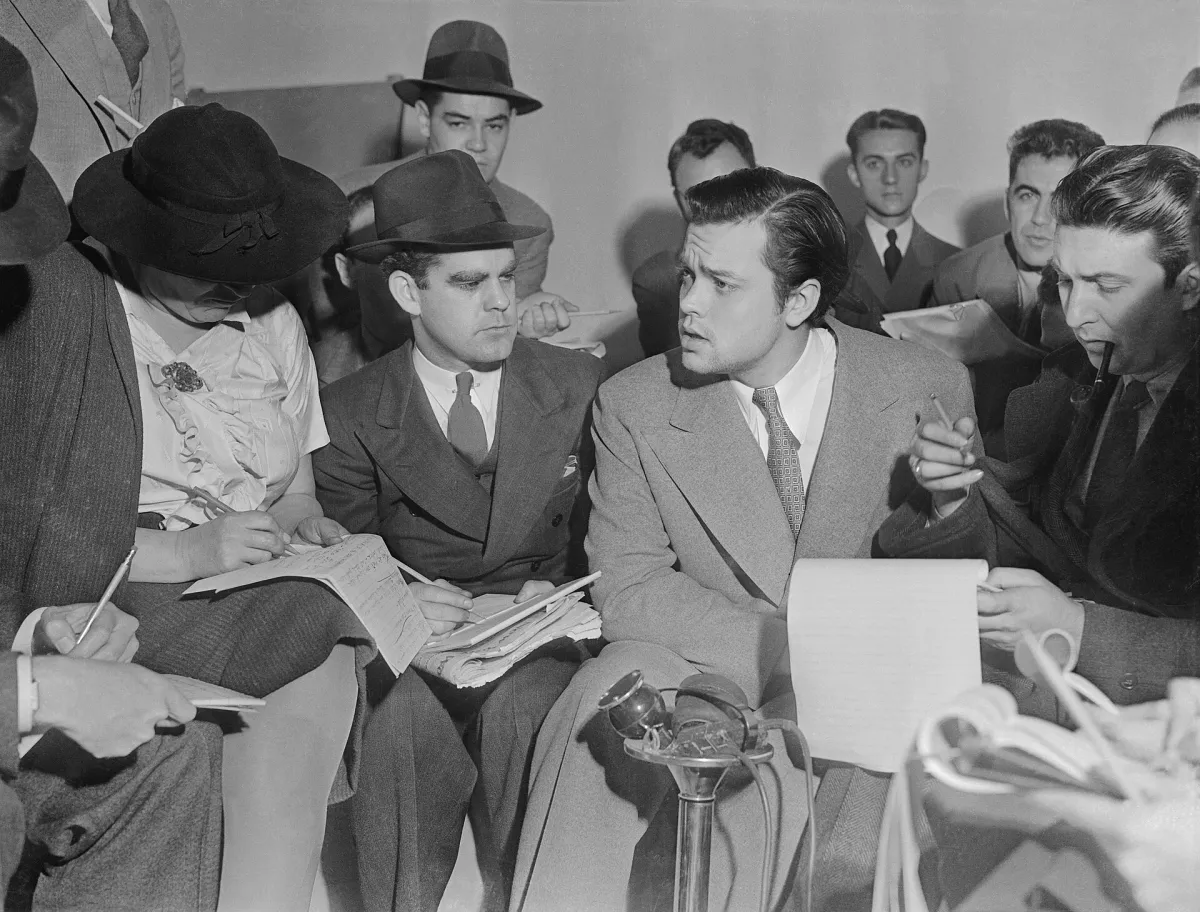
Welles facing the press the day after the broadcast. The photograph is the story in miniature — the panic became national news because newspapers made it so. Wikimedia Commons — Acme News Photos, Public domain

The problem: the panic is largely a myth
Everything in the theory rests on the broadcast having produced mass panic. If it did, the broadcast demonstrated something worth demonstrating. If it did not, there is nothing for an experiment to have found.
It mostly did not.
The ratings are the first difficulty. The broadcast was opposite the most popular show in America, and the survey data indicate a small audience — in the figure most often cited from the period's ratings, about two per cent of households surveyed. The Mercury Theatre was not a programme most of the country was listening to.
The second difficulty is that the specific panic stories do not survive checking. Jefferson Pooley and Michael Socolow went back through the claims of hospitals treating people for shock and found them unsupported. The familiar images — crowds in the streets, mass flight, suicides — are not corroborated by the records that should contain them.
What did happen is real but much smaller: some listeners who tuned in late were frightened, switchboards at stations and newspapers took calls, and a number of people went to check on relatives. That is a genuine reaction and it is not a nation in flight.
Where the panic story came from
This is the part that makes the episode worth an entry, because the manufactured version has an identifiable author and a motive.
The newspapers ran with it. In 1938 the press was losing advertising revenue to radio and was arguing to advertisers and regulators that broadcasting was irresponsible and needed restraining. A story in which radio had terrified the nation was extremely useful to that argument, and it was printed hard.
So the theory's foundational fact — that a broadcast produced mass panic, proving radio's power over a population — is itself a media artefact, produced by one industry about a competitor for commercial reasons. A conspiracy theory about media manipulation rests on a piece of media manipulation, which is not the usual shape of these things.
The part the theory gets right
There is a real kernel, and it is not the one usually pointed at.
Organised research into radio's effect on the public did exist, it was funded, and it predated the broadcast. The Rockefeller Foundation began funding work on the effects of mass media in 1937. The Office of Radio Research was based at Princeton, managed by Paul Lazarsfeld with Hadley Cantril and Frank Stanton overseeing it.
When the broadcast happened, that apparatus studied it. Cantril's The Invasion from Mars, published in 1940, is the book nearly every later account of the panic ultimately rests on. He estimated an audience of about six million and concluded roughly a quarter of them took the reports as real.
So the instinct behind the theory — that serious money and serious researchers were interested in what radio could do to a population's beliefs — is correct. The direction is what it gets wrong. The research programme did not commission the broadcast; it was already running, and the broadcast fell into it as an unplanned natural experiment.
Cantril's numbers are also the weak link in the received story rather than its foundation. Pooley and Socolow's objection is methodological: that he overestimated how many people were listening, and that an inflated denominator has been carried forward through eighty years of retelling.
What would be needed
For the strong version of the theory, a document: an instruction, a budget line, correspondence between the Mercury Theatre and a sponsor, something in the Rockefeller or Princeton records tying the programme to the research. None has been produced. The production history that does exist describes a show assembled under deadline pressure by people who thought the script was weak.
For the soft version, only that the broadcast functioned as a test whether or not anyone intended it — which is true, and is why Cantril wrote a book about it, and which is a description of what researchers did afterwards rather than a conspiracy.
Where it stands
No evidence has been produced that the broadcast was arranged, steered or commissioned as an experiment.
What the episode actually documents is stranger and better attested: a drama frightened a modest number of people, a rival industry inflated that into a national hysteria for commercial advantage, a foundation-funded research project measured the result with methods later found to overstate it, and the inflated version became the thing everyone knows. The manipulation in this story is real. It just runs through the newspapers rather than the broadcast.