
The test
Between 20 and 27 September 1950, a US Navy ship standing off the coast of San Francisco sprayed two organisms into the air: Serratia marcescens and Bacillus globigii. Both were chosen as simulants — stand-ins for a real biological weapon, believed at the time to be harmless, selected partly because Serratia produces a red pigment that makes it easy to find on a culture plate.
The purpose was to measure, not to harm. The question was how far and how thoroughly an aerosol released offshore would penetrate a large American coastal city, and the answer was obtained from monitoring equipment at 43 locations around San Francisco. On the Army's own calculation, the coverage was close to total: nearly all of the city's 800,000 residents inhaled at least 5,000 particles.
Nobody in San Francisco was told, before or afterwards. The city was the apparatus.
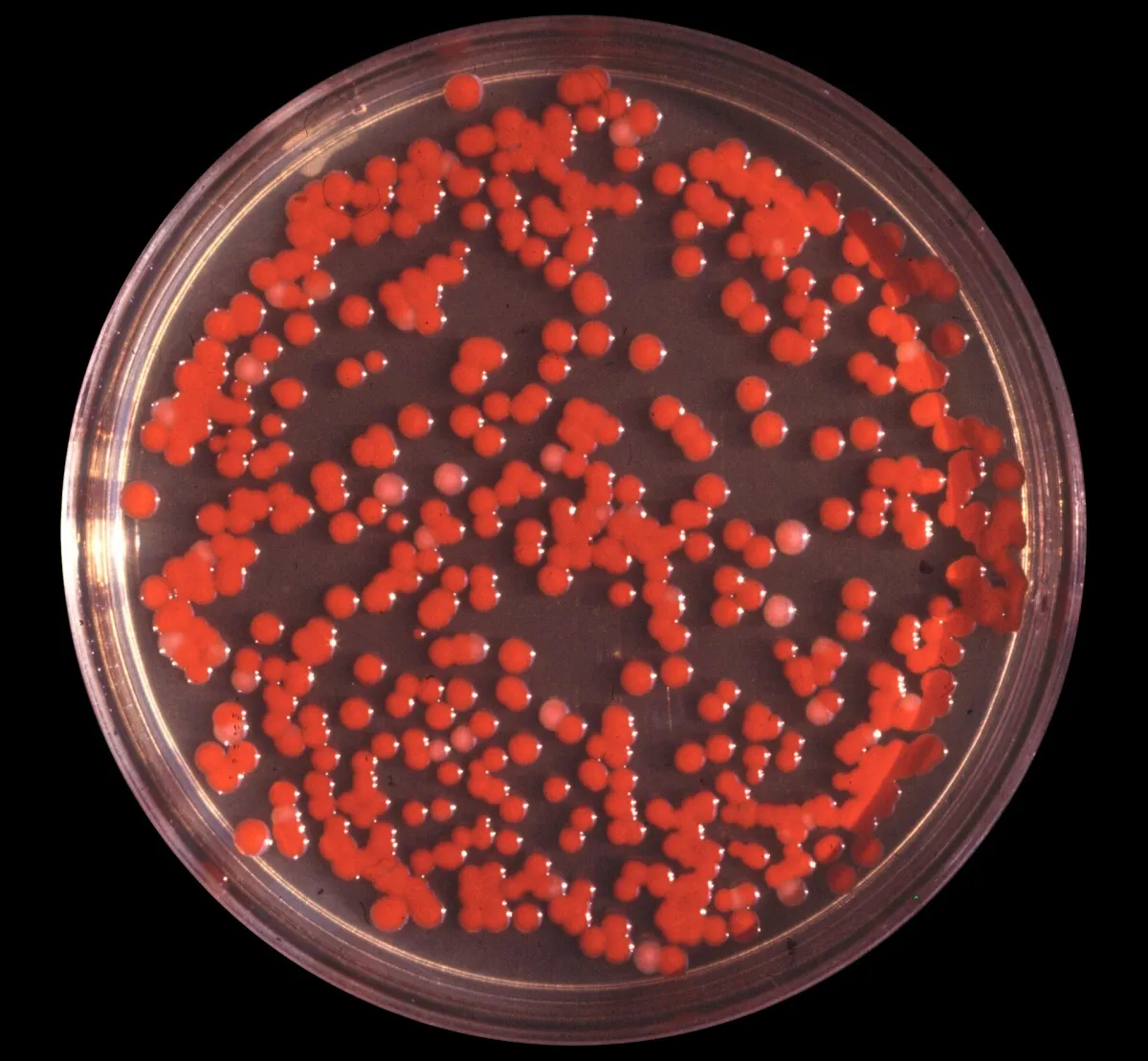
Serratia marcescens. The red pigment is why it was chosen as a simulant — it is easy to count on a plate — and it is also how the spread over San Francisco was measured. Wikimedia Commons — de:Benutzer:Brudersohn, CC BY-SA 3.0

How it became public
The test stayed secret for twenty-six years. It did not come out through a whistleblower or a leak from inside the programme.
In 1976 a Newsweek reporter obtained classified documents describing a broader programme of open-air testing, and the San Francisco Chronicle followed the trail to the 1950 experiment on its own city. The following year the Army described the tests to a Senate subcommittee. The disclosure was official, on the record, and made under the pressure of reporting that had already run.
Sea-Spray was not an isolated event. It belongs to a long programme of open-air trials later identified under designations including Project 112 and its shipboard component Project SHAD, which the Department of Veterans Affairs now maintains public information about for the servicemen who were exposed.
The death, and what it does and does not show
This is where most accounts of Sea-Spray go wrong, and it is worth getting right.
On 11 October 1950, two weeks after the spraying ended, eleven patients were admitted to Stanford Hospital with rare and serious Serratia marcescens urinary tract infections. Ten recovered. One, Edward J. Nevin, died about three weeks later. In 1981 his surviving family sued the federal government for negligence.
The eleven cases are real and the death is real. The causal connection to the Navy's aerosol is the part that is not established, and the reason is specific rather than hand-waving. At the 1977 hearings the Army testified that all eleven patients had recently undergone minor surgical procedures, and that the outbreak was confined to that single hospital — no comparable cluster appeared anywhere else in a city where, by the Army's own figures, essentially everyone had inhaled the organism. An agent that reached 800,000 people and produced eleven infections in one building, all of them in recent surgical patients, points at the building rather than the air.
The current assessment is that the Stanford cluster was unrelated to the test. That assessment comes in part from the institution with an interest in it being true, which is a reason to hold it loosely rather than to discard it; but the epidemiological shape of the thing supports it independently of who is saying so.
Serratia marcescens is also not the harmless organism it was taken for in 1950. It is now recognised as a genuine opportunistic pathogen, particularly in hospital settings and in patients who are already compromised. That changes the retrospective judgement of the decision to spray it over a city, without establishing that this particular spraying killed this particular man.
One test among many
Sea-Spray reads differently once it is placed where it belongs, which is inside a programme rather than at the end of one.
The United States ran open-air releases of simulants over populated areas for decades. Operation LAC dispersed zinc cadmium sulfide across very large areas of the United States and Canada from aircraft, tracing the spread by ground sampling in the same way. Project 112 and its shipboard arm Project SHAD ran trials involving service personnel, and are substantial enough that the Department of Veterans Affairs still maintains public information for veterans who may have been exposed.
The zinc cadmium sulfide trials eventually got the treatment Sea-Spray never has: the National Academies conducted a toxicologic assessment of them and published it. That is the right model for this kind of question — an independent body, working from the dispersal records, asking what the exposure actually did — and it is worth noting that it took public pressure decades after the fact to produce one.
The pattern across all of it is consistent. The organisms and compounds were chosen because they were thought to be harmless. The populations were not asked. The records were classified. And the reassessment of whether the materials were in fact harmless happened long afterwards, conducted by people who had not chosen them.
What it actually establishes
The temptation with a case like this is to make it carry the heaviest claim available, and the heaviest claim is the one the evidence will not bear. The lighter claims are damning enough, and they are solid.
A branch of the United States military released bacteria over an American city of 800,000 people, without their knowledge or consent, in order to learn how an attack would spread. It measured the result and found the coverage nearly complete. It kept this secret for twenty-six years and disclosed it only after a journalist had already found the documents. It did so as one episode in a far larger testing programme, and it used an organism then believed harmless that is now known to cause serious infection in vulnerable people.
None of that requires a death to be troubling, and attaching the claim to a death that the evidence does not support has a cost. It gives anyone defending the programme an easy thing to correct, and the correction then does duty for a defence of the whole enterprise — which is a poor trade, because the experiment is indefensible on facts that nobody disputes.