
Overview
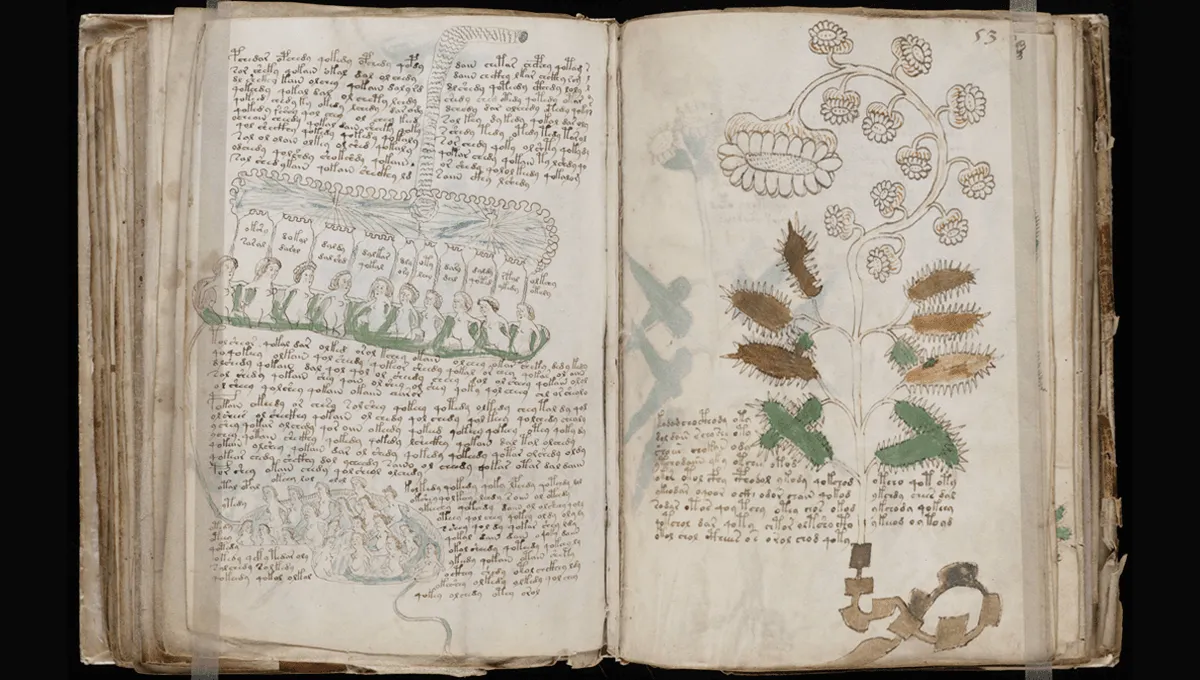
The Voynich Manuscript is one of the most famous unread books in existence. It is a handwritten illustrated codex now held by Yale University’s Beinecke Rare Book and Manuscript Library as MS 408. The manuscript is written in an unidentified script and language, or in a system that has not yet been publicly stabilized into a universally accepted reading. It contains botanical pages, circular diagrams, zodiac imagery, bathing figures, pharmaceutical drawings, recipe-like text blocks, and large foldouts that appear to map or schematize an entire hidden worldview.
From the standpoint of mystery literature, the Voynich Manuscript is not simply a difficult medieval text. It is a sealed archive of unknown meaning. Its script appears systematic, its illustrations are highly organized, and its pages suggest practical or ceremonial knowledge, yet the manuscript remains outside ordinary reading culture. This creates the central tension around it: the book looks meaningful at every level, but the meaning has remained locked behind a script and structure that continue to resist a final public key.
Wikimedia Commons — Unknown author, Public domain
.jpg)
The Basic Facts of the Object
The manuscript is commonly dated to the early fifteenth century based on radiocarbon testing of its parchment by the University of Arizona. The result placed the vellum in the range 1404 to 1438 with 95% probability. It is a medium-sized codex, roughly 23.5 cm tall, and today has about 240 surviving pages, though evidence from quire structure and numbering suggests that more pages originally existed and some were already missing before its modern rediscovery. The text runs left to right and appears in one main script with around 20 to 25 core glyphs, plus rarer symbols. The total corpus contains roughly 170,000 characters and about 35,000 word-like groups.
These facts matter because they define the Voynich Manuscript as a real historical object with a real fifteenth-century material base. It is not just a story about a lost book. It is a surviving codex whose writing system and content remain unusually closed.
Wilfrid Voynich and the Modern Name
The manuscript is named after Wilfrid Voynich, the antiquarian bookseller who bought it in 1912 from the Jesuit Collegio Romano collection. His acquisition gave the book its modern identity and launched the era of concentrated modern study. Before that, the manuscript already had a documented earlier chain of custody reaching into seventeenth-century Prague, but Voynich’s purchase is what turned it into an international literary and cryptographic mystery.
Within the lore of the manuscript, Voynich’s role is important because he did not merely discover an obscure codex. He reintroduced a dormant artifact into a modern world prepared to treat it as a challenge. Once the manuscript entered twentieth-century scholarship and cryptanalysis, it ceased to be a private curiosity and became an open problem.
The Prague Provenance Trail
The earliest secure ownership trail does not begin in the fifteenth century, but in seventeenth-century Prague. The first confirmed owner is generally identified as Georg Baresch, an alchemist in Prague. Baresch sent or discussed the manuscript with the Jesuit polymath Athanasius Kircher, apparently believing Kircher might be able to read it. Later, Johannes Marcus Marci, rector of Charles University in Prague, sent the manuscript to Kircher and included a now-famous covering letter written in 1665 or 1666. That letter is one of the manuscript’s most important documentary anchors.
This Prague connection is central to many hidden-history readings because Prague in that era sits at the crossroads of alchemy, imperial collecting, esoteric scholarship, and cryptic books. Once the Voynich Manuscript is placed there, it immediately acquires a courtly and occult atmosphere even before its actual content is understood.
The Rudolf II Tradition
A long-standing tradition associated with the manuscript says that it may once have belonged to Rudolf II, Holy Roman Emperor, and that he may have paid a large sum for it, possibly believing it to be the work of Roger Bacon. This tradition appears in the Marci letter and later discussions of provenance. While the manuscript’s material dating places the parchment in the early fifteenth century rather than Roger Bacon’s thirteenth century, the Rudolf association remained part of the manuscript’s aura because it links the book to one of Europe’s great collectors of the strange, arcane, and scientifically unusual.
Inside the lore, Rudolf II matters because he represents exactly the kind of ruler who might gather manuscripts at the border of science, magic, and secret knowledge.
The Script
The script of the Voynich Manuscript is its most famous feature. The writing appears fluid and practiced, suggesting that the scribe was comfortable with the system and not inventing each symbol awkwardly on the fly. The script is generally written left to right, with little obvious punctuation. Many glyphs occur in stable positions: some cluster at the beginnings of words, some in the middle, some near the ends, and some patterns repeat in ways that look law-governed rather than random. Statistical study of the text has repeatedly noted that it behaves in some ways like natural language, including patterned word-length and glyph-frequency distributions.
This is one of the main reasons the manuscript continues to draw serious attention. It does not look like casual gibberish. It looks like a designed linguistic system, whether natural, encoded, synthetic, compressed, or initiated.
Why the Text Feels Language-Like
Researchers and enthusiasts alike have long noted several features that make the text feel closer to language than to random symbol strings:
- repeated word families,
- positional behavior of specific glyphs,
- recurring prefixes and suffix-like clusters,
- internal regularity across large spans,
- and smooth scribal execution.
These features are repeatedly cited in discussions of the manuscript because they create the impression of grammar or orthographic law. The mystery does not come from total chaos. It comes from structured opacity.
The Six Conventional Sections
Because the text has not been publicly stabilized into a universally accepted reading, the manuscript is usually divided by illustration type rather than by title or chapter name. The conventional sections are:
- Herbal: pages showing one or two plants with blocks of text.
- Astronomical/Astrological: circular diagrams with suns, moons, stars, and zodiac symbols.
- Balneological: pages showing nude women in pools, baths, or connected fluid systems.
- Cosmological: foldouts and circular diagrams, including the famous rosette foldout.
- Pharmaceutical: jars, plant parts, and short labels or text blocks.
- Recipes: pages of short paragraphs marked by stars in the margins.
This internal organization is one of the strongest clues that the manuscript is not random notebook material. It has thematic zones, recurring iconographic systems, and an apparent progression from one kind of knowledge to another.
The Herbal Section
The largest section of the manuscript is usually called the herbal section. It contains plant drawings, each accompanied by text. Yet the plants do not cleanly map onto an agreed medieval herbal tradition. Some appear composite, as though roots, leaves, and flowers from multiple species were merged. Others feel close to real plants while remaining just outside clear identification.
Within hidden-knowledge readings, this has produced several possibilities:
- the plants are coded, not literal;
- the images depict now-lost or regionally obscure species;
- the plants are mnemonic composites designed to encode recipes or doctrines;
- or the manuscript reflects a botanical knowledge tradition that mixed observation with symbolic transformation.
The uncertainty of the plants is one of the manuscript’s most powerful features. If even the flora cannot be straightforwardly anchored, the whole book begins to feel like a displaced science.
The Zodiac and Astral Layer
The astronomical/astrological section contains circular diagrams and several recognizable zodiac signs such as Pisces, Taurus, and Sagittarius. Around these zodiac figures are often rings of female figures, frequently holding star-like objects or attached to them by lines or cords. Some of these zodiac pages are foldouts. Aquarius and Capricorn appear to be missing, while Aries and Taurus are split into multiple smaller diagrams.
This section is central to many esoteric interpretations because it places the manuscript inside the long medieval and ancient tradition of linking medicine, time, cosmology, and the body through the stars. The manuscript’s stars and women suggest more than simple astronomy; they suggest a correspondential system.
The Balneological Pages
One of the most unusual portions of the manuscript is the so-called balneological section, where many small nude female figures appear in pools, vessels, or fluid channels connected by elaborate pipe-like structures. Some wear crowns. Some seem to move through linked systems of containers and conduits.
These images have generated many interpretations:
- therapeutic bathing,
- alchemical transformation,
- gynecological or reproductive medicine,
- symbolic anatomy,
- sacred fluid circulation,
- or an initiatory map of bodily and cosmic processes.
The female bathers are one of the strongest reasons the manuscript is often linked with women’s medicine, fertility knowledge, or hidden body doctrine.
The Rosettes Foldout
Among the manuscript’s most discussed pages is the large rosettes foldout, a complex diagram spanning multiple connected pages. It contains nine major circular or “rosette” zones connected by pathways or causeways, along with towers, structures, and what some viewers describe as castles, chambers, or eruptive features.
This foldout has become one of the manuscript’s great symbolic centers because it feels like more than illustration. It resembles a map, mandala, city plan, cosmological diagram, or layered world-model. In the lore of the manuscript, the rosettes page often functions as the best evidence that the book encodes a full system rather than isolated recipes.
The Pharmaceutical and Recipe Sections
Later sections of the manuscript contain drawings of jars, roots, leaves, and segmented plant parts alongside shorter labels or paragraphs. The final recipe-like pages feature many short text blocks with star markers in the margins.
These sections are often treated as practical or applied knowledge: the point where cosmology, herbal lore, and bodily process are translated into usable preparations or instructions. In hidden-text readings, this makes the manuscript resemble a compendium rather than a literary work — a working manual, reference book, or encoded practitioner’s guide.
The Material Construction
Scientific study of the manuscript’s physical makeup adds another important layer. Protein analysis reported in 2014 found that the parchment is calfskin, and multispectral analysis indicated that the pages were not previously written on; in other words, the manuscript is not a palimpsest. The current goatskin binding is later than the manuscript’s creation and dates from its time at the Collegio Romano. The surviving parchment likely required at least 14 or 15 calfskins.
These facts matter in the lore because they reinforce that the manuscript was a substantial production effort. It was not a casual pamphlet. It required materials, scribal time, planning, and a coherent visual program.
The Natural Language vs. Cipher Question
One of the manuscript’s oldest and deepest questions is whether it encodes:
- a natural language written in an unusual script,
- a ciphered natural language,
- a constructed or artificial language,
- a shorthand or compressed notation system,
- or some hybrid of these.
This question structures almost every interpretation of the manuscript. If it is a cipher, then a plaintext lies beneath it. If it is a language, then the script itself is the primary barrier. If it is constructed, then its logic may belong to a small private community or school. If it is a memory aid, then the text may not be directly readable at all without an oral tradition.
The manuscript’s resistance comes partly from the fact that each of these possibilities produces a different kind of book.
Roger Bacon and the Older Attribution Lore
For a long time, one of the most famous attributions linked the manuscript to Roger Bacon, the thirteenth-century English friar and polymath. This tradition was important enough to be mentioned in provenance materials. The radiocarbon dates place the parchment much later, but the Bacon connection remained influential within the manuscript’s mythology because it attached the codex to a legendary scholar associated with experimental knowledge, secret learning, and anticipatory science.
Inside the lore of the manuscript, Roger Bacon functioned less as a settled author and more as a symbol of forbidden medieval intellect.
The Kircher Connection
The manuscript’s association with Athanasius Kircher is also fundamental. Kircher was a Jesuit polymath, linguist, collector, and interpreter of ancient scripts, especially Egyptian. Since the manuscript was sent to him from Prague in the seventeenth century, the book became attached to a figure already associated with difficult writing systems and vast symbolic syntheses.
In hidden-knowledge readings, Kircher’s presence gives the manuscript a second aura:
- the aura of a book too strange for ordinary scholars,
- and the aura of a text delivered to one of Europe’s great interpreters of secrets.
Codebreakers and Intelligence Interest
The Voynich Manuscript later attracted the attention of professional cryptographers, including notable codebreakers from the World War I and World War II eras such as William F. Friedman, Elizebeth Friedman, John Tiltman, and Prescott Currier. Their involvement is one of the strongest indicators that the manuscript was treated as more than a literary curiosity. It entered the orbit of people trained to break serious codes.
This intelligence-adjacent interest matters because it brought the manuscript into modern cryptanalytic culture. The book was not only a medieval puzzle. It became a twentieth-century code problem.
The Currier “Languages”
One of the important internal discoveries in Voynich research came from Prescott Currier, who argued that the manuscript appears to contain at least two statistical “languages” or scribal systems, now commonly called Currier A and Currier B. This did not solve the text, but it deepened the case for internal structure and layered composition.
Inside the lore, this is highly significant. It suggests not only structure but variation — perhaps different sections, different scribes, different source traditions, or different encoded registers.
Women’s Medicine and the “Trotula” Reading
One recurring interpretive family treats the manuscript as a compendium of women’s medicine, reproduction, baths, herbal treatments, and bodily processes. This line of thought often points to the balneological figures and the practical appearance of the herbal and recipe sections. Some attempts to read the text have proposed links to late medieval medical traditions, including women’s health compendia.
This family of interpretation remains one of the most compelling because it fits the internal architecture of the manuscript without requiring the book to be purely magical or wholly alien to medieval medicine. It gives the manuscript a plausible use-context while preserving its mystery.
Artificial Language and Constructed Script Readings
Another major interpretive family treats the manuscript as a consciously invented writing system, perhaps for a specialized group. In this reading, the stability of the glyphs and the internal statistical order reflect an intentional script rather than random fabrication. The codex could then be:
- a private scholarly language,
- an initiatory writing system,
- an encoded mnemonic method,
- or a constructed language tied to a small intellectual circle.
This approach is especially attractive because the manuscript really does seem to behave like a system, not like arbitrary doodling.
Hoax and Performance Theories
A different family of interpretations sees the manuscript as a deliberately constructed opaque object — a book made to look meaningful whether or not it contains ordinary readable content beneath its surface. In these readings, the manuscript is still a historical artifact of enormous interest, but its meaning may lie as much in its performance of knowledge as in any recoverable plaintext.
This possibility remains part of the manuscript’s mystery because the object is so coherent visually that even a nonstandard or self-referential text would still be a major cultural artifact.
Modern Decipherment Claims
The manuscript continues to generate recurring decipherment claims. One of the most publicized recent waves came in 2019, when Gerard Cheshire argued that the manuscript was written in a “calligraphic proto-Romance” language and represented a compendium on herbal remedies, bathing, and women’s health. That claim drew broad attention because it offered a direct linguistic identity for the text. Other later claimants, including a 2025 proposal built around a “Dai Anchor Method,” also attempted to produce coherent readings tied to the images.
What matters in the lore is not only whether any one claim prevails, but that the manuscript repeatedly invites total-reading attempts. It behaves like a sealed book that keeps producing keys, none of which has fully closed the matter in public consensus.
The Digital Era and Full Public Access
In the modern era, the manuscript’s complete digitization by Yale expanded access dramatically. This changed the nature of Voynich study. No longer limited to a small number of archive visitors and reproductions, the manuscript became a global object of collaborative scrutiny. Specialists, amateurs, machine-learning researchers, cryptographers, artists, linguists, and hidden-text communities could all work from the same image base.
The result is that the manuscript now exists in two modes at once:
- as a rare medieval codex,
- and as a permanently open digital enigma.
Main Interpretive Models
1. Encoded Natural Language Model
The manuscript contains a natural language concealed through script invention, ciphering, compression, or layered encoding.
2. Technical/Medical Compendium Model
The manuscript is a practical reference work on herbal medicine, women’s health, bathing, astrology, and pharmaceutical preparation.
3. Esoteric Knowledge Book Model
The codex is an initiatory or occult manual in which plants, stars, bodies, and cosmology form one symbolic system.
4. Constructed Language / Private Script Model
The manuscript was written for a small circle using an invented script or language known only within that community.
5. Mnemonic or Performance-Text Model
The manuscript’s function lies in guided use, oral instruction, or symbolic activation rather than direct transparent reading.
Conclusion
The Voynich Manuscript remains one of the most unusual surviving books in the world because it combines all the signs of meaningful construction with a script and image system that continue to hold their center. Its parchment belongs to the early fifteenth century, its pages are real, its organization is strong, its illustrations are deliberate, and its textual statistics are patterned. Yet the manuscript still stands apart from ordinary readable history.
Whether it is a medical compendium, a coded language book, a private script archive, an esoteric manual, or a layered synthesis of several of these, the Voynich Manuscript remains a closed text with an open field around it.
The quantitative evidence, specifically
The article above says more than once that the text "behaves in some ways like natural language." That claim does a great deal of work in this subject and is usually left unattributed, so it is worth setting out what was actually measured and by whom, because it is the strongest evidence bearing on the hoax question and it is not a matter of impression.
The best-known result is an information-theoretic analysis published by Marcelo Montemurro and Damián Zanette in PLOS ONE in June 2013. Rather than attempting a decipherment, they examined how words are distributed across the manuscript — specifically whether particular terms cluster in particular sections in the way that content words cluster by topic in a real text.
They do. In any genuine book, words carrying meaning are unevenly distributed: a word about plants appears in the herbal pages and not in the astronomical ones, while grammatical filler spreads evenly throughout. That signature — a measurable difference between content-bearing and structural vocabulary, organised by section — is present in the Voynich text. The clustering also tracks the manuscript's visual sections, meaning the words behave as though they are about the pictures beside them.
What makes this load-bearing is what it rules out. A simple hoax — glyphs strung together to look like writing — does not produce that structure by accident. Random or quasi-random generation reproduces letter and word-length statistics far more easily than it reproduces long-range semantic organisation across a two-hundred-page document, and the latter is what was found.
What it does not do is read the text. The finding is that the manuscript carries information organised the way a real message is organised. It says nothing about what the message is, in what language, or under what encoding — and it does not exclude a sufficiently elaborate construction, only a careless one.
That is the honest state of the evidence, and it is narrower than either camp usually reports it: the statistics make a casual fabrication very hard to sustain, and they bring nobody a single step closer to a translation.
What would settle it
Unusually for a subject of this age, the object itself is not the obstacle. The manuscript is in the Beinecke Rare Book and Manuscript Library at Yale as MS 408, it has been radiocarbon dated, and it has been photographed at high resolution and published in full. Anyone can look at every page.
That changes what an unsolved status means here. This is not a document withheld, lost or known only through a summary — the usual condition of things this archive covers. It is a document that everyone can read and nobody can read, which is a rarer and more interesting problem. Nearly a century of attention from cryptographers including professional codebreakers, and now from statistical and computational methods applied to a fully public text, has established a great deal about how the writing behaves and nothing about what it says.
The decipherment claims that appear every few years are tested against that same public text, which is why they tend not to survive contact with it.