Overview
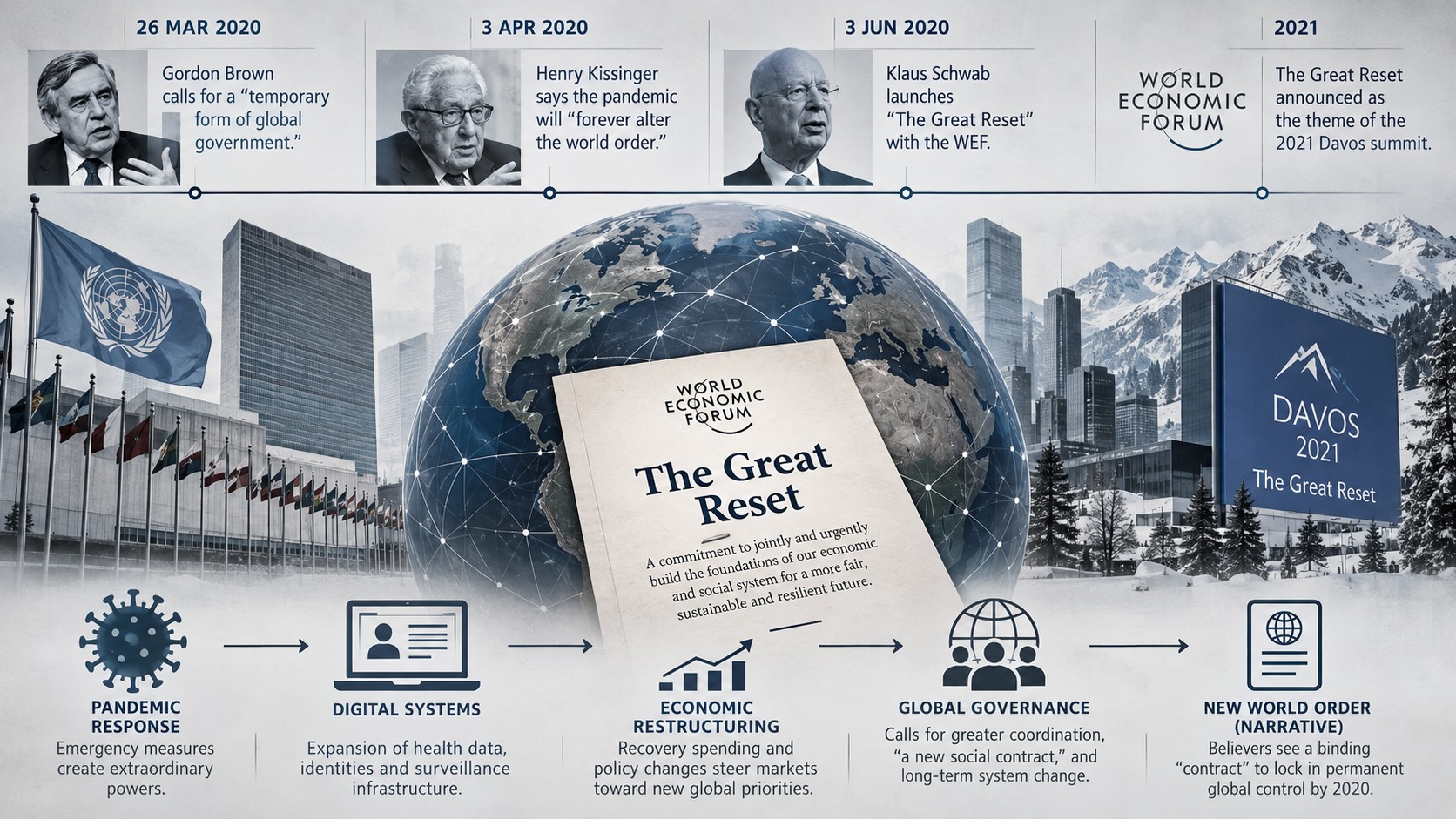
At half past two in the afternoon, Central European time, on 3 June 2020, the Prince of Wales and Klaus Schwab joined a virtual meeting and announced that the next Davos summit would have a single theme. The World Economic Forum's press release went out the same afternoon. "The Great Reset," it said, "is a commitment to jointly and urgently build the foundations of our economic and social system for a more fair, sustainable and resilient future. It requires a new social contract centred on human dignity, social justice and where societal progress does not fall behind economic development."
That phrase, a new social contract, sits at the centre of this theory. To the Forum it was a political slogan, the sort of thing a summit theme is for. To the people who built the "New World Order of 2020" out of it, it was a description of exactly what was happening: an old arrangement between governments and citizens being torn up during an emergency, and a new one being written by people nobody had elected. In the strongest version, 2020 was the year the long-promised world order stopped being planned and was signed.
No document of that kind has surfaced, and no believer has produced one. What does exist is a large public record of powerful people saying, in their own words, that the pandemic was an opportunity to change how the world was run. The theory was assembled almost entirely from that record, which is why it proved so hard to argue with.
What was said in the spring
The Great Reset was not the first time in 2020 that a senior figure spoke about world order. On 26 March, with most of Europe newly shut indoors, the Guardian reported that the former British prime minister Gordon Brown had urged world leaders to create what the paper called "a temporary form of global government" to handle the medical and economic crises together. Brown wanted a taskforce of leaders, health experts and the heads of international organisations with executive powers. "We need some sort of working executive," he said.
A week later, on 3 April, Henry Kissinger published an essay in the Wall Street Journal under the headline "The Coronavirus Pandemic Will Forever Alter the World Order." "The reality is the world will never be the same after the coronavirus," he wrote, and he called for "a parallel enterprise for the transition to the post-coronavirus order." The third of his three tasks for the United States was to "safeguard the principles of the liberal world order."
Read in context, both men were arguing for coordination between existing states, and Kissinger's essay is mostly about Enlightenment values and the legitimacy of governments. But "global government" and "world order" are the two phrases the New World Order tradition had been watching for since the 1990s, and in the spring of 2020 two elder statesmen said them within eight days of each other.
What the Forum actually proposed
Schwab set out the agenda in an article published the same day as the launch. Its opening argument would later be quoted back at him more than almost anything else he wrote:
"To achieve a better outcome, the world must act jointly and swiftly to revamp all aspects of our societies and economies, from education to social contracts and working conditions. Every country, from the United States to China, must participate, and every industry, from oil and gas to tech, must be transformed. In short, we need a 'Great Reset' of capitalism."
He gave the plan three parts. Governments would steer markets toward "fairer outcomes" through coordinated tax, regulatory and fiscal policy. Recovery spending would be directed toward "shared goals, such as equality and sustainability." And the innovations of what Schwab had for years called the Fourth Industrial Revolution would be harnessed "to support the public good." He wrote that the pandemic had shown "how quickly we can make radical changes to our lifestyles," and closed by calling it "a rare but narrow window of opportunity to reflect, reimagine, and reset our world."
The Prince of Wales was more direct still. "We have a golden opportunity to seize something good from this crisis — its unprecedented shockwaves may well make people more receptive to big visions of change," he told the launch, according to CNBC. He spoke of "a unique but rapidly shrinking window of opportunity," adding: "It is an opportunity we have never had before and may never have again."
The Forum's release lists who else was on the call. UN Secretary-General António Guterres called the Great Reset "a welcome recognition that this human tragedy must be a wake-up call," and IMF managing director Kristalina Georgieva also gave a statement. The supporting voices it listed included the president of Microsoft, the chief executives of Mastercard and BP, and a member of the monetary policy committee of the People's Bank of China. Schwab said the reset would require "a functioning system of smart global cooperation structured to address the challenges of the next 50 years." Time magazine ran a series in partnership with the Forum under the same name, opening with the line that the pandemic had "provided a unique opportunity to think about the kind of future we want." Schwab and the economist Thierry Malleret published a book the same year, COVID-19: The Great Reset.
All of this was public, put out under the Forum's own branding with a summit to promote. The Institute for Strategic Dialogue, which later tracked the theory, noted the other side of it: the initiative "did not feature any specific programmes or actions to be undertaken at a global level," and that vagueness "left it open to interpretation by all, including conspiracists."
The exhibits
Believers did not stop at the 2020 statements. Within months a set of older documents had been gathered around the launch as proof that the reset had been prepared in advance.
Event 201
On 18 October 2019, ten weeks before the first reports from Wuhan, the Johns Hopkins Center for Health Security, the World Economic Forum and the Bill & Melinda Gates Foundation held a pandemic exercise in New York called Event 201. The scenario was a novel coronavirus, spreading from pig farms in Brazil, that killed 65 million people. The three organisations published joint recommendations afterwards on the role of public-private partnerships in a severe pandemic.
When headlines in January 2020 said the exercise had "predicted" COVID-19, the Center put out a statement quoted by FactCheck.org: "To be clear, the Center for Health Security and partners did not make a prediction during our tabletop exercise. For the scenario, we modeled a fictional coronavirus pandemic, but we explicitly stated that it was not a prediction." The statement added that "the inputs we used for modeling the potential impact of that fictional virus are not similar to nCoV-2019." For believers, the Forum's place among the three hosts mattered more than the statement did. The organisation that announced the reset in June had rehearsed a coronavirus pandemic the previous autumn.
Lock Step
The second exhibit was older. In May 2010 the Rockefeller Foundation and the consultancy Global Business Network published Scenarios for the Future of Technology and International Development, a planning exercise that sketched four possible futures. The first, "Lock Step," was "a world of tighter top-down government control and more authoritarian leadership, with limited innovation and growing citizen pushback." In it, a pandemic arrives in 2012 and kills eight million people in seven months, and governments impose "the mandatory wearing of face masks" and "body-temperature checks at the entries to communal spaces." Then the authoritarian measures stay:
"Citizens willingly gave up some of their sovereignty — and their privacy — to more paternalistic states in exchange for greater safety and stability."
The scenario goes on to mention "biometric IDs for all citizens." Believers in 2020 read it as a script that had simply been run eight years late. The report itself warns twice that it is not a forecast: "scenarios are not predictions," and "the scenarios in this report are stories, not forecasts." But it is an exchange of sovereignty and privacy for safety, set during a pandemic and written by a major foundation a decade early. That is close to what the believers meant by a contract.
"You'll own nothing"
The third exhibit gave the theory its most famous line. In November 2016 the Forum published a short piece by Ida Auken, a Danish member of parliament, written as a first-person sketch of a city in 2030. "I don't own anything," it begins. "I don't own a car. I don't own a house. I don't own any appliances or any clothes." Shopping has become "choosing things to use," and sometimes she just wants "the algorithm to do it for me." The piece ends darker:
"Once in awhile I get annoyed about the fact that I have no real privacy. No where I can go and not be registered. I know that, somewhere, everything I do, think and dream of is recorded. I just hope that nobody will use it against me."
It also mentions "all the people who do not live in our city. Those we lost on the way," who have formed "little self-supplying communities" outside it. The Forum included the essay in a roundup of eight predictions for 2030 and promoted it in a video. According to PolitiFact, the video's first prediction read: "You will own nothing and be happy. Whatever you want you'll rent and it'll be delivered by drone."
Auken's piece was a provocation by a guest writer, and the Forum's own pages said the views were the author's. By November 2020 the page carried an author's note: "Some people have read this blog as my utopia or dream of the future. It is not. It is a scenario showing where we could be heading - for better and for worse." In 2023 the German fact-checker Correctiv asked the Forum about a meme crediting Schwab with the line, and its press office said he had not. None of this slowed the slogan down.
How a summit theme became a contract
The Institute for Strategic Dialogue dated the conspiracy version almost to the day. Four days after the launch, the first video calling the Great Reset a "New World Order power grab" appeared on the video platform BitChute. Before June was out, an op-ed by Justin Haskins of the Heartland Institute, a think tank that disputes climate science, ran on Fox News, arguing that the plan's "socialist outline is clear: destroy the global capitalist economy and reform the Western world."
What turned a niche reading into an international one was a short clip of Justin Trudeau. On 29 September 2020, in remarks to a United Nations meeting on financing for development, the Canadian prime minister said: "This pandemic has provided an opportunity for a reset. This is our chance to accelerate our pre-pandemic efforts, to re-imagine economic systems that actually address global challenges like extreme poverty, inequality and climate change." According to research by BBC Monitoring, cited in a 2023 study in the International Journal of Communication, online mentions of the Great Reset spiked worldwide after the speech.
In November the clip reached Pierre Poilievre, then the Conservative finance critic. He warned that "global financial elites" were attempting to "re-engineer economies and societies" in order to "empower the elites at the expense of the people," and launched a petition calling on the government to "end plans to impose the 'Great Reset'." CBC's Aaron Wherry noted that the petition cut Trudeau's second sentence off before the words about poverty, inequality and climate change. The academics Michael Christensen and Ashli Au began collecting tweets on the hashtag #StopTheGreatReset on 12 November. Over four months they gathered about 16,000 and found that, across the linked material they sampled, right-wing or libertarian narratives outnumbered left-wing ones by just over three to one.
The theory's most explicit statement had arrived a few weeks earlier, in a religious letter rather than a political one. On 25 October 2020 Archbishop Carlo Maria Viganò, the former apostolic nuncio to the United States, published an open letter to President Trump. "A global plan called the Great Reset is underway," it began. "Its architect is a global élite that wants to subdue all of humanity." The letter set out the deal it believed was being offered: a universal income and the cancellation of individual debt, in return for "the renunciation of private property and adherence to a program of vaccination against Covid-19 and Covid-21." It cast Trump as one of those who "impede the establishment of the New World Order." Here, in full, was the contract the title of this article refers to: terms offered in an emergency, accepted out of exhaustion, impossible to undo.
By December the idea had reached prime time. Writing in The Intercept on 8 December, Naomi Klein counted Laura Ingraham, Tucker Carlson and Ben Shapiro among commentators telling large audiences that the Great Reset was the same thing as Joe Biden's "Build Back Better" programme, which was itself a cover for the Green New Deal. Klein, whose book The Shock Doctrine had described elites using disasters to push through unpopular policy, called it "less a conspiracy theory than a conspiracy smoothie." She also wrote that the Great Reset was "an attempt to create a plausible impression that the huge winners in this system are on the verge of voluntarily setting greed aside." In her reading it was public relations, not a plot, though she also wrote that the initiative deserved scrutiny for normalising "mass surveillance and biometric tracking tools." In Alberta, Klein reported, Premier Jason Kenney took a question about it on a Facebook livestream and declared: "I'm not going to be taking any policy direction from Klaus Schwab and his ilk."
"Build Back Better" deepened the overlap. CBC noted that the slogan had been taken up that year by Trudeau, by Biden and by Boris Johnson. To someone already watching for coordination, three governments using one phrase in the same months looked like a script.
Where the record runs out
The documented part of this theory is unusually large. The World Economic Forum did launch a plan in the middle of a pandemic, called it a reset, and said that it required a new social contract. A future king, the head of the United Nations and the head of the IMF did lend it their voices. The Forum had co-hosted a coronavirus pandemic exercise ten weeks before the outbreak, and it had published an essay that imagined a citizen with no property and no privacy. Gordon Brown did call for an emergency global executive. Kissinger did write that the pandemic would alter the world order.
What has never been produced is the instrument itself, any agreement by which governments bound themselves to the Forum's programme, or any mechanism by which a Swiss foundation's summit theme could bind anyone. The "contract" in the Forum's own texts is a "new social contract," which in political philosophy names the unwritten bargain between a state and its citizens. PolitiFact, reviewing the "own nothing" claim in 2023, found "no evidence" that the Forum planned to seize people's possessions and rated the claim "False." The ISD pointed to a gap on the other side: the Forum never explained how its reset would be carried out, and after the backlash it issued no public rebuttals. That silence left believers to fill in the terms themselves.
Afterlife
The theory outlived the pandemic easily. The ISD counted more than 260,000 Facebook posts mentioning the Great Reset between June 2020 and January 2023, and 245 million views of TikTok videos under #GreatReset. In the Netherlands, it found, a Facebook post by the party leader Thierry Baudet in January 2021 was followed by a 94 per cent rise in discussion of the theory. In October 2021 members of the neo-fascist Forza Nuova, protesting Italy's vaccine pass in Rome, targeted a hospital emergency room and cast their actions as part of a fight against the Great Reset. The ISD also recorded white supremacist forums placing Schwab's name inside the triple parentheses used to mark people as Jewish. Christensen and Au traced the slogan to the convoy that occupied Ottawa in early 2022. They also cited an Elections Canada survey in which 40 per cent of respondents agreed that significant events, "including the pandemic," had been the work of "a small group who secretly manipulate world events."
Its themes have kept moving. The ISD found the Great Reset running into theories about 15-minute cities and "climate lockdowns." A Paul Joseph Watson piece analysed by Christensen and Au turned a Forum blog post about meat into a plan to put "bugs, weeds and sewage on the menu," an idea traced on this wiki under the WEF bug-eating agenda. By 2025 the commentator James Corbett was presenting the same story under a new name. In an episode titled "Algocracy: Government for the New World Order," he quoted the venture capitalist Marc Andreessen, who had told Bari Weiss of The Free Press in December 2024 that "AI is going to be the control layer for everything in the future." For Corbett, rule by algorithm was the reset's next form. The reset had been rebranded again, and the 2020 contract was now said to be enforced by software.