
Overview
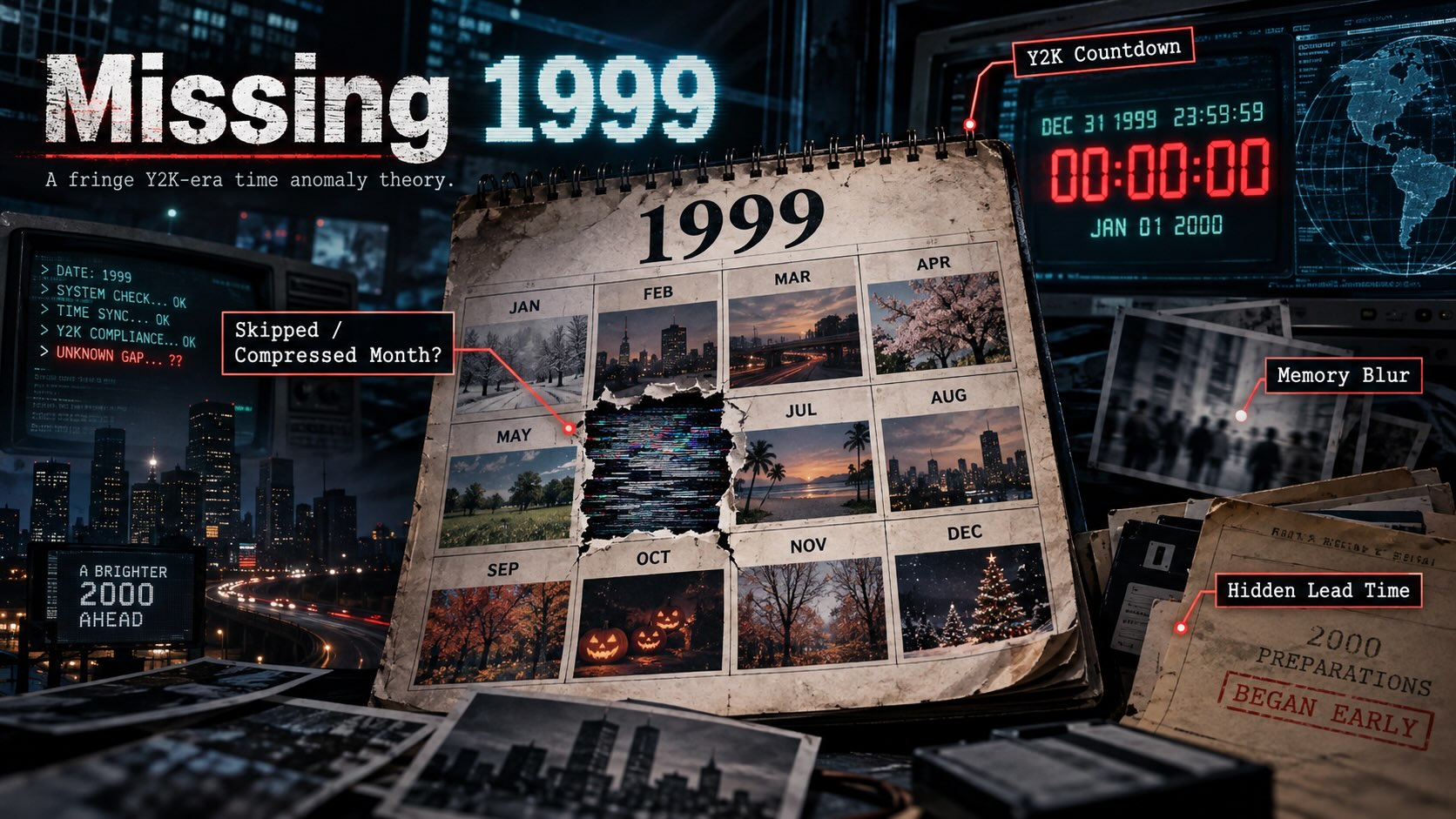
The Missing 1999 theory is one of the strangest post-Y2K folklore developments. It claims that sometime during 1999, a full month—or a psychologically equivalent block of time—was effectively skipped, compressed, or removed from ordinary historical awareness. The purpose, according to the theory, was to allow governments, elites, or technical managers to get ahead of the millennium bug without public scrutiny.
Some versions treat this literally. Others describe it as a managed temporal blur: a period erased through collective distraction, altered recordkeeping, or memory manipulation.
Historical Context
The theory does not come from the mainline Y2K era itself in any strong documentary way. Instead, it appears more clearly in later internet culture, where Y2K is often reimagined as a moment of hidden transition, timeline distortion, or psychological reset. That weak provenance is part of the theory’s identity. It feels like a theory that emerged after the fact from the sense that the late 1990s moved too quickly, too strangely, and too close to technological rupture.
By 1999, the public was saturated with countdown language. Media, finance, software, and government all framed the coming rollover as a finite temporal event. This environment made unusual experiences of time feel historically meaningful.
The Core Claim
The theory usually includes several linked ideas:
a month was secretly skipped or compressed
The elite allegedly accelerated internal timelines by removing a block of lived public time from meaningful awareness.
Y2K remediation required hidden lead time
Critical fixes, tests, or resets supposedly needed more calendar space than the public was allowed to perceive.
memory was blurred on purpose
The theory often emphasizes that people cannot identify the missing month clearly because the concealment was psychological rather than openly calendrical.
the late 1990s felt temporally unstable
A general sense of acceleration and countdown becomes reinterpreted as evidence that time itself was manipulated.
Why the Theory Spread
The theory spread because Y2K already cast time as a system problem rather than a neutral background. Dates mattered, clocks mattered, rollover mattered. Once time becomes technical, it becomes imaginable as something authorities might manipulate.
The theory also spread because 1999 has a special place in cultural memory. It was both the last full year before the rollover and the most media-saturated countdown year. A fringe theory about a missing segment of that year therefore feels symbolically appropriate even when evidence is vague.
Literal and Metaphorical Variants
Some believers imagine literal calendar alteration or hidden date adjustment. Others treat the “missing month” as metaphorical but still controlled: a period drowned in distraction, panic, or administrative secrecy. This flexibility helps the theory survive. It does not need one exact mechanism as long as 1999 feels “off” in retrospect.
Legacy
The Missing 1999 theory remains a fringe but revealing part of Y2K folklore because it shows how countdown culture can mutate into time-anomaly culture. Its factual base is the real saturation of 1999 with Y2K preparation and rumor. Its conspiratorial extension is that a meaningful stretch of the year was removed, compressed, or stolen so elite systems could get ahead of the crash before the public ever reached midnight.