
The claim
The theory pushes the recruitment of German rocket scientists backwards into the middle of the war — that by 1943 the United States was already seizing or quietly arranging for the capture of Nazi technical personnel, and that the object all along was a postwar space programme and eventually the Moon.
Two halves, and they are not equally supported.
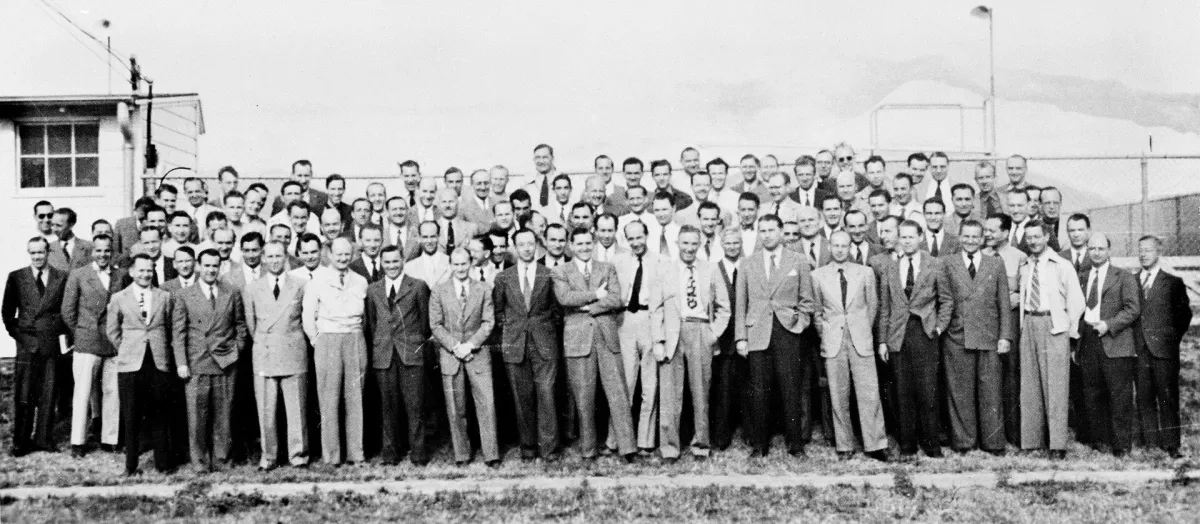
The Paperclip group at Fort Bliss, Texas. More than sixteen hundred German scientists, engineers and technicians were brought to the United States between 1945 and 1959. Wikimedia Commons — Public domain

The half that holds
American interest in German rocketry by 1943 is real and documented. Army officials asked Theodore von Kármán's group for technical assessment of the V-2, and as the Allied armies moved through Europe in 1944 and 1945 the hunt for German documents, hardware and personnel became an explicit objective rather than a by-product. Operations aimed at scientific and technical intelligence ran alongside the fighting.
So the idea that the capture of German expertise was planned rather than opportunistic is broadly right.
The half that does not
The Moon is a retrospective addition. In 1943 the United States was trying to understand a weapon that was falling on London, and then to deny it to the Soviet Union. There is no contemporaneous programme aiming at lunar flight, because there was no such ambition to aim at; the goal was ballistic missiles, and the space programme grew out of the missile programme more than a decade later.
Reading the Apollo programme back into a 1943 intelligence assessment is the same move as reading the suicide plot back into Sarajevo: it takes an outcome and treats it as the motive of people who could not have known it was coming.
The formal programme has dates. It began as Operation Overcast on 20 July 1945, and acquired the name Paperclip in November 1945 — from Ordnance Corps officers attaching a paperclip to the folders of the rocket specialists they wanted to employ. Truman approved and expanded it by secret directive on 3 September 1946. All of that is after the war, not during it.
What needs no theory at all
Here is what actually happened, and it is on the record.
Arthur Rudolph joined the Nazi Party in 1931 and later the SA. During the war he was operations director for V-2 production at the Mittelwerk, the underground factory near Nordhausen worked by prisoners from the Mittelbau-Dora concentration camp. Something in the order of twenty thousand labourers died producing those rockets — more people than the V-2 killed as a weapon.
He came to the United States, joined NASA in 1961, became assistant director of systems engineering, and in August 1963 became project director of the Saturn V programme. He received the NASA Exceptional Service Medal and the NASA Distinguished Service Medal for his work on Apollo.
The rocket that carried Americans to the Moon was run by the man who had run production at Mittelwerk.
In September 1982 the Justice Department's Office of Special Investigations asked to interview him. On 28 November 1983 he signed an agreement to leave the United States and renounce his citizenship. In March 1984 he and his wife left for West Germany. The arrangement protected his retirement benefits and spared him prosecution.
Wernher von Braun, the better-known name, joined the Nazi Party in 1937 and was made a junior SS officer in 1940. He directed the work at Peenemünde that the Mittelwerk existed to manufacture.
Of everyone brought over, exactly one was tried for anything: Georg Rickhey, at the Dora trial. He was acquitted.
What the historians found
The route by which men with these records were admitted to a country whose president had directed that ardent Nazis be excluded is the subject of a documentary literature rather than a rumour. Linda Hunt's Secret Agenda is the standard account, built from the programme's own files, and it describes how security evaluations that would have disqualified candidates were revised so that they did not.
This archive is not in a position to adjudicate every claim in that literature. What is not in dispute is the outcome: more than sixteen hundred German scientists, engineers and technicians were brought to the United States between 1945 and 1959, several with documented Party membership, SS rank or responsibility for facilities that used concentration camp labour, and the policy that was supposed to exclude them did not.
Where it stands
The specific theory — wartime capture from 1943 aimed at moon rockets — is half true and half anachronism, and it is the less interesting half that is true.
What sits underneath it does not need to be reached for. The United States decided that the men who built the V-2 were worth more as assets than as defendants, acted on that decision, and gave the one who had directed production at Mittelwerk the Saturn V and two medals. When that finally became a problem in the 1980s he was allowed to leave with his pension. No part of that is alleged.