
The accident
Mayak, near the town of Kyshtym in the Southern Urals, was where the Soviet Union made plutonium. Like every such site it generated high-level liquid waste, and that waste was stored in tanks which had to be actively cooled, because radioactive decay keeps producing heat indefinitely.
On one tank, the cooling failed. The contents grew steadily hotter over a period, and on 29 September 1957 they exploded with a force estimated at the equivalent of at least seventy tons of TNT. The tank's concrete cover, weighing 160 tons, was thrown clear. Something in the order of twenty million curies of radioactive material went into the air, and the wind distributed most of it to the north-east in a long narrow plume now called the East Urals Radioactive Trace.
By the measures usually applied, this is the third most serious nuclear accident in history, behind Chernobyl and Fukushima. It happened twenty-nine years before Chernobyl, in the same country.
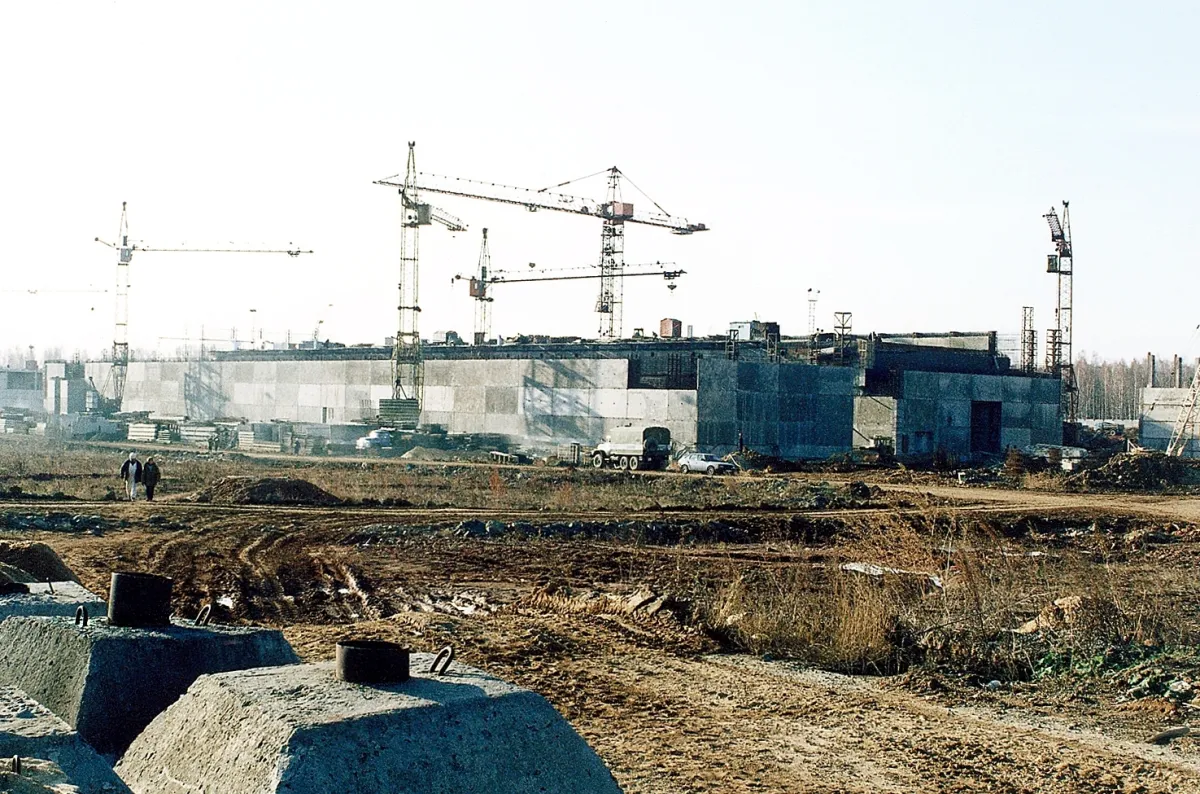
The Mayak complex. This photograph shows later construction at the site rather than the 1957 explosion, of which no contemporaneous published images exist. Wikimedia Commons — Carl Anderson, US Army Corps of Engineers, Public domain

The silence
Villages in the path of the plume were evacuated. More than ten thousand people were moved off contaminated land, and they were not told what had happened or why they were going. Estimates of deaths from radiation exposure run into the hundreds, with the usual difficulty that the figures depend on records the responsible state did not keep or did not release.
The Soviet government did not acknowledge the accident for thirty-two years. It was not confirmed until 1989.
That much would make an ordinary entry about a closed state concealing an industrial catastrophe. The reason Kyshtym belongs here is the other half.
The other silence
The Central Intelligence Agency worked out what had happened at Mayak. By around 1960 — three years after the explosion, nearly three decades before the Soviet admission — informant reporting and aerial photography had given American intelligence a clear picture of a major radiological accident and its consequences.
It said nothing, and the knowledge stayed classified.
The reasoning attributed to that decision is worth stating carefully, because the documented part is the silence rather than the motive. The usual account is that publicising a catastrophic waste-storage accident at the height of the American civil nuclear programme would have raised precisely the questions about waste handling that the industry and the government least wanted raised, and that the propaganda value of embarrassing the Soviet Union did not outweigh it. That is an inference about intent. What is established is that the United States had the information and withheld it for decades, and that the effect was to extend the life of a Soviet cover-up by an agency with every ordinary incentive to blow it open.
Medvedev, and the cost of being early
In 1976 Zhores Medvedev, a Soviet biologist then living in exile in Britain, published the first substantial Western account of the disaster in the scientific press.
The reception was poor. He was describing an event no government confirmed, from a closed country, on the basis of fragmentary evidence and inference, and he was a dissident with an obvious grievance against the state he was accusing. He was widely disbelieved, including by scientists who had no political stake and simply found the scale implausible.
He was right. It took thirteen more years for the admission that made him right, by which point the argument had moved on.
Medvedev appears elsewhere in this archive in the opposite role. On the Soviet Doctors' Plot he is the sceptic — the historian who argued that the claim of a planned mass deportation of Soviet Jews was not supported by documentary evidence. The same person, applying the same standard, was the one who insisted on a catastrophe nobody would credit and the one who declined to credit a catastrophe others asserted. That is what consistency looks like, and it is more useful than being reliably alarming or reliably dismissive.
What it establishes
Two states, with opposed interests, kept the same secret for different reasons and for roughly the same length of time.
That is the durable point, and it cuts against the simplest model of how cover-ups fail. The usual assumption is that a secret survives only while everyone who knows it benefits from keeping it, and that an adversary with the information will publish. Here an adversary had the information, had every reason to publish, and did not — because publishing would have raised a question it shared with the state it was opposing.
The accident is not the worst of it
One further point belongs here, because it cuts against the way this site is usually written about.
The 1957 explosion is the dramatic event and the one with a date, and it is therefore the one that gets the article. But the contamination around Mayak is not mainly the product of a single bad afternoon. For years the plant discharged high-level waste directly into the Techa, a river that communities downstream drank from, washed in and watered livestock from. Lake Karachay was used as an open-air dump for liquid waste from 1951, and became one of the most radioactive places on earth: a 1990 measurement near the point where effluent entered the water recorded about 600 röntgens per hour, a rate at which an hour's exposure is lethal. That figure describes the discharge area rather than the shoreline generally, which is worth stating precisely, because the imprecise version circulates widely and the precise one is quite bad enough.
Karachay no longer exists as a lake. It was backfilled with concrete blocks from 1978, filled completely by November 2015, and capped with rock and soil in 2016. It is now a dry near-surface nuclear waste store, which is to say the waste is still there and the water that used to cover it is not.
Those were not accidents. They were operating procedure, sustained over years, and the exposures they produced are plausibly larger in total than the explosion's.
The reason the explosion dominates the story is that explosions have dates, lids thrown through the air and a plume to map, and routine discharge into a river has none of that. It is worth noticing that the framing of this entry — a disaster on 29 September 1957 — is itself a kind of distortion, and one that favours the operator. A catastrophe can be regretted. A procedure has to be defended.
Mayak remains one of the most contaminated places on earth, and the health consequences in the region are still studied and still argued over.