
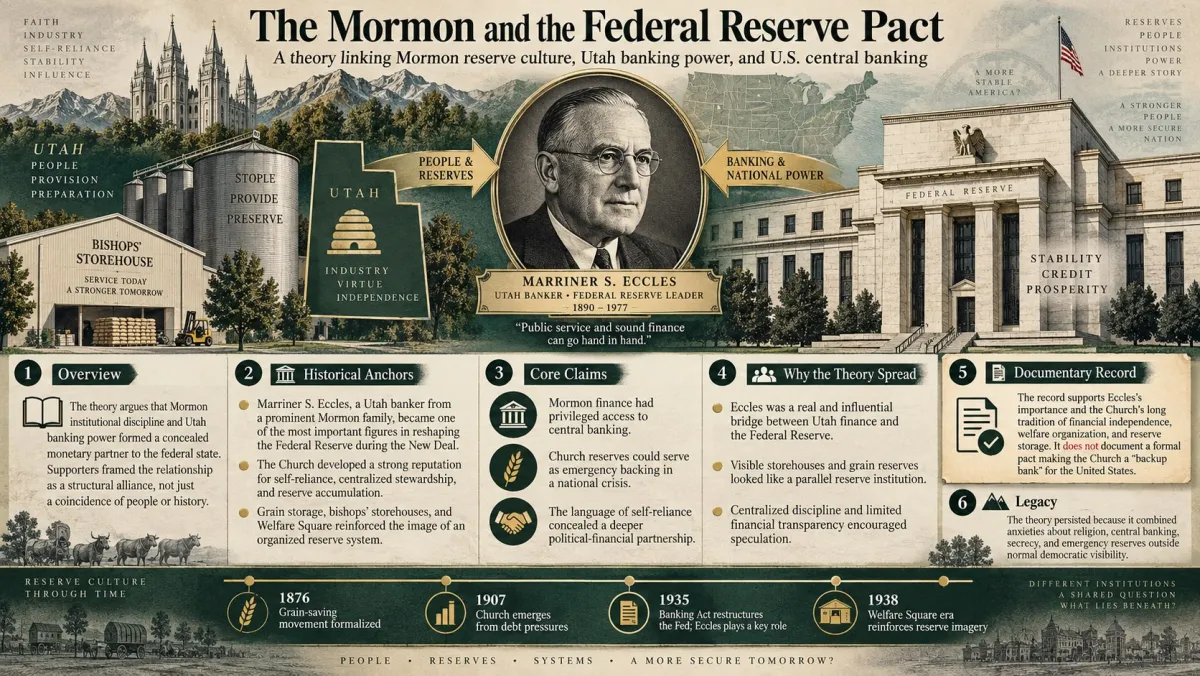
Overview
The theory holds that The Church of Jesus Christ of Latter-day Saints, or a network of Mormon finance centred on Utah, stands behind the American monetary system as a concealed reserve — a backup bank for the United States, maintained by tithes, grain, land and influence, and bound to the Federal Reserve by an arrangement never put on paper.
It is built on three things that are real: a Utah Mormon did more than almost anyone to shape the modern Federal Reserve, Church grain really did pass to the federal government in a national emergency, and the Church really did conceal the size of its investment portfolio for twenty-two years. Each of those is documented. None of them is a pact, and two of them point the opposite way.
One thing should be said at the outset, because it is unusual. This theory has no originating text. There is no pamphlet, broadcast, lawsuit or leaked document that first made the claim and that later tellings can be traced back to. It circulates as an atmosphere rather than an assertion, which is part of why it is so hard to answer: there is nothing specific enough to check. What follows is the record it gestures at.
One banker, and what he actually did
Marriner Stoddard Eccles was born in Logan, Utah, in 1890, went to Brigham Young College, and in 1910 served a mission for the Church in Glasgow. His father died in 1912 and he took over the family business interests; he founded the Eccles Investment Company in 1916. By the mid-1920s he, his brother George and the Browning family controlled seventeen banks across Utah, Idaho and Wyoming, and had organised First Security Corporation — believed to be the first multibank holding company in the country.
This is the Utah banking dynasty the theory points at, and it is worth being precise about what it was: a family business, built by brothers and in-laws, not an arm of the Church.
Eccles came to national attention in 1931 by talking a bank run down and keeping his bank open. His congressional testimony in 1933 proposed a five-point economic programme that became part of the basis of the New Deal, and on 15 November 1934 Roosevelt appointed him to lead the Federal Reserve Board. He served as Governor from 1934, as Chairman from 1936 to 31 January 1948, and remained on the Board until 14 July 1951.
His monument is the Banking Act of 1935, which he pushed for and helped draft, and which made the Federal Reserve into the institution it still is. It renamed the Federal Reserve Board the Board of Governors, fixed it at seven appointed members serving fourteen-year terms, and gave those members a majority on the Federal Open Market Committee, which the Reserve Bank governors had previously dominated.
It also did something the theory has no room for. The Act removed the Secretary of the Treasury and the Comptroller of the Currency from the ex-officio seats they had held on the Board since 1913. The single most consequential thing a Mormon ever did to the Federal Reserve was to take the federal government's two standing representatives off it.
The minutes he released
The second thing cuts deeper. Through the 1940s the Fed held a low interest-rate peg on government bonds — helpful for financing a war, ruinous for controlling inflation afterwards. After Korea the Fed wanted out, and the Treasury did not.
In 1951 President Truman told the press that the Federal Open Market Committee had agreed to maintain the peg. It had not. Eccles released the Committee's minutes, which showed it had not, and the fight ended in the Treasury–Fed Accord of March 1951, the agreement that freed the Federal Reserve from the obligation to support the Treasury's borrowing and established its control over monetary policy.
So the one Mormon at the centre of the Federal Reserve used the last significant act of his career to contradict a sitting president in public and prise monetary policy out of the government's hands. A theory about a concealed partnership between church finance and the federal state has to account for that, and it does not.
The name on the building
The Federal Reserve's headquarters in Washington is the Marriner S. Eccles Building, which is the detail most often produced as evidence that Mormon money is lodged at the centre of American banking.
The building opened in 1937, dedicated by Roosevelt. It was renamed in 1982 — forty-five years later, and five years after Eccles died — by an act of Congress, in the Garn–St Germain Act, whose lead Senate sponsor was Jake Garn of Utah. A Utah senator put his state's most famous banker's name on the Fed's headquarters through a public banking bill with a recorded vote. It is a monument to how ordinary legislative credit-taking works, not to a hidden arrangement.
The grain that really did go to Washington
The reserve half of the theory has a genuine documented instance behind it, and it is the strongest thing in the whole record.
Under Brigham Young's direction the Relief Society began storing grain in 1876, a programme Emmeline B. Wells carried for decades. In 1918, with the United States at war, that stored wheat was sold to the federal government. Church accounts put it at around 200,000 bushels; other accounts give the figure as 205,518. The government paid market prices, and the interest on the proceeds funded Relief Society maternal and child health work through the 1920s.
Church reserves did therefore pass to the federal government in a national emergency. They passed once, by sale, at market rate, in wartime, in a transaction that was written down at the time and has been described in the Church's own published history ever since. That is the shape of the real event: an open sale, not a standing facility.
The church that left banking
Zion's Savings Bank and Trust was founded in 1873 with Brigham Young as its first president, and Church-controlled banking in Utah is a real and lengthy history. It ends on a date.
After a 1957 merger produced Zions First National Bank, the Church decided to leave the business, and on 22 April 1960 it sold majority control. An institution maintaining a standing arrangement with the national banking system does not sell its bank.
The Church's own financial teaching pulls the same direction. J. Reuben Clark, who had been Under Secretary of State and ambassador to Mexico before being called to the First Presidency in 1933, used his April 1938 general conference address to warn members against debt in the strongest terms available to him. The welfare programme organised in the 1930s was built around storehouses and self-reliance. Whatever else that posture is, it is an argument for standing outside the credit system rather than for being wired into it.
What was actually concealed
There is real concealment in this story. It is documented, it was penalised, and it is not about the Federal Reserve.
In December 2019 a former portfolio manager at Ensign Peak Advisers, the Church's investment arm, filed a complaint with the IRS putting its holdings at between $99 billion and $101 billion. The Washington Post reported it; the Church responded publicly that week. David Nielsen gave his first television interview about it in May 2023, describing what he had worked on as a clandestine hedge fund.
On 21 February 2023 the Securities and Exchange Commission charged both Ensign Peak and the Church. From 1997 through 2019, Ensign Peak had not filed Forms 13F in its own name. It created thirteen shell companies and filed in their names instead, and those filings stated that the shell companies had sole investment and voting discretion over the securities when Ensign Peak in fact retained control of every investment and voting decision. The portfolio had reached $32 billion by 2018. Ensign Peak paid a $4 million penalty and the Church paid $1 million. The SEC's director of enforcement said the Church's investment manager had gone to great lengths to avoid disclosing the Church's investments.
This is what the theory is reaching for and keeps missing. Something was hidden, deliberately, for twenty-two years, using instruments built for the purpose. What was hidden was the size of a share portfolio, and it was hidden from the Securities and Exchange Commission and from the Church's own membership — not from or with the Federal Reserve, which has no role anywhere in the order.
Evidence and assessment
Three claims survive contact with the record. A Utah Mormon shaped the modern Federal Reserve more than any other single person. Church reserves passed to the federal government once, in 1918. And the Church concealed the scale of its investments for more than two decades, which the SEC established and fined.
No evidence has been produced for the thing the theory is actually about. There is no document, testimony, filing or minute describing an arrangement between the Church and the Federal Reserve, and no named person has ever claimed to have seen one. The theory has no founding text to examine either, which leaves nothing to test beyond the atmosphere.
The chronology runs against it at every point where it can be checked. The legislation the theory's central figure wrote removed the federal government's representatives from the Federal Reserve's board. His final act took the Fed out of the Treasury's control. The Church sold its bank in 1960. And the one episode of real, proven concealment was a disclosure failure to a securities regulator.
Legacy
What keeps the theory alive is that its instinct is not wrong, only badly aimed. A church with centralised finances, a storehouse system, a published culture of reserve and, as it turned out, a portfolio in the tens of billions behind a row of shell companies is a reasonable thing to be curious about. The curiosity was eventually satisfied, by a whistleblower and a regulator, and the answer was stranger and more specific than the rumour.
It also sits in a family of claims that attach hidden money to the Latter-day Saints — the same period produces the theory of a Church gold hoard assembled during the 1933 confiscation — and in the much larger family of claims about how the Federal Reserve itself was made, which begins with the 1910 meeting on Jekyll Island.