
The method
Doug Bower and Dave Chorley were two men from Southampton who had been drinking in the same pub for years. In 1978 they went into a Hampshire wheat field and flattened a circle in it.
The equipment never got more complicated than it was that night. A plank about four feet long with a loop of rope through a hole at each end, held taut by the hands and stepped on to press the stalks down without snapping them. A length of cord to keep the radius even. Later, a wire sight fixed to the peak of a baseball cap, so a line could be held straight across a dark field by eye.
They worked by moonlight and walked in along the tramlines — the wheel ruts a tractor leaves — so that there were no footprints in the standing crop. By their own account they made more than two hundred.
The idea came from Australia. Bower had lived there, and knew the 1966 report from Tully in Queensland of a circle of flattened reeds in a lagoon, which the papers had called a saucer nest.
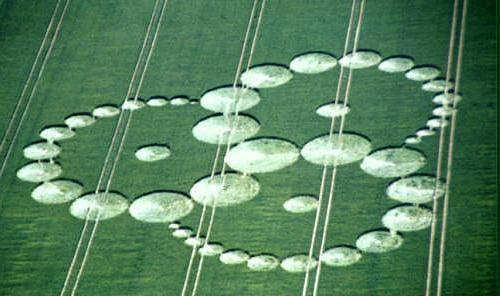
A formation of the kind the circles became by the late 1980s. The straight lines running through it are tractor tramlines — the route Bower and Chorley used to walk in without leaving prints in the standing crop. Wikimedia Commons — Thomas J. Sutter, Jr., Public domain

What grew on top of it
By the mid-1980s the circles had stopped being a local curiosity. They multiplied, they got more elaborate, and they acquired a research community, a literature, and competing scientific explanations.
The serious proposals included a meteorological one — that spiralling columns of charged air could flatten crop in regular patterns. Others were less restrained, and the formations were read as messages, as geometry too precise for human hands, as marks of something landing.
Researchers measured stalk nodes, soil chemistry and radiation. Books sold. The circles became a fixture of the British summer and a subject on which people had publicly staked a great deal.
The demonstration
On 9 September 1991 Bower and Chorley told a newspaper what they had been doing for thirteen years, and then did something considerably more useful than a confession.
They made a fresh circle, in a field, in front of journalists. Then Pat Delgado — among the best-known researchers in the subject and co-author of the books that had made it one — was invited to examine it without being told its provenance.
He examined it and declared it authentic. He said no human could have made it.
That is the moment the case turns on, and it is why this entry exists. The confession alone could have been dismissed as two men claiming credit for something larger than themselves, and in some quarters it was. What cannot be dismissed is a controlled test, with a known answer, failed in public by the person best placed to get it right.
What it does and does not settle
It does not establish that Bower and Chorley made every circle. They plainly did not — there were far more formations than two men in their sixties could produce, especially after 1991, and a great many people have made them since, some as art and some as advertising.
What it establishes is narrower and more damaging to the mystery than a complete confession would have been. It shows that the central claim of the field — that an experienced investigator could tell a genuine formation from a made one by examining the crop — was false. The diagnostic did not work. And if it did not work on a circle that was known to be made, there is no reason to believe it worked on any of the others it had been used to certify.
Why it did not end
The subject survived, and the way it survived is the familiar move.
The confession was absorbed rather than accepted: the hoaxers became a known quantity who had made some circles, while the genuine ones remained genuine, now identified by other criteria. A claim that can relocate its evidence after a failed test is not one that a further test can reach.
There is also a real residue, and it should be said plainly. Nobody has catalogued every formation or accounted for each one individually, and it is not possible to do so retrospectively. What has been shown is that the phenomenon had a documented human origin in 1978, that the people who made it said so and demonstrated the method, and that the field's leading expert certified their work as beyond human capability while they stood nearby.
No evidence has been produced that any crop formation has a non-human origin.