
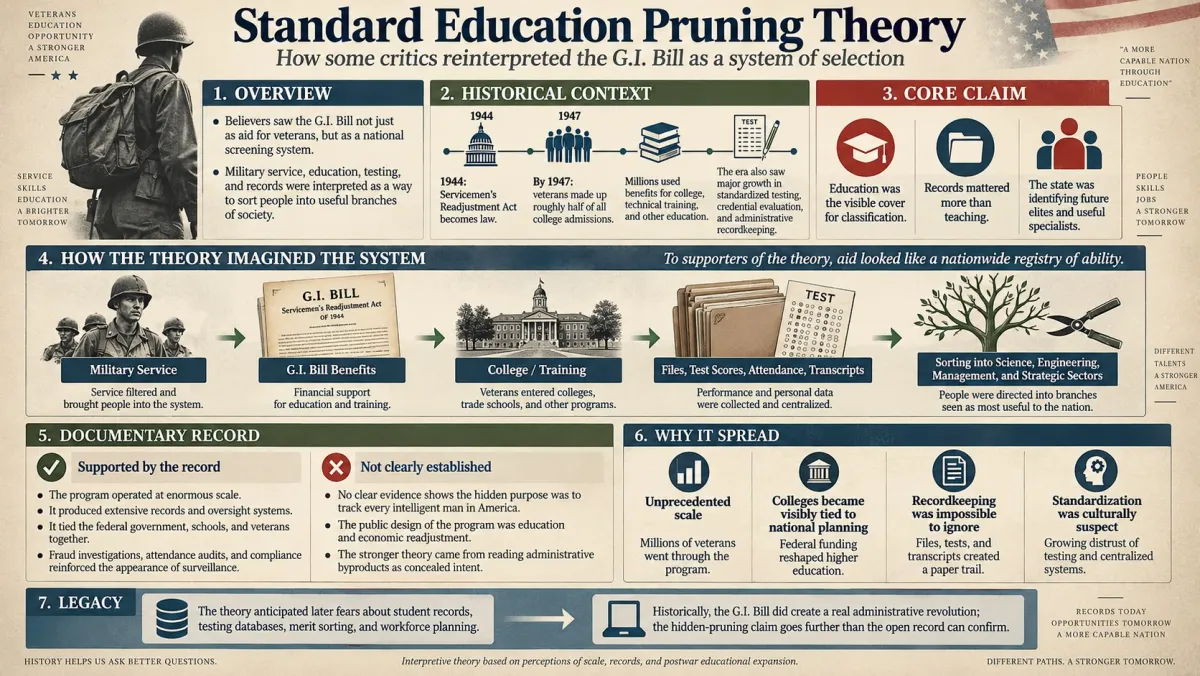
Overview
The "Standard Education Pruning" theory interpreted the G.I. Bill as a machine for selection. Rather than seeing the law primarily as veterans’ readjustment policy, believers treated it as a systematic screening process. Men entered the military, emerged into colleges and training programs funded by the federal government, and left behind records, transcripts, aptitude profiles, and institutional assessments. To the theory’s supporters, this looked less like aid than like pruning: sorting the population into useful branches.
Historical Context
The Servicemen’s Readjustment Act of 1944 transformed postwar education. By 1947, veterans made up roughly half of all college admissions, and millions used benefits for college, technical training, or other education. Administration of those benefits required extensive recordkeeping by the Veterans Administration and educational institutions, while the wider era also saw major growth in standardized testing, credential evaluation, and screening.
Those realities made the program appear to some observers as a national intelligence map. The federal government was now funding education at enormous scale, keeping files, reimbursing schools, and helping move veterans into sectors judged economically and strategically important. In that setting, a benefit program could easily be reimagined as a database.
Core Claim
Education was the visible cover for classification
The theory said tuition support and training aid were secondary to the creation of a nationwide registry of ability.
Records mattered more than teaching
Believers focused on application files, attendance monitoring, test results, and administrative oversight as the true substance of the program.
The state was identifying future elites and useful specialists
In stronger versions, the G.I. Bill became a postwar talent-harvesting device aimed at science, engineering, management, and national planning.
Documentary Record
The historical record clearly supports the program’s scale, administrative reach, and importance to higher education. The GI Bill did produce extensive records and created a powerful relationship between the federal government, schools, and veteran students. It also became entangled in fraud oversight, attendance audits, and compliance systems, which reinforced the impression of state surveillance.
What is not clearly established is that the hidden purpose of the G.I. Bill was to track every intelligent man in America. The program’s public design was educational and economic readjustment. The stronger pruning theory emerged by reading the unavoidable byproducts of administration—files, tests, records, accreditation, and mass enrollment—as evidence of concealed intent.
Why It Spread
The program reached unprecedented scale
No earlier educational benefit structure had drawn so many men through one state-linked system.
Colleges became visibly tied to national planning
Science, engineering, administration, and professional training expanded in ways that made higher education look strategic.
Recordkeeping was impossible to ignore
Oversight, reimbursement, and later scandal investigations showed how much information the system generated.
Standardization was culturally suspect
For critics already wary of testing and federal administration, the GI Bill looked like an intelligence sieve.
Legacy
The theory anticipated later fears about student records, testing databases, merit sorting, and the use of educational systems for workforce planning. Historically, it rests on a real administrative revolution: the G.I. Bill genuinely turned education into a large-scale federal concern. The hidden-pruning claim extended that fact into a more explicit tracking narrative than the open record can confirm.