
Overview
The Mothman is one of the most famous modern American cryptid legends. The story centers on a series of reported sightings in and around Point Pleasant, West Virginia, primarily from November 1966 through December 1967. Witnesses described a tall, dark, winged humanoid with glowing red eyes, extraordinary speed, and an unsettling presence. Over time, the legend expanded beyond a simple creature sighting into a broader paranormal mystery involving UFOs, Men in Black, prophetic dreams, poltergeist-like disturbances, and warnings of impending disaster.
For many believers, the Mothman was not merely an unknown animal. It was something stranger: a supernatural entity, an interdimensional being, a harbinger of catastrophe, or a government-related experiment. For skeptics, the sightings can be explained through misidentification, folklore amplification, witness suggestion, and the tendency for local panic to generate a self-sustaining legend.
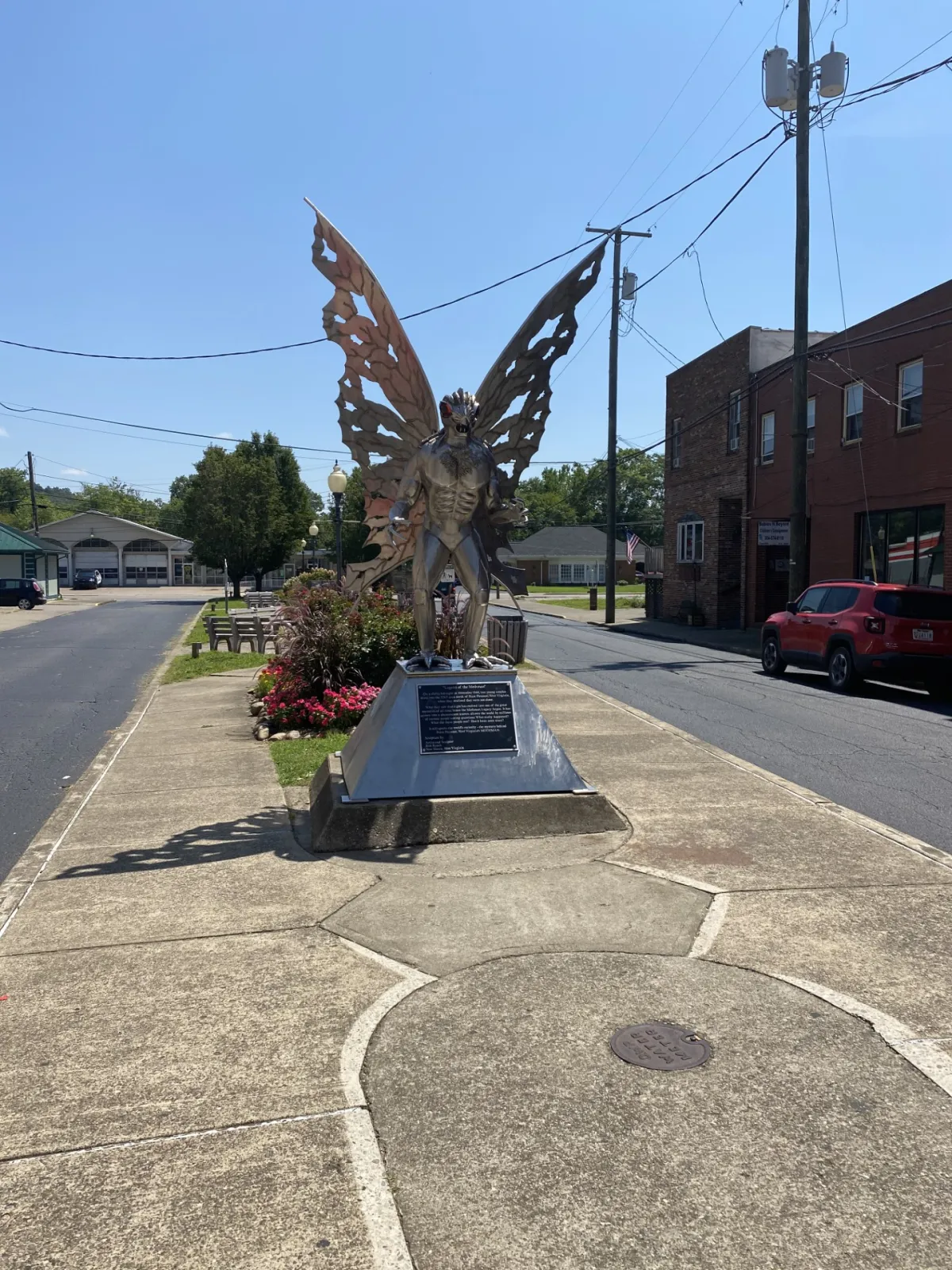
Wikimedia Commons — Csassen13, CC0

The First Major Sightings
The best-known Mothman reports began in mid-November 1966 near an abandoned World War II munitions area outside Point Pleasant known as the "TNT Area." This site, with its concrete domes, bunkers, overgrown roads, and isolated atmosphere, became central to the legend.
On the night of November 15, 1966, two young couples — Roger and Linda Scarberry, and Steve and Mary Mallette — were driving through the TNT Area when they reported seeing a strange figure standing near a generator plant. They described it as a large gray creature, roughly human-shaped, with wings folded against its back and bright red reflective eyes set high on its body. As they sped away in fear, they said the creature lifted off and pursued their car, reportedly keeping pace at speeds approaching 100 miles per hour.
Their account was quickly reported to local authorities and newspapers, and the story spread rapidly. The witnesses were generally treated as sincere, and their frightened reaction helped establish the case as something more than a casual ghost story.
Description of the Entity
Descriptions of the Mothman vary slightly from witness to witness, but several recurring details appear across the reports:
- Height: Commonly described as between 6 and 7 feet tall, though some accounts imply it seemed even larger.
- Build: Broad-shouldered, man-like, or vaguely humanoid, but not clearly human.
- Eyes: The most consistent detail; glowing or shining red eyes, often described as hypnotic, reflective, or intensely bright.
- Wings: Large wings spanning several feet, sometimes folded behind the body and sometimes extended in flight.
- Movement: Reportedly capable of vertical takeoff, rapid gliding, or chasing vehicles with little apparent effort.
- Sound: Some witnesses reported a squeaking, screeching, or high-pitched sound, while others claimed it moved silently.
- Behavior: Generally evasive but menacing, often watching from a distance, appearing near roads, rooftops, or fields, then suddenly taking flight.
One of the most unusual aspects of the legend is that many witnesses did not describe the being as flapping its wings constantly in a bird-like manner. Instead, some said it rose straight into the air like a helicopter or glided unnaturally, feeding theories that it may not have been a biological creature at all.
The TNT Area
The TNT Area became the geographic heart of the Mothman case. Originally used during World War II for ammunition production and storage, the area contained abandoned igloos, old roads, industrial ruins, and wetlands. Its isolated and eerie atmosphere made it an ideal breeding ground for strange stories.
Believers argue the environment may have concealed unusual activity for years. Some suggest the area was a hotspot for paranormal manifestations; others propose that pollutants, chemical residues, or hidden military operations may have contributed to sightings or altered wildlife behavior. Because the area was both remote and unsettling, it became the perfect setting for repeated encounters, rumor, and mythmaking.
Additional Witness Reports
Following the Scarberry and Mallette sighting, more reports emerged from Point Pleasant and surrounding areas:
- Several witnesses claimed to see a large winged creature crossing roads at night.
- Some described it perched in trees, on rooftops, or near abandoned structures.
- Others reported hearing strange noises outside their homes before seeing glowing red eyes in nearby fields.
- A few witnesses claimed encounters involved intense fear, confusion, or a sense of being watched.
The creature was not always seen in the exact same way. In some cases it seemed more bird-like; in others, more humanoid. This inconsistency has led both believers and skeptics to interpret the sightings in very different ways.
The McClintic Wildlife Management Area Theory
A skeptical explanation often connects the Mothman reports to large birds living in or passing through the region, especially the sandhill crane. The crane can stand several feet tall, has a broad wingspan, and features reddish coloring around the eyes. In low light, a startled witness could conceivably interpret such a bird as something monstrous.
However, believers argue that the sandhill crane explanation does not fully account for the humanoid descriptions, vehicle pursuit claims, or the psychological intensity reported by witnesses. Critics of the cryptid theory counter that once the local media labeled the creature and public excitement took hold, later reports became shaped by expectation and retelling.
The Men in Black Connection
One of the strangest layers of the Mothman legend involves alleged visits from mysterious "Men in Black." According to some accounts, odd, pale, or socially awkward men in dark suits appeared in the area after sightings, questioning witnesses or behaving in unsettling ways. These figures were described as speaking strangely, driving unfamiliar vehicles, or seeming unfamiliar with ordinary human behavior.
In paranormal interpretations, these visitors were thought to be connected to UFOs, intelligence operations, or nonhuman entities trying to monitor or suppress information. Skeptics view these stories as embellishments that became fused with the growing UFO subculture of the 1960s.
UFOs and Other Paranormal Activity
The Mothman flap did not exist in isolation. During the same period, Point Pleasant residents reported a wider range of strange phenomena:
- Unusual lights in the sky and possible UFO sightings.
- Disturbing dreams or feelings of dread before unusual events.
- Reports of bizarre phone calls, electronic interference, and apparitions.
- Encounters with strange strangers, unexplained voices, or prophetic warnings.
Because these reports overlapped in time, some researchers concluded that Point Pleasant was experiencing a broad paranormal wave rather than a single creature event. In this framework, Mothman was only one manifestation of a larger phenomenon.
John Keel and the Prophecy Theory
Researcher John Keel played a major role in shaping the Mothman narrative into a paranormal and prophetic mystery. Rather than treating Mothman purely as a hidden species, Keel connected the sightings to UFO activity, psychic events, Men in Black stories, and disaster warnings. He suggested that the phenomenon might involve deceptive, intelligence-like forces that appear in different forms throughout human history.
This interpretation shifted the legend away from zoology and toward high strangeness. In Keel's view, Mothman was less a flesh-and-blood monster and more a manifestation linked to prophecy, fear, and manipulation of perception.
The Silver Bridge Collapse
The most tragic event associated with the Mothman legend occurred on December 15, 1967, when the Silver Bridge connecting Point Pleasant, West Virginia, and Gallipolis, Ohio, collapsed during rush hour traffic. Forty-six people died in the disaster.
Because the collapse came after more than a year of sightings and warnings, many later interpreted the Mothman as an omen or harbinger of catastrophe. In this reading, the creature did not cause the collapse but appeared as a warning before it happened. This transformed the legend permanently. Mothman was no longer just a monster seen in the woods; it became a symbol of doom and forewarning.
Skeptics note that the bridge collapse had identifiable engineering causes and that linking it to prior sightings is a retrospective narrative pattern. Believers counter that the timing is too dramatic to dismiss and that many witness experiences involved dread, premonition, or a sense that something disastrous was coming.
Main Interpretations
Over the decades, several major theories have emerged to explain the Mothman:
1. Unknown Animal or Cryptid
In this view, Mothman was a real but unidentified creature — perhaps a rare bird, mutated animal, relict species, or undocumented humanoid. This is the most literal reading of the sightings.
2. Misidentified Bird
This is the most common skeptical explanation. Witnesses may have seen owls, herons, cranes, or other large birds under stressful nighttime conditions and transformed those impressions into a humanoid monster.
3. Supernatural Entity
Some believers argue Mothman was paranormal in nature: a demon-like being, spirit manifestation, or nonhuman intelligence associated with haunted places and heightened psychic states.
4. Harbinger of Disaster
This theory holds that Mothman appears before major tragedies, not as a cause but as a warning sign. Supporters sometimes connect later reports from other locations around the world to disasters, accidents, or social unrest.
5. Interdimensional or Ultraterrestrial Being
Influenced by paranormal researchers, this theory suggests the entity was not extraterrestrial in the traditional sense but an intelligence crossing into human perception from another dimension or reality layer.
6. Government Experiment or Secret Technology
A more conspiratorial reading claims the Mothman may have been linked to covert military projects, psychological operations, radiation exposure, or advanced surveillance technology. The TNT Area's wartime history and the broader Cold War atmosphere help fuel this interpretation.
Why the Story Endured
The Mothman legend has lasted for decades because it sits at the intersection of many powerful themes:
- Fear of the unknown.
- Rural isolation and eerie landscapes.
- Cold War suspicion and secrecy.
- Religious and supernatural symbolism.
- Tragic coincidence and the search for meaning.
- The power of newspapers, retellings, and folklore to transform local events into myth.
Unlike many cryptid stories, Mothman is tied to a specific place, a specific time period, a dramatic eyewitness wave, and a real tragedy. This gives the story unusual emotional force.
Legacy and Cultural Impact
Today, Mothman has evolved from local terror into regional iconography. Point Pleasant embraces the legend through museums, tourism, merchandise, and annual festivals. What was once a frightening mystery has become one of the most recognizable cryptid stories in American culture.
Books, documentaries, podcasts, films, and internet communities continue to revisit the case. Some treat it as folklore, others as unsolved paranormal history, and others as evidence that reality occasionally breaks down in ways science cannot easily explain.
Skeptical Assessment
Skeptics argue that the Mothman case represents a classic feedback loop:
- A frightening but ambiguous initial sighting occurs.
- Media coverage labels and dramatizes the event.
- Additional witnesses interpret ordinary stimuli through the new story framework.
- Later unrelated tragedies become incorporated into the mythology.
From this standpoint, Mothman is not a real creature but a modern legend built from fear, suggestion, and coincidence.
Believer Assessment
Believers maintain that the consistency of the red-eyed winged figure, the sheer number of reports, the emotional intensity of witnesses, and the broader cluster of paranormal activity point to a genuine anomaly. Whether creature, warning entity, or interdimensional intelligence, they argue that something extraordinary occurred in Point Pleasant during 1966–1967.
Conclusion
The Mothman remains unresolved. It occupies a unique place between cryptozoology, folklore, paranormal investigation, and conspiracy culture. Whether understood as bird, beast, omen, or intelligence from beyond ordinary reality, the legend endures because it speaks to a deeper fear: that warnings may come in forms we do not understand until it is too late.