
Overview
The Gulf of Tonkin Incident refers to two reported confrontations between North Vietnamese naval vessels and the U.S. destroyer USS Maddox in the Gulf of Tonkin in August 1964. The first incident on August 2 was a genuine engagement; the second, reportedly occurring on August 4, almost certainly never happened. President Lyndon B. Johnson used the reported attacks to push through the Gulf of Tonkin Resolution on August 7, 1964, granting him broad authority to escalate U.S. military operations in Vietnam without a formal declaration of war.
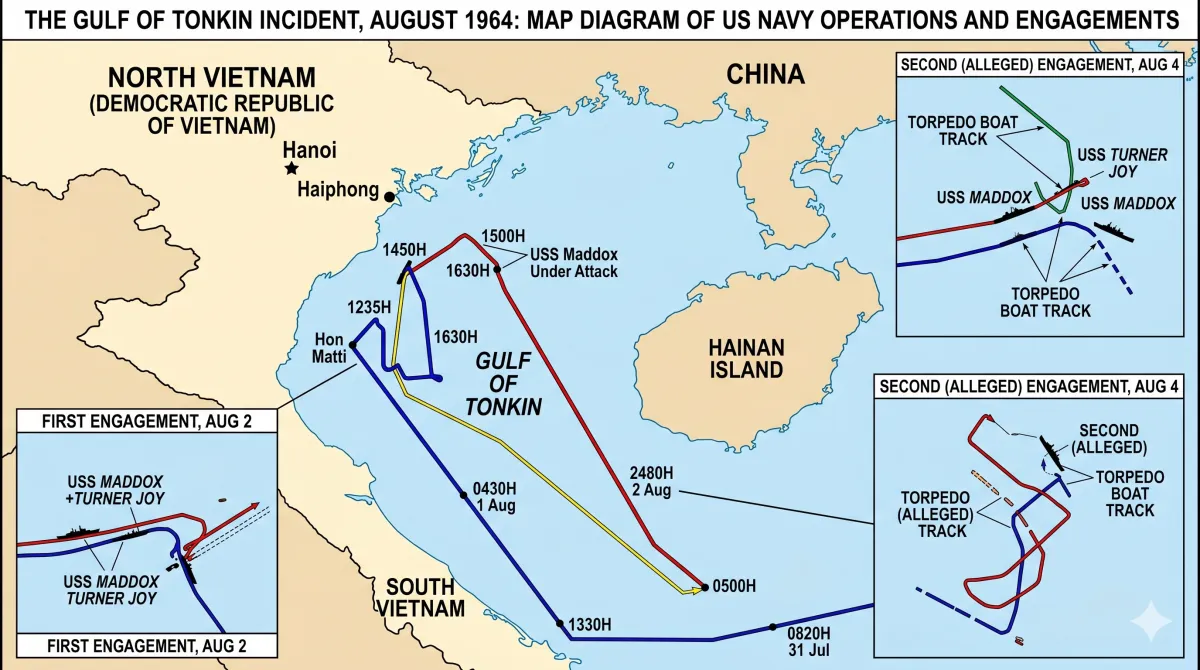
The First Incident — August 2, 1964
Section
On August 2, 1964, the USS Maddox, while conducting a signals intelligence patrol (DESOTO patrol) in the Gulf of Tonkin, was approached by three North Vietnamese torpedo boats. The Maddox fired first, and a brief engagement followed in which one torpedo boat was damaged and four North Vietnamese sailors were killed. The Maddox suffered negligible damage.
What the Johnson administration did not publicly disclose was that the Maddox's patrol was coordinated with OPLAN 34A — a covert South Vietnamese operation (supported by the CIA and U.S. Navy) that had conducted raids on two North Vietnamese islands just two days earlier. The North Vietnamese likely perceived the Maddox's mission as connected to these raids, making the attack a response to American-supported aggression rather than an unprovoked attack.
The Second Incident — August 4, 1964
On the night of August 4, the Maddox and the USS Turner Joy reported a second attack, claiming to detect torpedo boat movements on sonar and radar. The crews fired at targets in the dark for approximately two hours. However, Captain John J. Herrick of the Maddox sent a cable within hours stating: "Review of action makes many reported contacts and torpedoes fired appear doubtful. Freak weather effects on radar and overeager sonarmen may have accounted for many reports."
Despite Herrick's doubts and the inability to confirm any physical evidence of the attack (no wreckage, no visual confirmations, no North Vietnamese casualties), President Johnson ordered retaliatory airstrikes (Operation Pierce Arrow) against North Vietnamese naval facilities within hours. He addressed the nation on television that evening, describing the second attack as confirmed and "unprovoked."
The Gulf of Tonkin Resolution
On August 7, 1964, Congress passed the Gulf of Tonkin Resolution with near-unanimous support (88-2 in the Senate, 416-0 in the House). Senators Wayne Morse (Oregon) and Ernest Gruening (Alaska) cast the only opposing votes. The resolution gave the president authority to "take all necessary measures to repel any armed attack against the forces of the United States and to prevent further aggression" — effectively a blank check for military escalation.
By 1965, the United States had deployed combat troops to Vietnam, and the conflict would eventually cost over 58,000 American lives and an estimated 2-3 million Vietnamese lives.
Evidence of Deception
Multiple lines of evidence confirm that the Johnson administration knowingly misrepresented the events:
- NSA intercepts: In 2005, the National Security Agency released a declassified study by historian Robert Hanyok confirming that NSA intelligence analysts had deliberately skewed the translation and interpretation of intercepted North Vietnamese communications to support the claim of a second attack. The original SIGINT showed no evidence of a second engagement.
- Johnson's private statements: Recordings of Johnson's private conversations reveal he had doubts about the second attack. He told Under Secretary of State George Ball: "Hell, those dumb, stupid sailors were just shooting at flying fish."
- McNamara's admission: In the 2003 documentary The Fog of War, former Secretary of Defense Robert McNamara acknowledged that the August 4 incident did not occur as reported.
- Pentagon Papers: The Pentagon Papers, leaked by Daniel Ellsberg in 1971, revealed that the Johnson administration had been planning military escalation months before the Tonkin incidents and had drafted the resolution beforehand.
Legacy
The Gulf of Tonkin Incident is one of the most consequential government deceptions in American history. It demonstrates how manufactured or misrepresented intelligence can be used to bypass congressional authority and commit a nation to war. The incident led directly to:
- The War Powers Resolution of 1973, requiring congressional approval for extended military commitments
- Deep public skepticism toward government claims justifying military action — a dynamic that continues to influence debates about Iraq, Syria, and other conflicts
- Standard academic and journalistic scrutiny of government justifications for military intervention