
Overview
The "Golden Gate Bridge as a Defense Target" theory argued that the bridge was not only a transportation project but also a strategic wartime object, planned from the outset with the possibility that it might be destroyed to deny or obstruct passage through the Golden Gate during an attack. In some versions, the bridge was a passive trap: a structure whose fall would clog the narrows. In stronger versions, it was an intentional demolition asset built into the harbor’s defensive logic.
The theory gained force because the Golden Gate had been militarized for generations. Long before the bridge existed, forts, guns, minefields, and observation systems guarded the entrance to San Francisco Bay. Building a giant steel span across such a strategic passage invited military interpretation.
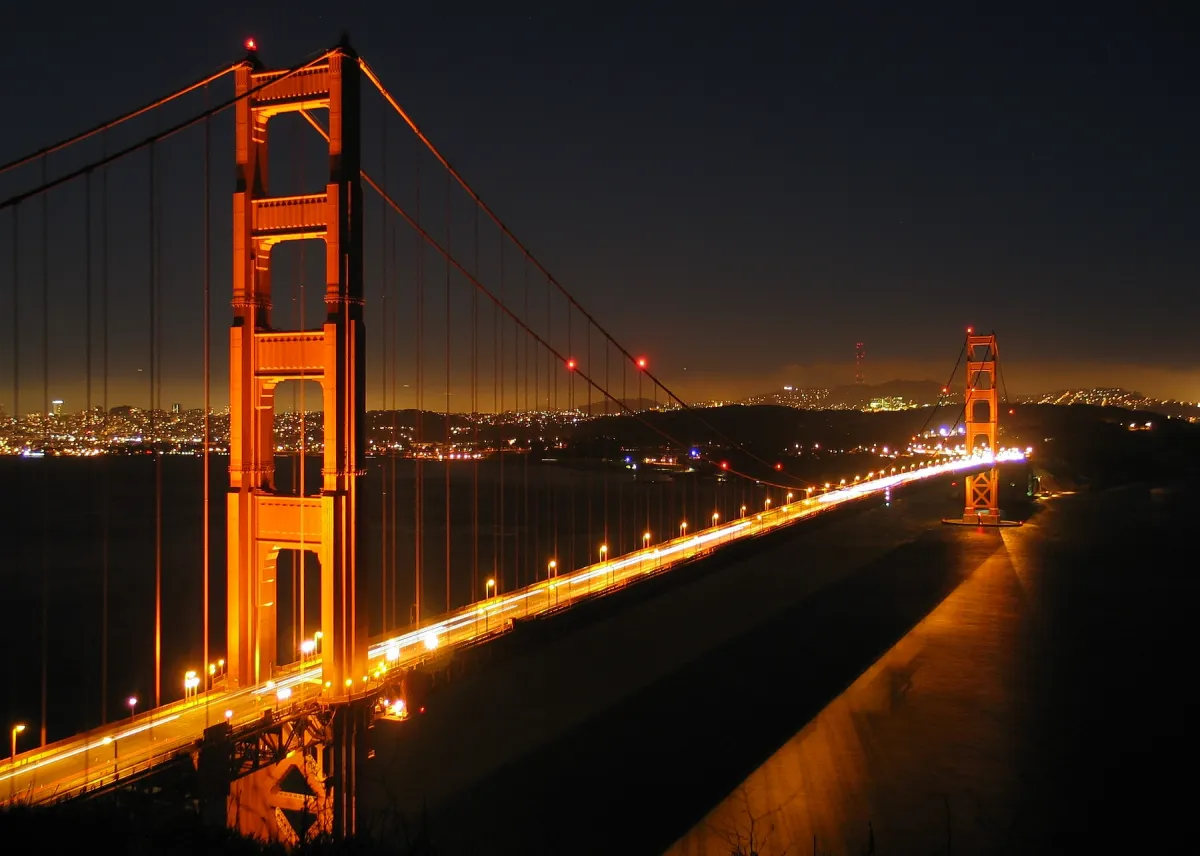
Wikimedia Commons — Image taken by Daniel Schwen, CC BY-SA 3.0

Historical Setting
Construction of the bridge began in the 1930s in a landscape already marked by coastal defense. Fort Point, batteries on both shores, and later World War systems all reflected the fact that San Francisco Bay was considered one of the most important harbors on the Pacific coast. The Golden Gate itself was a narrow, tactically meaningful entrance.
The War Department’s review of the bridge underscored the strategic tension. Military officials worried that if the span were bombed or collapsed, naval movement could be impaired and ships could be trapped in the bay. That concern became one of the main historical foundations for later conspiracy claims.
Central Claim
The theory held that the bridge’s strategic placement was too important to be purely civilian. In moderate versions, designers and the military simply understood that the bridge could become a defensive obstruction if destroyed during an emergency. In stronger versions, the bridge was effectively built with that wartime role in mind, whether or not it was ever stated publicly.
Some retellings imagined pre-positioned demolition planning. Others focused less on explosives than on the bridge’s existence as a giant controllable chokepoint at the harbor mouth. In both cases, the bridge’s military meaning overshadowed its public presentation as a civic monument.
Why the Theory Persisted
The theory persisted because the bay really was heavily defended, and because the bridge occupied one of the most strategic pieces of geography on the Pacific coast. Civilian infrastructure placed inside a defended military corridor naturally attracts dual-use interpretations.
It also mattered that the bridge was controversial from a military perspective. The idea that the War Department feared the span could trap ships helped later observers infer that the same hazard might be inverted into a deliberate plan.
Fort Point and the Defensive Landscape
Fort Point beneath the southern anchorage preserved the most visible reminder that the bridge did not occupy neutral land. The site had long been understood as the key southern defensive position at the narrows. The bridge was therefore built directly atop an older military geography.
That continuity encouraged a conspiratorial reading: if the land had always been about controlling the gate, why assume the bridge had escaped that logic?
Interwar and Wartime Interpretation
The 1930s were a period of growing international tension, and on the Pacific coast invasion fears were not abstract. Invasion scenarios, coastal artillery, mine control, and harbor defense planning all remained active concerns. The theory translated those anxieties into a single image: the bridge as a giant engineered barricade that could, if necessary, close the bay.
Legacy
The "Golden Gate Bridge as a Defense Target" theory survives because it rests on a visibly real strategic fact: the bridge sits in one of the most militarily important harbor entrances in the United States. The conspiracy claim extends that fact into intentional sacrificial design, turning a celebrated civic structure into a latent instrument of denial and obstruction in wartime.