
The policy
On 25 January 1945, Grand Rapids, Michigan, became the first city in the world to add fluoride to its public water supply. It was a controlled experiment: Grand Rapids fluoridated, nearby Muskegon did not, and children's teeth in both were tracked. The results, published in 1950, showed a substantial reduction in tooth decay.
Other cities followed through the 1950s, usually by council vote or local referendum, and usually after a public argument.
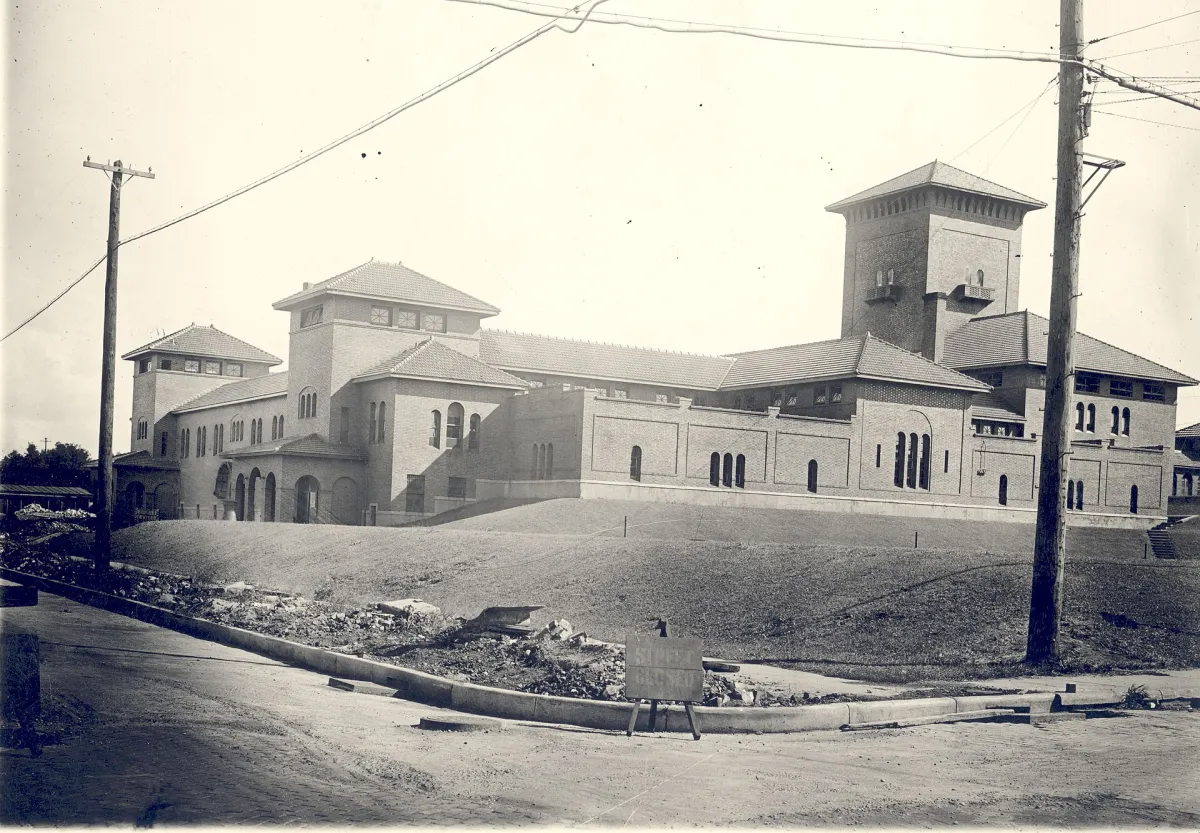
Grand Rapids’s water filtration plant in 1930. On 25 January 1945 this became the first municipal supply in the world to be deliberately fluoridated. Wikimedia Commons — Murch S. Morris, Public domain

The Cold War reading
The theory that concerns this entry took shape in the same years, and it was specific. Fluoride in the water was not merely unnecessary or unsafe. It was a communist measure — introduced or promoted to dull mental clarity, weaken resistance and make a population easier to manage.
That framing did real work in the 1950s. It converted a dispute about a city's water into a front in an existing global struggle, which meant a local council vote could be understood as a place where the Cold War was being won or lost. The John Birch Society and allied groups campaigned on it, and it circulated through pamphlets, local radio and referendum fights.
It is also the version Kubrick put on screen in 1964, when General Jack D. Ripper explains in Dr. Strangelove that fluoridation is the most monstrously conceived communist plot he has ever had to face, and that he denies women his essence to protect his precious bodily fluids. That scene is why most people now encounter the theory as a joke rather than as an argument, which has had the odd effect of making it harder to examine seriously.
What is behind the plot version
Nothing. No document, defector, intercepted instruction or participant account has ever been produced linking fluoridation to the Soviet Union or to any communist organisation. The policy's actual origin is traceable in the opposite direction: dental researchers noticed that people in areas with naturally fluoridated water had markedly less decay, and the Grand Rapids trial was designed to test whether adding it deliberately would reproduce the effect.
The plot claim is now mostly of historical interest. It tells you a great deal about 1954 and very little about fluoride.
The objection that is not the plot
The theory survived the collapse of its Cold War framing, and it did so because something underneath it does not depend on communists at all.
Fluoridation is medication delivered through infrastructure. A person who does not want it cannot easily decline it, because the dose arrives in the tap. Unlike almost every other medical intervention, there is no individual consent step and no per-person adjustment for age, weight or existing intake. That is a genuine objection on civil-liberties grounds, it was made from the beginning by people with no interest in communism, and it is not answered by evidence that the policy works.
Several European countries have declined to fluoridate for broadly this reason while accepting the dental evidence, which is the clearest demonstration that the two questions are separable.
What the evidence actually says
The dental case is strong and endorsed by the major health bodies — the World Health Organization, the CDC and the FDI World Dental Federation all describe fluoridation at recommended levels as safe and effective. In April 1999 the CDC named it one of the ten great public health achievements in the United States between 1900 and 1999.
The documented adverse effect at those levels is dental fluorosis: mottling of the enamel. It is usually mild, and the 2015 Cochrane review estimated that about twelve per cent of people experience fluorosis of aesthetic concern at 0.7 parts per million.
That figure is worth stating plainly rather than minimising, because it is the kind of fact that costs credibility when it is left out and discovered later.
The part that has genuinely moved
The strongest thing an opponent can say is not about communists. It is that the recommended level has changed.
In 2015 the United States lowered its recommendation from a range topping out at 1.2 mg/L to a single figure of 0.7 mg/L, on the reasoning that people now get fluoride from toothpaste and other sources that did not exist in 1945. The WHO's guidance is a range of 0.5 to 1.5 mg/L depending on climate, because consumption varies with how much water people drink.
So the dose has been revised downward by the authorities who set it, in living memory, in response to new information. That is science behaving correctly. It is also, straightforwardly, an admission that the earlier figure was higher than it needed to be — and anyone told that the question has always been settled has been told something untrue.
Where it stands
No evidence has been produced that water fluoridation was conceived, promoted or directed as a communist measure, and the claim is best understood as an artefact of the period that produced it.
The policy itself is well supported for the thing it was adopted to do. It also delivers a substance to everybody connected to a water main regardless of what any of them want, produces a visible cosmetic effect in roughly one person in eight at current levels, and has had its recommended dose reduced once already. Those are the terms on which it is still argued, and they do not require a plot.