
What was taken
The Amber Room was a complete interior: wall panels of amber mosaic backed with gold leaf and mirrors, begun in Prussia in 1701 and given to Peter the Great, and installed finally at the Catherine Palace outside St Petersburg. It covered something like fifty-five square metres and used several tonnes of amber. It was not a treasure stored in a room; it was the room.
In 1941 German forces reached the palace. The Soviet curators had tried to hide the panels behind wallpaper, having concluded the amber was too brittle to move safely. The deception failed. The room was dismantled in thirty-six hours, crated, and sent to Königsberg in East Prussia.
There it was reassembled and put on display in the castle, under Alfred Rohde, the director of the castle's collections, and with the Gauleiter of East Prussia, Erich Koch, exercising control over what left the city.
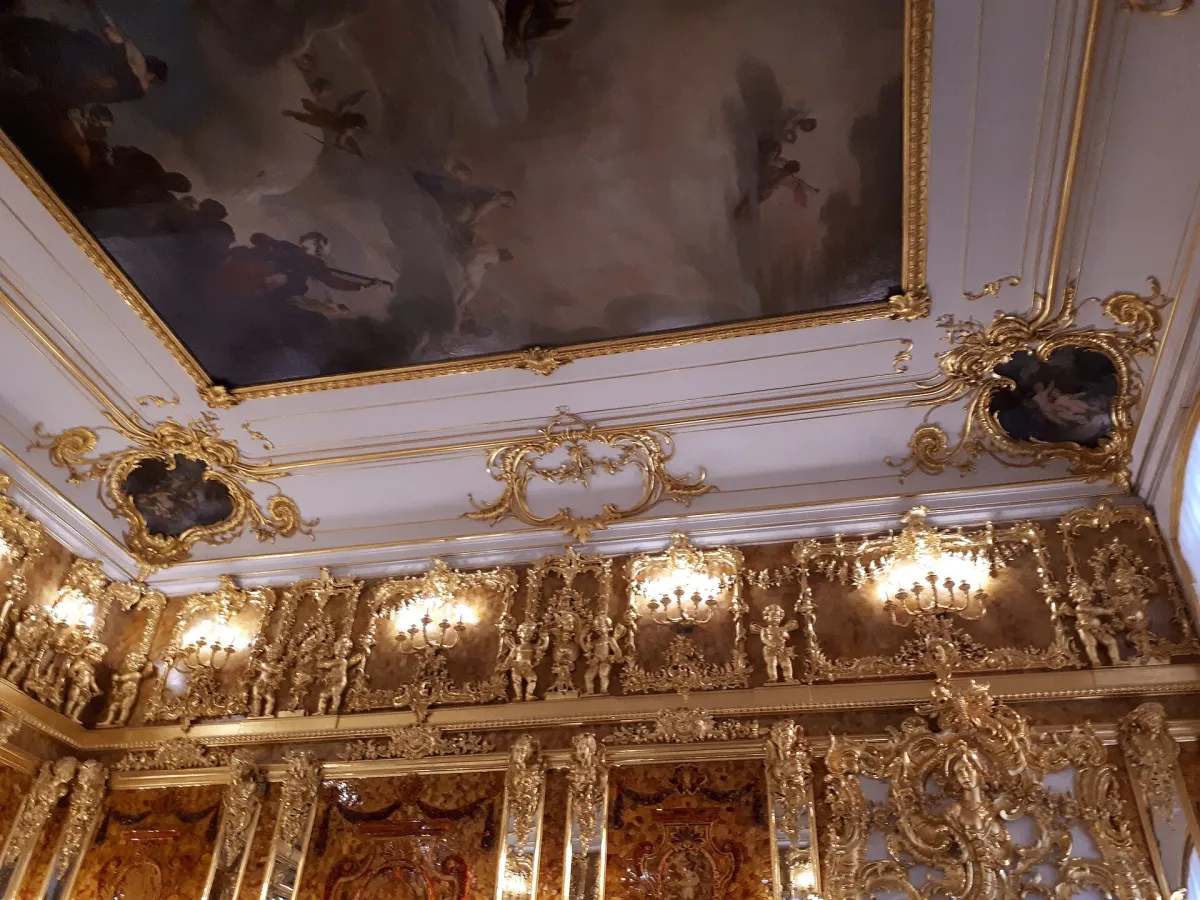
The Amber Room at the Catherine Palace today. This is the reconstruction completed in 2003, not the original — the panels looted in 1941 have never been recovered. Wikimedia Commons — GAlexandrova, CC BY-SA 4.0

Where the record stops
This is the part that matters, and it is short.
In late August 1944 the RAF bombed Königsberg heavily and the castle was badly damaged. Rohde had the panels taken down again and packed, and reported them stored in the Knight's Hall. In January 1945, with the Red Army approaching, there were instructions to load the amber into strongboxes for evacuation.
After that there is nothing. The city fell in April 1945. The castle burned. Rohde and his wife died later that year, of typhus, before Soviet investigators got a consistent account out of him — and his accounts were not consistent: he said at different times that the panels were stored in the castle and that they had been moved elsewhere and lost to fire.
Koch survived, was tried, and in the 1960s told Polish authorities the room had been sealed in a bunker outside Königsberg whose location had been lost under the bombing. He produced nothing that led anywhere.
The tunnel-and-wall version
The theory this entry is named for takes that gap and fills it with deliberate concealment. In its usual form the Nazis recognised the room was too famous to move and too recognisable to sell, so they destroyed its form rather than its substance — melting or breaking the amber down, mixing it with other looted material, and sealing it inside the masonry of a tunnel, mine or bunker where it would read as construction rather than cargo.
Two things make it durable, and they are worth naming separately because they do different work.
The first is that it explains failure. A mine can be searched and found empty without touching the theory, because walls and sealed corridors can always be the wrong walls. A claim that survives its own disproof is not thereby true, but it is very hard to kill.
The second is that it inverts a real physical fact. Amber burns, and it degrades badly under heat — which is the strongest argument that the room was destroyed in the castle fire. The theory takes that same property and reads it as motive: if heat could ruin the amber, heat could also be used to make it unrecognisable on purpose. The evidence for destruction becomes evidence of method.
What the investigations found
Two independent lines of inquiry have reached the same place. Soviet investigators working in the immediate postwar period, and later the British journalists Catherine Scott-Clark and Adrian Levy working from Soviet and German archives, both concluded that the Amber Room most probably burned in Königsberg Castle in 1945, shortly after the city surrendered.
That conclusion is not a refusal to look. It is what the trail supports: the last documented location is a building that burned, the material is flammable, and in eighty years of searching — mines, bunkers, lagoons, a shipwreck, a Polish forest — nothing of the room has been recovered beyond a handful of fragments that left Königsberg separately.
Why it keeps going anyway
Partly because the loss is genuinely unresolved in the strict sense: no one has produced the ashes, and absence of recovery is not the same as proof of destruction.
Partly because the theatre around it has never stopped. Every few years a new search is announced — a bunker, a tunnel, a sunken ship — and each announcement restores the room to the realm of the findable. The searches are real, the funding is sometimes real, and the coverage treats each one as a live possibility.
And partly for a reason that has nothing to do with evidence. A reconstruction of the Amber Room was completed at the Catherine Palace in 2003, after decades of work, and is open to visitors. The original is therefore not needed for anyone to see what was lost — which leaves the search free to be about the object itself, somewhere, intact, rather than about the room.
Where it stands
No evidence has been produced that the Amber Room was melted, walled in, or concealed in any tunnel. The specific claim this entry describes rests on inference from a documentary gap and on the inversion of the one physical property that most argues against it.
What is established is narrower and sadder. A room was stolen, moved twice, packed into boxes, and left in a castle that was bombed in August 1944 and burned in 1945, in a city that was then levelled and renamed. The men who could have said where it went gave inconsistent accounts and died, one of typhus and one in prison. That is enough to explain why nobody has found it.