
The claim
From 1997 Otis Eugene Ray, who went by Gene, published a website setting out what he called Time Cube. Its central assertion was that a single rotation of the Earth contains four simultaneous days rather than one, corresponding to the four quadrants a rotating sphere passes through, and that the single-day convention everyone else uses is not a convention but an error — one taught deliberately.
The site was formatted in coloured, capitalised, unpunctuated blocks of text that ran down the page without obvious order. It is among the most recognisable artefacts of the early web, and the Internet Archive holds it.
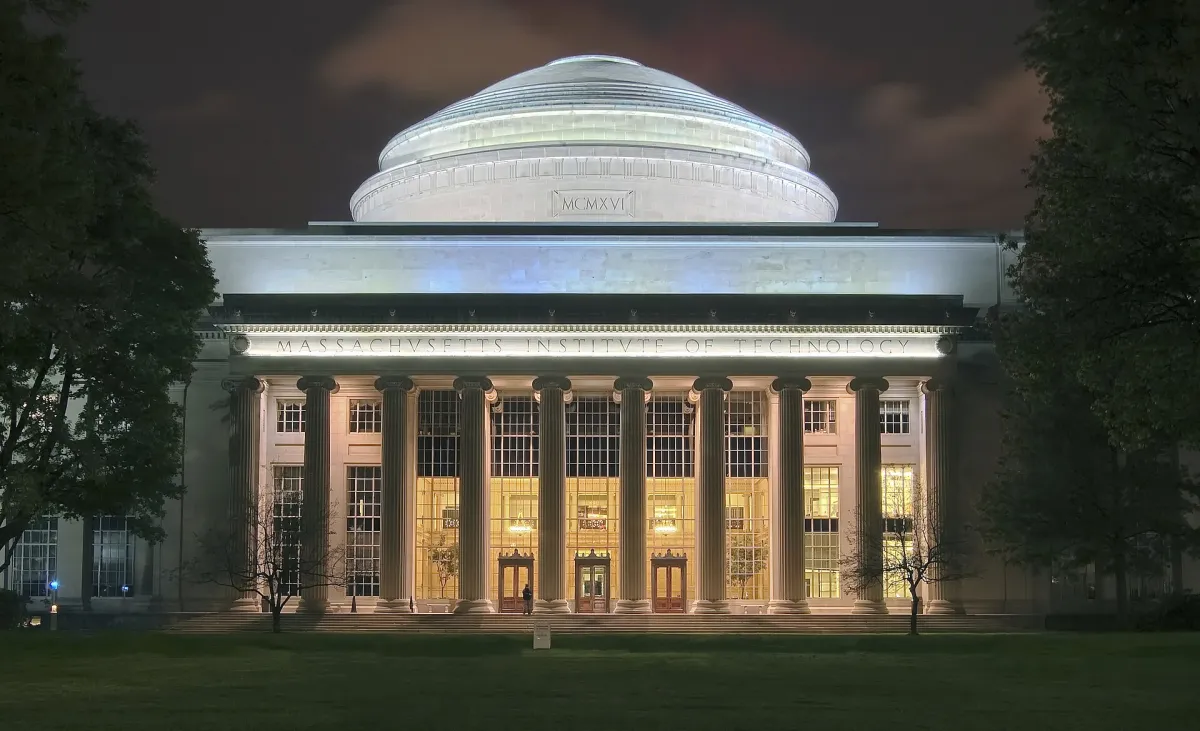
MIT, where students invited Ray to speak in January 2002 and he repeated his ten-thousand-dollar challenge. It is a difficult venue to have been suppressed at. Wikimedia Commons — Fcb981, this edited version by Thermos, CC BY-SA 3.0

The conspiracy part
This archive is not primarily interested in whether a day has four parts. What places Time Cube here is the second half of Ray's argument, which was about why nobody agreed with him.
He held that the world's academics were engaged in a conspiracy to omit his discovery — that the educational system existed to prevent people from being able to perceive the Cube, and that teachers and scientists were knowingly maintaining the error. He called them evil and he called the condition they produced in students stupidity, in a construction he used constantly.
He also made the claim testable in the way such claims usually are not. He offered money — a thousand dollars, later ten thousand — to anybody who could disprove the Cube.
What actually happened to him
The suppression claim has an unusually clean test, because the institutions he named as suppressing him invited him to speak.
In January 2002 students at MIT brought him in during the independent activities period, and he addressed an audience there. He repeated the ten-thousand-dollar offer to any professor who would disprove him. None attempted it. In April 2005 he appeared at Georgia Tech, where he used the platform to attack the teaching offered by academics.
A man subject to a worldwide academic conspiracy to omit his work does not usually get a lecture slot at the Massachusetts Institute of Technology, twice over, at student invitation, with the microphone on.
Why nobody took the money
The unclaimed prize was the part Ray treated as decisive, and it is worth answering directly rather than ignoring.
Nobody collected because the claim is not of a kind that can be disproved. It does not make a prediction that could come out one way or the other; it reassigns the meaning of a word — day — and then observes that the reassignment is not reflected in ordinary usage. There is no experiment whose result would settle it, because nothing about the physical world is in dispute. The Earth rotates once; Ray and his critics agreed about that completely.
An unclaimed prize for disproving an unfalsifiable claim is not evidence of the claim. It is a description of what unfalsifiable means.
What it is actually worth
It would be easy to file this as a curiosity and leave, and that would miss what makes it useful.
Time Cube is an unusually pure specimen of a structure that appears throughout this archive attached to much larger subjects: the claim that rejection is itself evidence. Once a theory holds that the people qualified to assess it are the ones conspiring against it, every expert who declines to endorse it becomes a data point in its favour, and the theory can no longer be reached by the only people equipped to test it.
Ray's version is unguarded enough to see the mechanism plainly, because nothing else is in the way — no political interest, no disputed event, no competing account of a real occurrence. Just the move itself.
A note on the man
Ray was in his seventies for most of the period his site was famous, and much of its fame consisted of people quoting him to laugh. His own writing refers to psychiatrists and how they would judge him.
This entry concerns a claim about institutional suppression and the structure of that claim. It is not an assessment of him, and the archive takes no view on his health. He was invited onto two of the better stages in American science, said what he thought, and died in 2015 at 87.
Where it stands
No evidence has been produced of an academic conspiracy to suppress Time Cube, and the clearest thing against it is the lecture invitations. The theory itself makes no claim about the physical world that could be tested, which is why the standing offer was never collected and never could have been.