
Overview
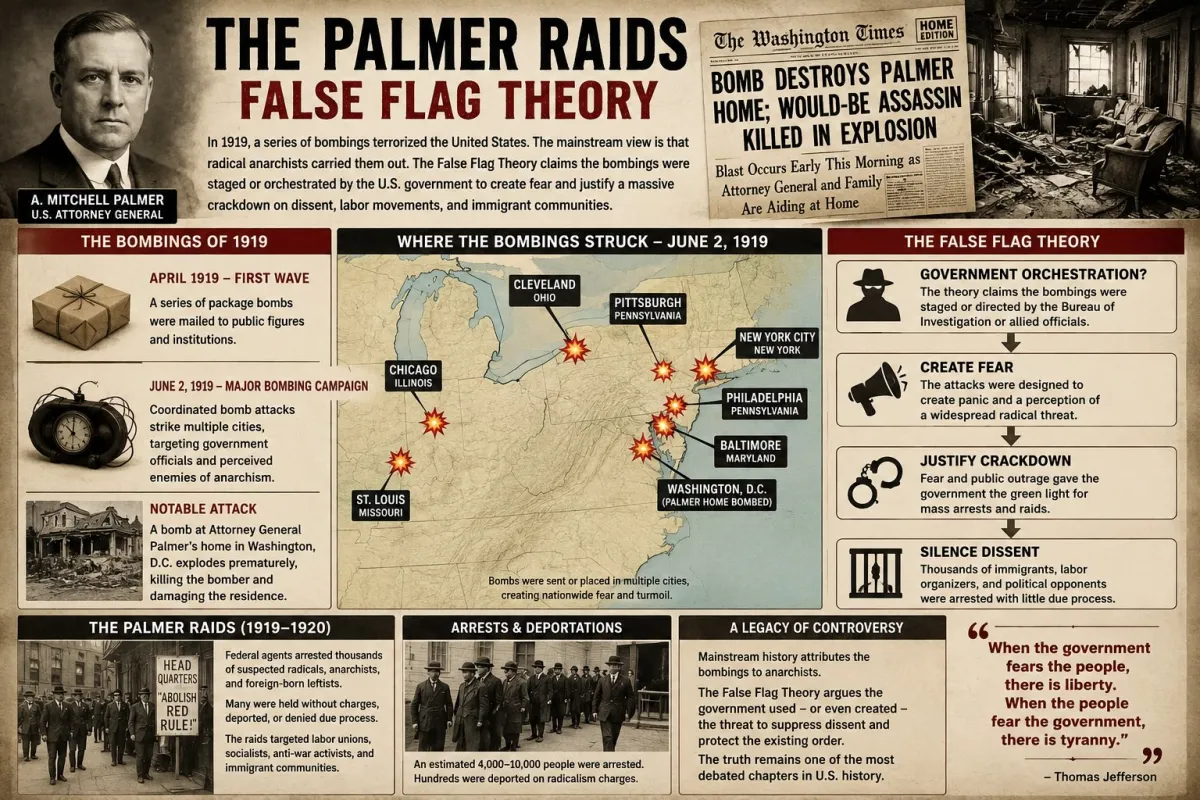
The Palmer Raids False Flag theory grew out of one of the most volatile moments in post-World War I American politics. In 1919, bombs were mailed to public figures and larger explosions struck multiple cities. Within the same atmosphere of fear, Attorney General A. Mitchell Palmer and federal authorities launched a broad campaign against anarchists, radicals, and foreign-born leftists that came to be known as the Palmer Raids.
The theory proposed that the bombings were not simply used politically after the fact, but were connected more deeply to the repressive apparatus itself. In its strongest form, the Bureau of Investigation or allied officials were said to have staged or steered the attacks in order to generate consent for a sweeping crackdown on labor unrest and radical organizing.
The Bombings
A first wave of package bombs appeared in April 1919. A more dramatic coordinated bombing campaign followed on June 2, 1919, striking or targeting prominent officials and public enemies of anarchist movements in several cities. One of the most famous attacks damaged Attorney General Palmer’s Washington home and killed the bomber when the device exploded prematurely.
These bombings mattered not only as acts of violence but as political catalysts. They provided a vivid, national, and emotionally powerful image of domestic radical menace. That made them ideal raw material for later false-flag suspicion.
Why the Theory Emerged
The theory emerged because the fit between event and response seemed exceptionally close. The bombings intensified fear of anarchism. Federal agencies gained political latitude. New intelligence structures expanded. Hoover’s anti-radical apparatus developed rapidly in the same climate. To critics of the raids, the sequence looked too convenient.
The theory was also nourished by the broader repressive environment. Labor militancy, immigration suspicion, and anti-left panic were already present. Because authorities appeared eager for a justification to widen surveillance and arrests, the bombings came to be seen in some quarters as either staged outright or at least operationally useful enough to invite suspicion.
The Official and Historical Record
The official and most common historical account has attributed the bombings to anarchist circles, especially those associated with the Galleanist movement. Investigators cited common flyers, target patterns, and other clues linking the attacks to Italian anarchist militants. The premature death of the Washington bomber was treated as an important clue in identifying Carlo Valdinoci as a likely participant in the June attack on Palmer’s house.
The false-flag theory does not necessarily deny that anarchists existed or that they had engaged in violence. Instead, its stronger versions claim infiltration, provocation, orchestration, or selective allowance. In that view, even real anarchists could have been manipulated into providing the crisis the state needed.
Labor Union Dimension
Some versions of the theory shift emphasis away from anarchists and toward labor unions. They argue that the bombings, whether staged or exaggerated, gave federal authorities cover to criminalize wider forms of labor radicalism that had little to do with parcel bombs. Under this interpretation, the true target was not only anarchist violence but the broader world of strikes, organizers, and immigrant working-class politics.
That interpretation gives the theory a social-control dimension. The bombings become the triggering spectacle, while the raids become the real objective.
Why the Theory Persisted
The Palmer Raids False Flag theory persisted because the raids themselves were so extreme. Large numbers of people were arrested, detained, mistreated, and in some cases deported under sweeping assumptions of radical danger. When the repression is broad enough, the event that justified it naturally comes under suspicion.
It also persisted because the bombings remain symbolically concentrated. A few explosive acts had enormous national consequences. The theory therefore asks whether the consequences were simply seized upon, or whether they were built into the event from the beginning.
Historical Significance
This theory is significant because it treats one of the foundational crises of the First Red Scare as a possible act of state pretext creation. Even where the mainstream historical record points toward anarchist culpability, the false-flag theory has remained attached to the case because the political payoff for the state was so immediate and so large.
As a conspiracy-history entry, it belongs to the family of pretext theories: claims that dramatic violence is engineered, guided, or opportunistically allowed in order to authorize repression that would otherwise face greater resistance.