
Overview
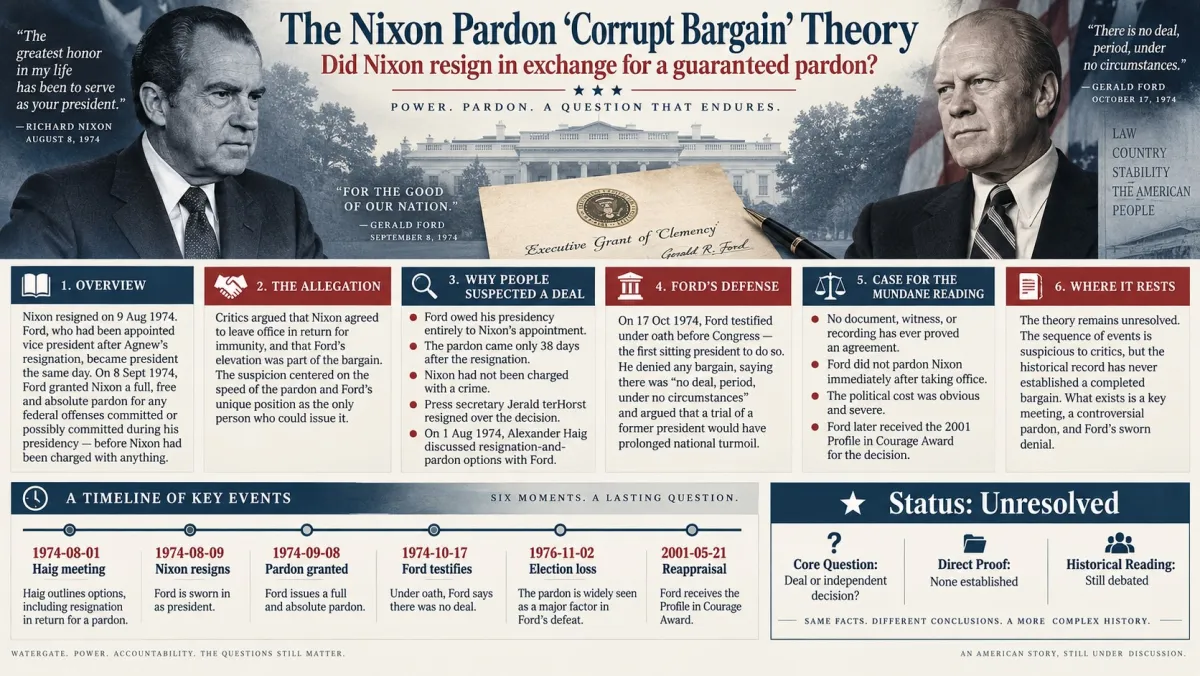
The sequence is what did the damage. Nixon resigned on 9 August 1974 rather than face near-certain impeachment and conviction. Gerald Ford — who had not been elected to either of the two offices he now held, having been appointed vice president after Spiro Agnew's resignation — took the oath the same day. On 8 September he granted Nixon a full, free and absolute pardon for all offences against the United States committed or possibly committed during his presidency.
Nixon had not been charged with anything. The pardon covered crimes that had not been specified, in proceedings that had not begun. Ford's approval rating fell from the seventies to the forties within days, and it is generally regarded as the reason he lost in 1976.
The Allegation
The charge was made immediately and in plain terms: that Nixon had agreed to go quietly in return for a guarantee of immunity, and that Ford's elevation had been the consideration. In the language of American political history, a corrupt bargain.
The circumstantial case is not weak. Ford owed his position entirely to Nixon's appointment. He was the only person in the country who could deliver a pardon, and the pardon arrived within a month, unprompted by any legal necessity. Ford's press secretary, Jerald terHorst, resigned over it.
Ford's Testimony
Ford's response was without precedent. On 17 October 1974 he appeared before the House Judiciary Committee's Subcommittee on Criminal Justice, chaired by William Hungate, and answered questions under oath. No sitting president had ever given sworn testimony to a congressional committee.
His statement on the central point was unambiguous: there was no deal, period, under no circumstances. He said he had acted to end a national preoccupation that was consuming the government's capacity to function, and because the prospect of a former president on trial would have prolonged it for years.
The testimony did not persuade the people who were unpersuaded, but it is a substantial fact in the record. A president submitted to hostile questioning under oath about his own motives, which is not the behaviour usually associated with concealing an arrangement.
What Haig Brought
The most substantial evidence for the other reading emerged later, and it concerns a meeting on 1 August 1974 — eight days before the resignation, while Ford was still vice president.
Bob Woodward's reporting, set out in Shadow, describes Nixon's chief of staff Alexander Haig coming to Ford's office and laying out options. Among them: that Nixon might resign in return for an agreement that his successor would pardon him. Haig is described as leaving papers behind, including an analysis of the pardon power and a draft pardon form requiring only a signature and a name.
Ford's account, then and afterwards, was that he listened, did not agree to anything, and later that day told Haig explicitly that no recommendation had been given. His aides recalled urging him to close the conversation down, which he did.
So the meeting happened. What is disputed is whether anything was concluded in it. Ford maintained to the end of his life that nothing was.
The Case for the Mundane Reading
Several things sit awkwardly with a bargain.
If a deal had been struck on 1 August, the natural moment to honour it was immediately. Ford waited a month, through a period in which the pressure ran the other way. He also sought and received a legal opinion that acceptance of a pardon carries an implication of guilt, and he kept a copy of that reasoning in his wallet for years afterwards — a detail his defenders read as a man assembling a justification rather than executing a contract.
And the political cost was enormous and entirely foreseeable. A president who had traded a pardon for an office had already banked his side of the exchange; paying for it with his own election is a strange way to complete the transaction.
Where It Rests
Historical opinion has shifted a long way since 1974. Ford's reasoning — that a criminal trial of a former president would have paralysed the country for years — has been treated more sympathetically by later historians than it was by contemporaries, and in 2001 he received the Profile in Courage Award for the decision, from an institution named for the president whose brother he had once served alongside in Congress.
What has never been produced is a document, a witness or a recording establishing an agreement. What exists is a meeting on 1 August at which the possibility was raised by a man acting for Nixon, and a pardon thirty-eight days later. Whether that constitutes a deal or a suggestion that was declined and then independently arrived at is the question, and the only person who could have closed it testified under oath that it was the latter.