
What the order actually did
Franklin Roosevelt signed Executive Order 6102 on 5 April 1933. It forbade the hoarding of gold coin, gold bullion and gold certificates within the continental United States, and required most holders to deliver them to a Federal Reserve bank by 1 May. The compensation was the statutory rate: $20.67 a troy ounce, paid in paper currency.
It was not total. Individuals could keep up to $100 in gold coin — around five ounces. Coins with recognised value to collectors of rare and unusual coins were exempt, as was gold required for legitimate and customary use in industry, profession or art. Dentists kept their gold. So did jewellers.
Section 9 set the penalty for refusing: a fine of not more than $10,000, or for a natural person imprisonment of not more than ten years, or both. In 1933 money that fine was ruinous.
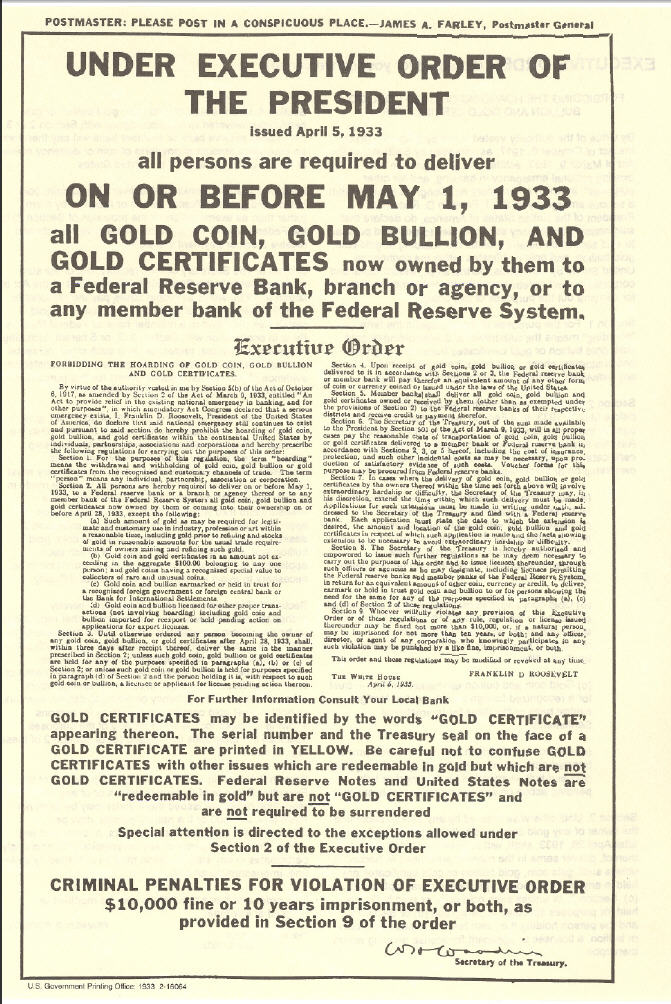
The notice posted in public places. It carries both dates the article turns on — issued 5 April, surrender by 1 May — and the penalty: a Executive Order 6102 issued by Franklin D. Roosevelt in 1933 during the Great Depression requiring citizens to surrender their gold for which they were reimbursed.0,000 fine or ten years, or both. Wikimedia Commons — U.S. Government Printing Office, Public domain

The part that is true, and is the whole engine
On 30 January 1934 the Gold Reserve Act changed the statutory gold content of the dollar, moving the price from $20.67 to $35 an ounce.
Set the two dates beside each other. Citizens surrendered gold in April and May 1933 at $20.67. The following January the government revalued the same metal at $35. The difference — roughly sixty-nine per cent — accrued to the Treasury, not to the people who had handed it over.
That is not a conspiracy theory. It is what happened, it is in the statute, and the Federal Reserve's own historical essays describe the revaluation and its purpose, which was to expand the money supply and break the deflationary spiral. Whether it was sound policy is a real argument in economic history. Whether people were paid less than their gold was shortly worth is not an argument at all.
Almost every version of this theory is built on that fact. The fact does not need a theory.
Who was actually prosecuted
The enforcement record is worth stating, because it is the detail that most complicates the story the theory tells.
Frederick Barber Campbell, a New York attorney holding over five thousand ounces, was the test case; the prosecution failed on a technical point, and the gold was confiscated anyway. Gus Farber, a San Francisco merchant, was prosecuted over the sale of thirteen twenty-dollar gold coins. Louis Ruffino was convicted of possessing seventy-eight ounces and sentenced to six months in jail and a $500 fine.
Thirteen coins. Seventy-eight ounces. Six months.
If the order had been cover for a transfer of wealth from the public to concentrated private interests, the enforcement would be expected to run upward. It ran downward, against a merchant and a man with seventy-eight ounces, which is what enforcement of an unpopular currency measure looks like rather than what a heist looks like.
The courts
The gold program reached the Supreme Court in 1935 in the four Gold Clause Cases — Norman v. Baltimore & Ohio Railroad, United States v. Bankers' Trust, Nortz v. United States and Perry v. United States. At issue were contract clauses, standard before 1933, requiring repayment in gold or its equivalent value.
The Court substantially upheld the government's position. Perry is the interesting one: the Court held that Congress could not repudiate its own obligations on government bonds, and then found the plaintiff had suffered no recoverable damages, which is a judgment that says the thing was wrong and awards nothing for it.
Private gold ownership did not become legal again in the United States until 31 December 1974.
What the theory adds
Everything above is documented. The theory's distinctive claim is the destination: that the gold did not stay under Treasury control but was routed outward, usually to a private bank in London, with the national-emergency framing as the cover story.
Nothing supports it. No shipping record, no ledger, no congressional finding, no participant account. The gold's subsequent custody is one of the better-documented things in American monetary history — the Treasury's holdings were accounted for publicly, and the depository at Fort Knox was built in 1936 precisely to hold it.
London is in the story for reasons of association rather than evidence. It was the centre of the international gold market and of imperial finance, and it supplies a place for the metal to have gone that feels explanatory without requiring any particular transaction to be named.
Where it stands
This entry is unusual in that the grievance underneath it is real and the specific claim on top of it is not.
A government compelled its citizens to sell an asset at a fixed price, under threat of a $10,000 fine and ten years, and then changed the price by sixty-nine per cent in its own favour ten months later. People were prosecuted over thirteen coins. That is a legitimate thing to be angry about eighty years later, and no evidence has ever been produced that the metal went anywhere other than where the Treasury said it did.