
Overview
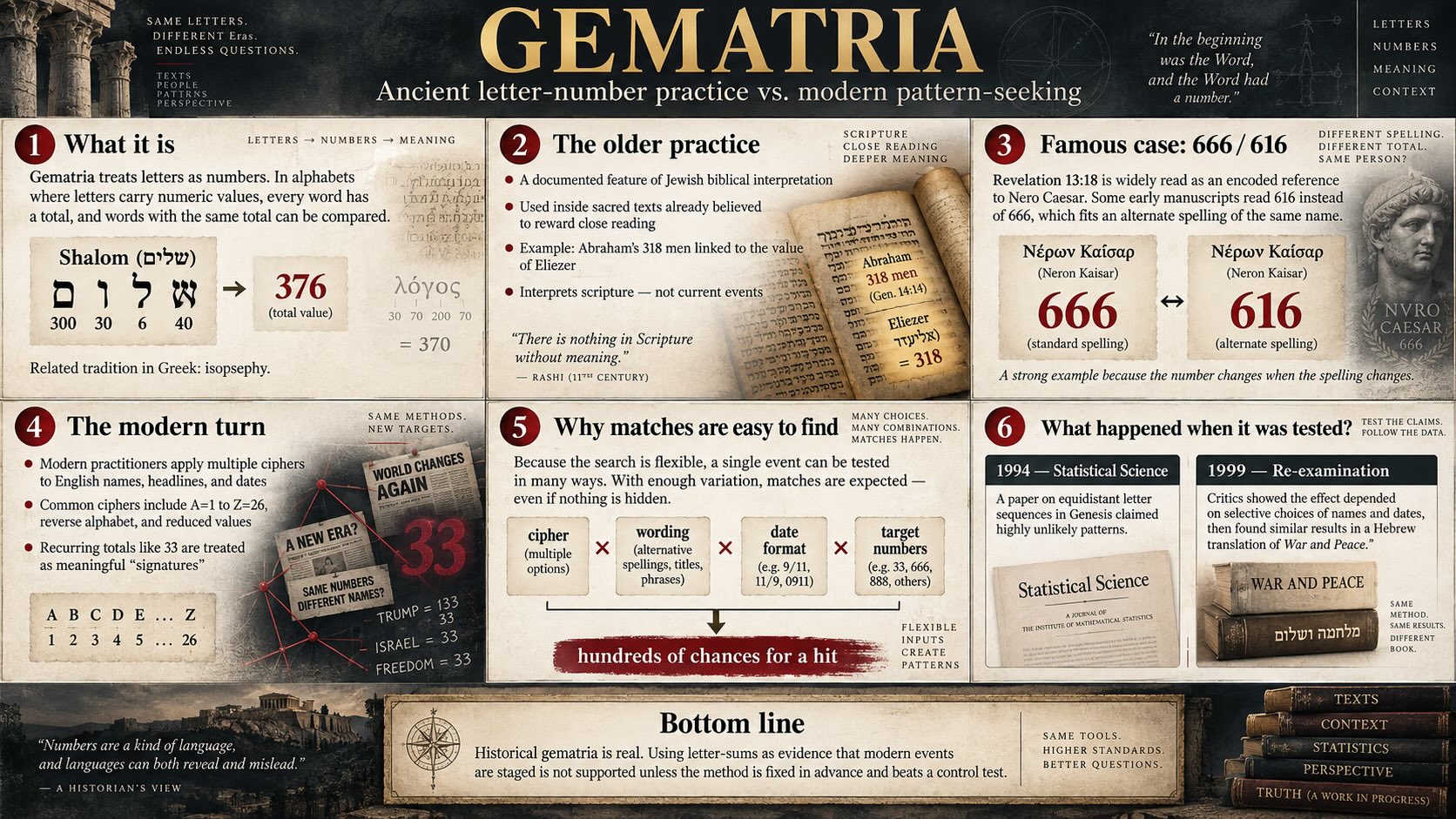
Gematria is the practice of treating letters as numbers. In an alphabet where each character also carries a value, every word has a total, and two words that share a total can be set beside each other as though the arithmetic had revealed something the spelling concealed.
The practice is old and genuinely documented. It has a place in Jewish biblical interpretation, a Greek counterpart in isopsephy, and one famous appearance in the New Testament. What is much newer is the use of letter-sums as an investigative tool — applying ciphers to English names, headlines and dates, and reading the numbers that recur as evidence that events are being arranged and signed by whoever arranged them.
Those two things share a technique and very little else, and the distinction is the most useful thing to hold on to when reading about the subject.
How it works
The Hebrew alphabet doubles as a number system: the first nine letters run one to nine, the next nine count the tens, the remainder the hundreds. A word's value is the sum of its letters. Nothing has to be decoded, because nothing was encoded — the number is simply a property the word already has, the way a word also has a length.
The interpretive move comes next. If two words total the same, they are treated as standing in some relation: one glossing the other, one predicting the other, one naming what the other conceals.
The older practice
The Jewish Encyclopedia records gematria as a long-established feature of rabbinic interpretation, and is candid that even the word's origin is uncertain — variously derived from the Greek geometria, in the sense of arithmetic, or from grammateia, from gramma, a letter.
The examples it gives show what the device was for. In Genesis 14:14 Abraham arms 318 men, and 318 is the value of the name of his servant Eliezer — read by the commentators as a remark about Eliezer rather than a claim that the number was a cipher. The money Haman offers in the Book of Esther and the gallows he builds both come to 165. The 613 commandments are reached through a permutation of letters.
What these have in common is their setting. They are homiletic moves made inside a text already held to be sacred and already assumed to reward close reading. The number is an argument about scripture, offered to readers who share the assumption that scripture is dense. It is not a method for identifying who is behind current events.
The one everybody knows
The best-known instance is the number of the beast in Revelation 13:18. Most New Testament scholars read it as a name written in numbers: Nero Caesar, transliterated into Hebrew letters, totalling 666. The reading suits the book's circumstances, since naming a living emperor as the beast was not a thing to do in plain text.
What makes this case unusually strong is a detail from the manuscripts rather than from the arithmetic. Some early copies of Revelation do not read 666 at all; they read 616. The Oxyrhynchus papyrus catalogued as P.Oxy. 66 4499 is among them. And 616 is what the same name comes to under a different, Latin-influenced spelling — one fewer letter, one smaller total.
That is the shape of a genuine encoded reference. The number moves when the spelling moves, and it moves to exactly the place the spelling predicts. Nobody had to choose which of several ciphers to apply, because the variation in the text itself did the confirming.
The modern turn
The contemporary practice applies the same idea to English, which has no traditional numbering of its letters — so the numbering has to be supplied, and several competing schemes are in use. The most common assigns A=1 through Z=26 in order. Others reduce those values to single digits, reverse the alphabet so that A=26, or follow tables derived from sixteenth-century occult writers. The schemes are called ciphers, and a practitioner will typically run a phrase through several.
The subjects are current. Names of public figures, headlines, the dates of shootings and crashes and elections, the ages of the dead, the distances between events. Certain totals are treated as significant wherever they appear — 33 above all, along with a handful of others — and a headline whose words reach one of them is read as marked: not a coincidence, but a signature left by the people who staged the event.
It is worth noting plainly that one of the commonly used tables is conventionally called the Jewish cipher, after the Hebrew values it borrows, and that the practice's vocabulary carries that inheritance whether or not a given practitioner intends anything by it.
Why a match is always available
The objection to reading news through letter-sums is not that the practitioners are careless. It is a property of the search itself, and it can be counted.
Consider what is free to vary before a match is declared. The cipher: several are in play, so every phrase has not one value but several. The wording: a person can be entered by full name, surname, nickname, or name plus title, and an event by any of the phrasings a headline might use. The date: written as a whole, or as month plus day, or with the century dropped, or as the number of days from some other event. And the target: a hit counts against any of a set of numbers already deemed meaningful, not against one specified in advance.
Multiply those together and a single event offers hundreds of chances to land on one of a couple of dozen numbers. Under those conditions matches are not surprising; they are what the arithmetic predicts. A method with that much freedom will produce the same density of hits applied to anything at all — which is the test that settles it, and which has in fact been run.
The time it was tested properly
In 1994 the journal Statistical Science published a paper by Doron Witztum, Eliyahu Rips and Yoav Rosenberg on equidistant letter sequences in Genesis. Reading the Hebrew text at fixed intervals, they reported that the names of later rabbinic figures appeared close to their dates of birth and death far more often than chance allowed, with odds they put at about one in sixty thousand. This was not a pamphlet; it was a peer-reviewed statistics journal, and that is precisely why the claim carried weight.
In 1999 the same journal published the examination. Brendan McKay, Dror Bar-Natan, Maya Bar-Hillel and Gil Kalai showed that the result turned on choices made while preparing the data — which form of each rabbi's name was used, which of the available dates, how each was spelled. None of those choices was fixed in advance by a protocol, and the authors demonstrated that varying them within equally defensible limits moved the effect.
They then did the thing that makes the argument conclusive rather than merely sceptical: they ran the same procedure over a Hebrew translation of War and Peace and recovered comparable results. A method that finds the same structure in Tolstoy is not detecting a property of Genesis.
That exchange is the closest the subject has come to a controlled test, and the control is exactly what the modern practice does not have. Letter-sums are computed for the event that happened; they are not computed for the thousands of events that did not, or for a matched body of text where nothing is supposed to be hidden.
The words that carry the weight
A handful of totals do most of the work in the older tradition, and they are worth setting out because they show what the practice looks like when it is done inside a community that agrees on the text.
The word chai, life, is chet and yod: eight and ten, eighteen. That total is the reason a gift of money in Jewish custom is so often eighteen pounds, or a multiple of it. It is the least contested example there is, because nothing is being claimed beyond the arithmetic and a custom built on it.
The four letters of the divine name total twenty-six. Echad, one, totals thirteen — and so does ahavah, love. The commentators who set those two beside each other are making an argument about what the oneness of God has to do with love, and the number is the hinge the argument turns on.
Mashiach totals 358. So does nachash, the serpent of Genesis. The kabbalistic reading takes the match as a statement about what the messiah is for: the same value, one undoing the other.
Two more have already appeared above. The 318 armed men of Genesis 14:14 is the value of Eliezer. And Neron Kesar written in Hebrew letters totals 666, while the shorter Nero Kesar totals 616 — the difference being exactly the fifty of the final nun that the second spelling drops.
Every one of those can be checked in the calculator below rather than taken on trust, which is the honest way to read a claim of this kind.
What the modern practice looks for
The English side has no inherited table, so it works from several, and the numbers it treats as meaningful are its own. Thirty-three carries the most weight, with a handful of others — thirteen, forty-seven, ninety-three — close behind. A name, a headline or a date that lands on one of them is read as marked.
The calculator shows all the ciphers at once for a reason. A single English phrase does not have a value; it has six, and they are rarely close together. Choosing which to quote is a decision taken after the number is known, and that is the freedom the section above is about.
What would settle it
The procedure is not mysterious, and nothing about gematria makes it untestable. State the cipher before looking. State the spelling of the subject. State which totals count as hits and how many will be tried. Then run the same search over a control body of material — old headlines, invented names, a novel — and compare how often each turns up a hit.
A practice that produced hits at a higher rate in real events than in the control would have something to explain. Until a claim of this kind is stated before the event rather than fitted to it afterwards, the evidence does not support treating a matching total as a sign that anything was arranged.